Showing posts sorted by date for query burn. Sort by relevance Show all posts

Thursday, January 26, 2017

Grassland Burning

In the previous post, we showed the grasslands that Audubon South Carolina established in the fields across from the driveway at the Francis Beidler Forest. Earlier this month, we were able to burn all three fields.

Grassland burn - Image by Mark Musselman

Grassland burn - Image by Mark Musselman

Grassland burn - Image by Mark Musselman

Grassland burn - Image by Mark Musselman

Burning the fields reduces the fuels on site by consuming the dead plant material, returns nutrients to the soil, and invigorates plant growth. New growth is more palatable to wildlife, including seeds and fruits. We look forward to what will emerge during the spring flush. We are also hopeful that the habitat improvements will attract Northern Bobwhite Quail as there are a few in the neighborhood.

Monday, December 12, 2016

Grassland Restoration

Grassland bird species are in decline, mainly from loss of habitat, which is why grassland conservation and restoration are part of the National Audubon Society's strategic plan.

With a cost-share grant from the United States Fish and Wildlife Service (USFWS), Audubon South Carolina committed to convert recently purchased agricultural fields to grasslands. These fields are adjacent to Mims Road across from the driveway entrance to the Francis Beidler Forest.

After decades of use for agriculture, the fields held few desirable plant species in the soil seed bank. Most of what volunteered was dog fennel (Eupatorium capillifolium), which would form a dense, sun-blocking thicket having little wildlife value. Therefore, the first step in the conversion was to herbicide the emerging vegetation in order to clear the site for the introduction of desirable grassland plant species.

Plants referred to as "ag weeds" in fallow field - Image by Mark Musselman
The fields one month after planting.

Field across from driveway - Image by Mark Musselman
Field across and right from driveway - Image by Mark Musselman
Field right from driveway across Cantley Rd. - Image by Mark Musselman
The first two fields shown above were planted in grassland mixes (Showy Wildflower and Mixed Meadow). The third field will receive longleaf pine seedlings this winter, so it was planted in a longleaf pine understory mix. The plantings were accomplished through the use of the USFWS seed drill, which was towed behind our tractor. Seeds are placed in the hopper where agitators feed seed into separate tubes leading to the seed drills. A harrow disturbs the soil ahead of the seed drills. The seed drills place the seed at the proper depth below the soil surface before a set of compacting wheels ensure the seeds are covered and in good contact with the soil.

Seed drill on transport trailer - Image by Mark Musselman
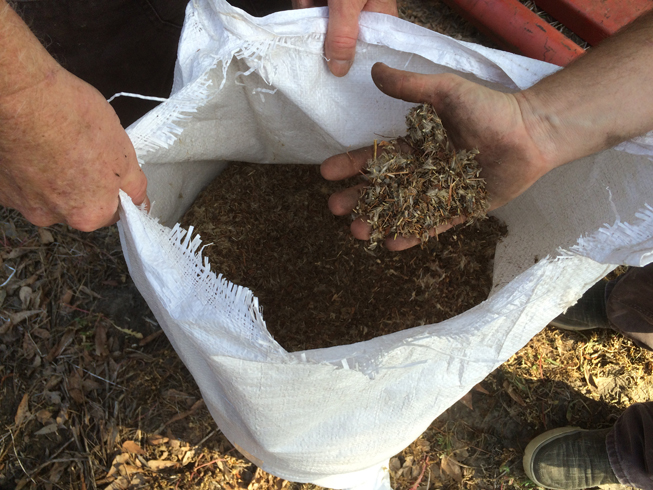
Seed mix prior to loading into seed drill - Image by Mark Musselman
After three month, the fields showed green with a mix of wildflower colors vying for attention.

Field across from driveway - Image by Mark Musselman
Butterfly Milkweed (Asclepias tuberosa) - Image by Mark Musselman
False Sunflower (Heliopsis helianthoides) - Image by Mark Musselman
Partridge Pea (Chamaecrista fasciculata) - Image by Mark Musselman
Indian Blanket (Gaillardia pulchella) - Image by Mark Musselman
The grasslands will be burned annually to prevent trees from becoming established, to reduce fuel (dead plant material), and to invigorate new plant growth. Due to the dry weather since Hurricane Matthew, we have been waiting for some precipitation to fall before conducting a prescribed burn. The rain over the last week certainly fits that bill, so now we wait for the next day with winds out of the south or southwest to ensure any smoke blows toward the swamp and away from neighbors' homes.

Ready for winter burn - Image by Mark Musselman


Monday, October 17, 2016

GP Longleaf Pine Burn

Hurricane Matthew brought wind and rain to the southeast. Four Holes Swamp filled short of last October's record water levels, but rose over the deck of the boardwalk and overflowed swamp-crossing roads like US Hwy 78. However, the weather after the storm has been cooler, less humid, without precipitation and with winds generally out of the northeast.
Map of tract, Image Mark Musselman
To conduct a prescribed fire at the GP longleaf pine tract, the first tract planted at the Francis Beidler Forest, wind direction is important. Due to the tract's location on the west side of Hwy 27, the winds must be from the northeast or east to prevent smoke from crossing the highway and presenting a danger to drivers. However, northeast winds are not the common wind direction for our area and are often preceded by or accompanied by precipitation.  Spoiler alert: precipitation tends to put a damper on fires and fuels.

Therefore, after clearing the nature center's driveway of fallen trees and the fire break around the GP tract of several stout fallen oaks, we sent out a call for volunteers to help with the prescribed fire on Friday.
Volunteers! (l to r) Bob, Bob, Michael, and Joe; Image Mark Musselman
With the fire break disced, the middle fire break was cleared with a leaf blower in order to burn the 21-acre tract in two units. A test fire was started along the east side of the middle fire break in unit A in order to determine how the fuels would burn. Normally, a test fire is started in a corner in order to allow a rapid extinguishing of the fire should it behave contrary to expectations. However, water oaks have been allowed to infest this tract and are especially dense around the edges. The flat oak leaves do not burn well unless licked by a hot fire pushed by the wind, which allows the fuels to be preheated and dried. Additionally, the majority of fuels on the tract were pine straw and small woody materials, so a test fire in the oak leaves would not reflect conditions across most of the tract.

Test fire, Image Mark Musselman
Note the circular shape of the test fire as it slowly burns evenly in all directions in the absence of wind.

Being satisfied with the fire behavior at the test fire site, we used drip torches to light a line of along the line 2-6. We chose to burn unit A first as it is the closest to the highway and completing it before conditions changed was preferable. Additionally, unit A had been burned two years ago, while unit B had not been burned for 6.5 years, which meant that there would be more fuel on the ground in unit B and the possibility of a larger fire. With a swamp full of water to the west and a burned out unit A to the east, a larger fire in unit B would be easier to contain. As the fire slowly backed into the wind from the eastnortheast within unit A, we began lighting spot strip fires at 20-meter intervals toward the highway. Below is an example from later in the day when we burned unit B.

Spot strip fire in unit B, Image Mark Musselman
Dropping a continuous line of fire uses more diesel/gas fuel and creates a curtain of fire that generates more heat than is desired. By dropping spots of fuel from the drip torches every 10-15 meters, the spots burn out in all directions, like the test fire image, at a lower intensity. Eventually, the spots burn together and the fire briefly intensifies before consuming all the fuel and extinguishing itself.
Spot strip fires burning (left), burned unit A (right), Image Mark Musselman
The result of the fire is a reduction of fuel on the ground, which will limit damage from a wildfire caused by lightning or human negligence. The next rain will help wash the nitrogen from the burnt fuels back into the soil. The bare mineral soil will provide the necessary conditions for longleaf pine seeds to germinate and survive. The seeds can germinate in the duff that existed prior to the fire, but survival is less likely as the duff layer can dry more quickly than the soil allowing the seedling to desiccate. Competing loblolly pines and hardwoods are killed outright or top-killed as they are not adapted to fire like longleaf pines. Grasses and other forbs are invigorated by fire and immediately begin sending out softer material more palatable to deer and other wildlife. Not all desirable plants and animals survive, but on balance, fire is overwhelmingly beneficial to the longleaf pine ecosystem.

At the end of the day, approximately 75% of the 21 acres burned and no smoke reached the highway. Success!
Burned unit A, Image Mark Musselman
Burned area between units (see volunteer image above), Image Mark Musselman
Smoke free!, Image Mark Musselman


Monday, July 18, 2016

Warm Season Burn - Update

One month ago (see previous post), we attempted a warm season burn on 29 acres of old agricultural fields in which our planted longleaf pines were being crowded by other vegetation, mainly dog fennel. Last Thursday, we checked on the progress of the longleaf pines and grasses in the field where the burn was successful.
Grasses under dead dog fennel - Mark Musselman
In areas where the burning was complete, the dog fennel remains dead or absent and the grasses have pushed out new green blades.

With most of the vegetation burned away and the longleaf pine pushing out new needles of a brighter green than the grasses, the longleaf pines are more easily located than before the burn.

Longleaf pine growth after fire - Mark Musselman
With the majority of the competition removed, especially the tall dog fennel, the young longleaf pine are in full sunlight and should grow rapidly over the coming months. By spring, many will have a root collar of one inch and will begin vertical growth leaving the grass stage behind. We look forward to the day when the longleaf pine stand taller than the neighboring grasses!

Sunday, June 26, 2016

Warm Season Burn

In January 2015, University of Missouri students on their alternative winter break planted 29 acres of longleaf pine seedlings in old farm fields north of the nature center driveway. For South Carolinians, the weather was uncomfortably cold (50sF) and wet, but for the students it was a warm contrast to their campus.
University of Missouri students - Mark Musselman  
Step #1 for planting longleaf pine: Using dibbles (orange tools), students would open a wedge-shaped hole in the earth, drop a longleaf pine seedling into the hole, and then used the dibble to close the hole around the seedling. To complete the job, repeat step #1 thousands of times.   
University of Missouri students planting longleaf - Mark Musselman

University of Missouri students planting longleaf - Mark Musselman
As our volunteer workforce was with us in January, we did not have the luxury of applying herbicide to the spring vegetation when it emerged and then repeating the herbicide treatment in the fall for the later emerging vegetation. Therefore, we had plenty of pioneering plants become established during the intervening year. Dog fennel (Eupatorium capillifolium) was the most prolific.

Dog fennel in longleaf pine tract - Mark Musselman
The dog fennel made it difficult for us to move through the tract. However, rabbits, rodents, and a wide-variety of birds--including wild turkey, painted bunting, blue grosbeak, summer tanager, indigo bunting, Mississippi kites, and swallow-tailed kites--found ample forage and shelter within and above the fennel thicket.
Dog fennel in longleaf pine tract - Mark Musselman
A longleaf pine is practically hidden in grasses and dog fennel (above the red line in the image below). Though the dog fennel seemed to form a thicket dense enough to block sunlight from reaching the ground, sufficient light reached the seedling longleaf pines to allow them to survive. However, to grow out of the grass stage, the longleaf pines would need more direct sunlight. Bring on the fire!
Longleaf pine hidden in vegetation - Mark Musselman
Our opportunity to light a prescribed fire came when a cold front dipped down from the northeast a week ago. If you were in the area, you will certainly remember the severe thunderstorms that accompanied that cold front, including tornadoes to our north. Cold, in this case, was relative. The high temperature two days after the storm was only to reach 83F and winds were forecast to be 15 mph from the northeast.

This week's fire was the first for this longleaf pine stand. The six prescribed fire volunteers arrived on schedule, but the winds did not. After several failed attempts to ignite the smaller of the two longleaf pine fields, we moved to the larger, less sheltered field where even a slight wind might have a chance to push fire through the dog fennel and grasses.

In some areas, the fire was 100% effective in consuming the fuels at ground level, killing loblolly pine and sweet gum seedlings, and wilting or consuming dog fennel.

100% fuel burned - Mark Musselman
60% fuel burned - Mark Musselman
Overall, approximately 60% of the field burned leaving refugia (unburned green areas) for wildlife to use until new vegetation emerges.

Longleaf pine in unburned area - Mark Musselman
Grasses began showing new growth after only two days. New vegetative growth is more palatable to wildlife, which is yet another reason for periodic fire. Additionally, after a fire, many plants will germinate and/or produce seeds or fruit desirable to wildlife.
Grasses new growth - Mark Musselman
Although uneven burning of a tract is beneficial, as it provides refugia for wildlife and fails to consume all of the woody material in more mature stands, it is not planned. Terrain, wetlands, fuel loads, and wind are some of the factors that dictate where and how a fire will burn. In the image below, there was plenty of suitable fuel for the fire to continue on its path. However, the wind died and the fire could not span the gaps between clumps of grass without a slight push from the wind. (Note the spacing between grasses in the "100% fuel burned" image earlier on this page.)

Burned/unburned boundary - Mark Musselman
Some areas burned hot enough to consume the grasses and wilt the dog fennel, but left longleaf pines green and unaffected.
Longleaf pine - Mark Musselman
Some areas burned hot enough brown the needles of the longleaf pines. Closer inspection at the needle bases reveals that they are green, having successfully insulated the terminal bud of the tree.

Brown needles of longleaf pine - Mark Musselman
Green at base of needles - Mark Musselman
Areas at the boundary of the fire provided a combination of heat, but still exposed the longleaf pine to increased sunlight.
Partially scorched longleaf pine - Mark Musselman
Some areas burned hot enough to consume the longleaf pine needles. The future of the longleaf pine shown in the image below is uncertain. In the grass stage, longleaf pines are close to indestructible. The tap root the longleaf pine has sent into the ground may be sufficient to allow new needles to grow. With the neighboring vegetation eliminated, the longleaf pine may thrive in the abundant sunlight and begin rapidly increasing its height above the ground. Conversely, the tree may have been cooked and become part of the anticipated loss within the planted stand.
Longleaf pine - Mark Musselman
A mature longleaf pine stand has been described as a prairie with some trees. There should be an abundance of space and light between the longleaf pine trees. Therefore, we always plant more trees than we intend to see reach maturity. Mortality begins a planting. Some seedlings are not physically fit or are improperly placed in the ground. Weather (drought, hurricanes, lightning, ice storms), insects, wild hogs, fire, competing vegetation are but a few of the factors that affect longleaf pine survival. However, more than enough of the well-adapted trees become large enough to elude the previously listed threats and we have to selectively cull less desirable trees (crooked growing, weather damaged, multiple trunks, etc.) to create the open stand we seek.

This longleaf pine stand is scheduled to be burned again in fall of 2017. What is certain is that the stand will look different in a year and the fire will be unlike the one we conducted this week.

Sunday, May 15, 2016

Season of Burning


Till Farm Longleaf - Mark Musselman
This year, the late winter/early spring weather provided us the opportunity to conduct several prescribed fires at the Francis Beidler Forest and the Till Farm west of Walterboro in Colleton County. With the exception of one 12-acre loblolly pine stand, all of the burns were conducted to reduce fuels and enhance the health of the longleaf pine tracts we have planted. In all, we burned 76 acres in 7 burns at Beidler Forest and 84 acres in 2 burns at the Till Farm.

Post-fire Till Farm - Mark Musselman
Due to concerns over smoke possibly lingering into the night, several of the tracts at Beidler Forest were burned in smaller pieces due to the logging debris, including some substantial piles, still on the sites. Now that the tracts have been burned and the debris reduced, future burns can be conducted for these tracts on a single day.

We have planted longleaf pine in order to restore the native pine ecosystem of the southeastern United States. Read more...previous posts

Mizzel tract - Mark Musselman
Mizzel tract - Joe Cockrell
Although it appears apocalyptic after a fire, the habitat rapidly rebounds. Nutrients from the burned material are made available and new vegetation can be seen within days. Additionally, longleaf pine competition (hardwoods and loblolly pines) are not adapted to fire and fare poorly as younger trees. Finally, fuels are reduced thereby preventing a catastrophic fire in the future that even longleaf pine might be unable to survive.

Post-fire Mizzel tract - Mark Musselman
The majority of the browned trees in the above image are young loblolly pines killed by the fire. Below are images showing how the fire-adapted longleaf pines survive.

Post-fire Mizzel tract - Mark Musselman
The loblolly pine in the foreground is likely dead, while the longleaf pines in the background survived with one less competing neighbor. Although the needles that shielded the terminal bud of the longleaf pine were killed by the fire's heat and have dropped to the ground, the new growth "candle" can be seen emerging. Farther in the background, a longleaf pine only had needles scorched on its left side.

Post-fire Mizzel tract - Mark Musselman
Above, a longleaf pine's terminal bud was protected from heat by its long needles, which folded up as fire arrived. Fresh needles will emerge from the new growth "candle". More examples are shown below.
Post-fire Mizzel tract - Mark Musselman
As noted earlier, logging debris was a smoke concern, but it was also a concern due to the intense and sustained heat it could generate. Longleaf pine seedlings that were planted in or near such debris would face fire conditions beyond the protective capability of their needles. Even so,  despite appearing to be all but incinerated, many are pushing out new needles.

Post-fire Mizzel tract - Mark Musselman
These necessary prescribed fires could not have been conducted safely and efficiently without the help of volunteers. This year we have had 12 volunteers (several at more than one burn) log 126 hours in support of the 110 staff hours, which included planning and site preparation work.  Additionally, while the Mizzou students were here on their alternative spring break, they cleared felled oaks from the original longleaf pine tract, which we converted for use as firewood for wintertime visitors to our log cabin.

Removing oak - Mark Musselman
Mizzou students also removed loblolly pines from a longleaf pine tract planted by fellow Mizzou students on their January 2015 alternative winter break. In both cases, removing the non-longleaf pines helps to eliminate competition for resources in addition to keeping the canopy relatively open to allow in sunlight for longleaf-obligate understory vegetation.