http://sc.audubon.org/Centers_FBF_Educators_Species-Birds.html#TanagerWhile eating lunch at one of the picnic tables under the trees in the parking area at the Audubon Center at Francis Beidler Forest, we noticed a Red-shouldered Hawk (Buteo lineatus) fly through the trees along the edge of the swamp. In less than five minutes, we saw a Red-shouldered Hawk fly in the other direction with what appeared to be a lizard in its beak. We have learned that birds flying with food in their bills are almost always heading toward a nest. Therefore, we watched.
Our watching paid off when we finally spied the nest in a crook high in a Loblolly Pine.
If you are having difficulty seeing the chick on the nest, follow the arrow! This view is from the parking slot in the bus loop where the ROC is stored.
There appeared to be only one chick in the nest.
An adult returned approximately every five minutes, though we could never see what was being brought as a meal.
Just beyond the entrance ramp at the center, is a Summer Tanager (Piranga rubra) nest in a Horse Sugar leaning over the driveway. The female has only been sitting on eggs for a few days.
Near #121 on the boardwalk, we spotted A250 foraging. A250 was the male with the nest in the cypress knee in the channel near the Meeting Tree at #120. The chicks were gone from the nest sometime this weekend, but we could not confirm that they had successfully fledged. However, following close behind A250 was a fledgling , so at least one of the chicks is still in the game!
Beidler Forest is always full of life, but spring accentuates that fact!
Images by Mark Musselman
Thursday, May 19, 2011
Red-shouldered Hawk Nest
Labels:
audubon,
bird,
conservation,
nest,
swamp
Wednesday, May 18, 2011
Swamp Potpourri
With school drawing to a close, it has become quite busy at the Audubon Center at Francis Beidler Forest. We have not had time to blog regularly, so today's entry is a potpourri of items from the last week.
Insects, like the damselfly and dragonfly shown below, continue to emerge from the water where they have been for years.
The Great Blue Skimmer shown above recently emerged from a smaller version of an exoskeleton like the one shown below. The nymph will emerge from the water, usually at night, and crawl up a structure (tree, plant, boardwalk). The adult form will emerge from the back of the exoskeleton and crawl to a nearby perch to allow the wings and abdomen to expand, dry and stiffen before it can fly away. During this time, the adult insect is vulnerable to birds, lizards, and any other predator searching for a meal. In fact, the Great Blue Skimmer in the image was only able to muster a slow, loopy flight and would have been easy prey for a passing bird.
The fallen log in the image below apparently had sufficient prey items to keep the Pileated Woodpecker (Dryocopus pileatus) occupied in the the same spot for several hours.
Beavers (Castor canadensis) continue to maintain their network of dams. While checking the smaller lodge and the damage caused by beavers and the standing water behind their dam...
...we discovered a White-tailed Deer (Odocoileus virginianus) fawn hidden in a fallen log. The female has not abandoned the fawn, simply parked it safely somewhere that the female's scent would not disclose her young's location.
Finally, today we were able to add another prey item to the list of things we have seen a Barred Owl eat. Near #146 on the boardwalk on the way to Goodson Lake, we saw an owl tearing pieces from a small turtle, which was likely a Yellow-bellied Slider (Trachemys scripta scripta). However, we were not able to get an image of the meal.
Images by Mark Musselman
Insects, like the damselfly and dragonfly shown below, continue to emerge from the water where they have been for years.
Blue-tipped Dancer (female, Argia tibialis)
Great Blue Skimmer (female, Libellula vibrans)
The Great Blue Skimmer shown above recently emerged from a smaller version of an exoskeleton like the one shown below. The nymph will emerge from the water, usually at night, and crawl up a structure (tree, plant, boardwalk). The adult form will emerge from the back of the exoskeleton and crawl to a nearby perch to allow the wings and abdomen to expand, dry and stiffen before it can fly away. During this time, the adult insect is vulnerable to birds, lizards, and any other predator searching for a meal. In fact, the Great Blue Skimmer in the image was only able to muster a slow, loopy flight and would have been easy prey for a passing bird.
The fallen log in the image below apparently had sufficient prey items to keep the Pileated Woodpecker (Dryocopus pileatus) occupied in the the same spot for several hours.
Beavers (Castor canadensis) continue to maintain their network of dams. While checking the smaller lodge and the damage caused by beavers and the standing water behind their dam...
lodge
dam
...we discovered a White-tailed Deer (Odocoileus virginianus) fawn hidden in a fallen log. The female has not abandoned the fawn, simply parked it safely somewhere that the female's scent would not disclose her young's location.
Finally, today we were able to add another prey item to the list of things we have seen a Barred Owl eat. Near #146 on the boardwalk on the way to Goodson Lake, we saw an owl tearing pieces from a small turtle, which was likely a Yellow-bellied Slider (Trachemys scripta scripta). However, we were not able to get an image of the meal.
Images by Mark Musselman
Saturday, May 14, 2011
Grant Brings GPS Units to Beidler Forest
The education department at the Audubon Center at Francis Beidler Forest has received a $1000-grant from the South Carolina Geographic Alliance to purchase GPS units in support of a program to get Geographic Information Systems (GIS) technology into the classroom.
Part of the GPS/GIS program will involve students learning to use GPS technology while at the Francis Beidler Forest (FBF) as well as on their school campus.
Once students are familiar with how latitude and longitude coordinates mark unique points on the globe, the next phase of the program will involve students using their school computers and free GIS reading software to analyze FBF-supplied species-sightings and research data.
Where do Prothonotary Warblers nest? How large are their territories? Why are some much larger than others?
Why are Brown Water Snakes not seen on the western half of the boardwalk...
...when Eastern Cottonmouths can be seen all around the boardwalk? What are the habitat preferences for the two snake species?
Let us know if your school would like to participate in this technology-based program!
Maps created by Mark Musselman
Image by Garmin
Part of the GPS/GIS program will involve students learning to use GPS technology while at the Francis Beidler Forest (FBF) as well as on their school campus.
Image by Mark Musselman
Once students are familiar with how latitude and longitude coordinates mark unique points on the globe, the next phase of the program will involve students using their school computers and free GIS reading software to analyze FBF-supplied species-sightings and research data.
Species Sightings
Where do Prothonotary Warblers nest? How large are their territories? Why are some much larger than others?
Prothonotary Warbler Territories
Why are Brown Water Snakes not seen on the western half of the boardwalk...
Brown Water Snake Sightings
...when Eastern Cottonmouths can be seen all around the boardwalk? What are the habitat preferences for the two snake species?
Cottonmouth Sightings
Let us know if your school would like to participate in this technology-based program!
Maps created by Mark Musselman
Thursday, May 12, 2011
Owl vs Duckling Video
The last blog entry described how Barred Owls (Strix varia) were hunting Wood Duck (Aix sponsa) ducklings near the boardwalk in the old-growth swamp at the Audubon Center at Francis Beidler Forest. We were also able to capture a few minutes of video.
The Wood Ducks can barely be seen as they swim through the swamp, but the hen can be heard calling.
Images and video by Mark Musselman
The Wood Ducks can barely be seen as they swim through the swamp, but the hen can be heard calling.
Images and video by Mark Musselman
Sunday, May 08, 2011
Boardwalk Assassins
No, Boardwalk Assassins is not the title of a new movie based on a best-selling novel. The title refers to the experience we had last night while waiting for darkness and the arrival of Dr. Brian Scholtens from the College of Charleston. Tomorrow's blog entry will cover what we learned during Dr. Scholtens' visit regarding the insect community here at the Audubon Center at Francis Beidler Forest.
Having been in the building all day running the front desk, we needed to stretch the legs before the evening insect activity. We've learned to take along the camera, even if the light is rapidly diminishing, because one never knows what will be seen in the swamp. Each trip onto the boardwalk through the old-growth, cypress-tupelo swamp is guaranteed to be a different experience and frustration is seldom greater than not being able to capture a rare sighting. The saying in the education department is, "If you don't have a picture, it didn't happen." Turn away now if you do not want to see owls killing ducklings, because we have the pictures.
Walking at a rapid pace along the return side of the boardwalk loop near #15, we heard a female Wood Duck continuously calling. Usually, the only sightings we have of a Wood Duck (Aix sponsa) during the breeding season are by chance as she silently paddles away with her ducklings. This hen was making a racket! It soon became apparent that the cause of her stress was a pair of Barred Owls (Strix varia) perched low over the creek channel in which the ducks were moving. This is not unusual owl behavior in the swamp as owls frequently hunt crayfish in the shallow water. Tonight, however, the adult owls were serving ducklings to their young.
With each pass of an owl, the Wood Duck hen rose out of the water, flapping her wings and calling loudly. The owls were unfazed and simply maneuvered around the hen and snatched a duckling. After each attack, the ducks moved on with the hen continuing to protest. Hearing the begging of its own young, the adult owl would carry a captured duckling to its offspring. The lulls between attacks were only as long as it took the young owl to consume the duckling. Once the begging began once more, the adult owl would reacquire the ducks and begin another attack glide. Immediately, the hen would increase the volume and frequency of her calls and rise up to defend her young. Each time the owls succeeded in removing a duckling from the group.
Eventually, the Wood Duck hen took her remaining ducklings out of the creek and into the forest where the Dwarf Palmettos appeared to offer some cover from the avian predators. The results did not change for the duck, but once an owl had a duckling on dry land, American Crows began harassing the owl in hopes that the duckling might be dropped.
There is a reproductive strategy for having large numbers of young. Not all will survive, but enough will survive to ensure the species continues to exist. Today, the cells of growing Barred Owls along the boardwalk near #15 are being fueled by Wood Ducks, which previously received their energy from plants...and life goes on.
Images by Mark Musselman
Having been in the building all day running the front desk, we needed to stretch the legs before the evening insect activity. We've learned to take along the camera, even if the light is rapidly diminishing, because one never knows what will be seen in the swamp. Each trip onto the boardwalk through the old-growth, cypress-tupelo swamp is guaranteed to be a different experience and frustration is seldom greater than not being able to capture a rare sighting. The saying in the education department is, "If you don't have a picture, it didn't happen." Turn away now if you do not want to see owls killing ducklings, because we have the pictures.
Wood Ducks on an earlier day in the power line right-of-way
Walking at a rapid pace along the return side of the boardwalk loop near #15, we heard a female Wood Duck continuously calling. Usually, the only sightings we have of a Wood Duck (Aix sponsa) during the breeding season are by chance as she silently paddles away with her ducklings. This hen was making a racket! It soon became apparent that the cause of her stress was a pair of Barred Owls (Strix varia) perched low over the creek channel in which the ducks were moving. This is not unusual owl behavior in the swamp as owls frequently hunt crayfish in the shallow water. Tonight, however, the adult owls were serving ducklings to their young.
With each pass of an owl, the Wood Duck hen rose out of the water, flapping her wings and calling loudly. The owls were unfazed and simply maneuvered around the hen and snatched a duckling. After each attack, the ducks moved on with the hen continuing to protest. Hearing the begging of its own young, the adult owl would carry a captured duckling to its offspring. The lulls between attacks were only as long as it took the young owl to consume the duckling. Once the begging began once more, the adult owl would reacquire the ducks and begin another attack glide. Immediately, the hen would increase the volume and frequency of her calls and rise up to defend her young. Each time the owls succeeded in removing a duckling from the group.
Eventually, the Wood Duck hen took her remaining ducklings out of the creek and into the forest where the Dwarf Palmettos appeared to offer some cover from the avian predators. The results did not change for the duck, but once an owl had a duckling on dry land, American Crows began harassing the owl in hopes that the duckling might be dropped.
There is a reproductive strategy for having large numbers of young. Not all will survive, but enough will survive to ensure the species continues to exist. Today, the cells of growing Barred Owls along the boardwalk near #15 are being fueled by Wood Ducks, which previously received their energy from plants...and life goes on.
Images by Mark Musselman
Thursday, May 05, 2011
Birds From the Office Window
Although we would prefer to be outside, the windows at the Audubon Center at Francis Beidler Forest never fail to provide us with an opportunity to vicariously experience nature. Previously, we have reported our sightings out the office window, but yesterday's activity produced an new set of images.
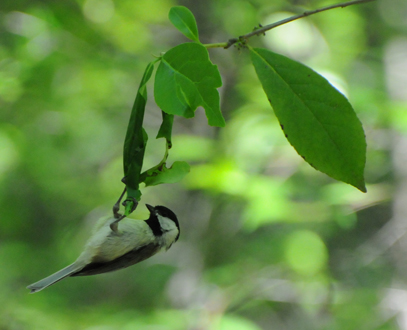
Carolina Chickadee searching curled leaves for a meal and...
being harassed by a male Northern Cardinal.
Although we couldn't get the camera pointed quickly enough, a Red-shouldered Hawk landed within six feet of the window. This image is of one along the boardwalk several years ago. The hawk by the office window may have been attracted by the erratic flights of the young Carolina Wrens. However, our movement within the building, slight though it may have been, was sufficient to alert the hawk and send it flying though the forest.
Although we could not see the waterfowl from our office, we could hear them and we made a quick dash behind the outdoor classroom to take a look. With water pooling behind the beaver dam, the area under the power line looks more like a pond than a swamp. The changing habitat has attracted a Muscovy Duck (Cairina moschata), which based on the color is likely an escaped domesticated bird.
The flooded area under the power line is also favored Wood Ducks, including this hen and her four or five ducklings.
While trying to get the shot of the newly-arrived Muscovy Duck, a Pileated Woodpecker landed overhead.
At the tree line, a male Blue Grosbeak (Guiraca caerulea) ate seeds from the grasses growing in the flooded area. Shortly after spying the grosbeak, a male Indigo Bunting (Passerina cyanea) arrived and kept watch nearby.
To put a wrap on today, a Carolina Anole worked his way into the sun to do a few pushups and show off his dewlap. The air temperature may not have reached 70F today, so the lizard was not his bright green self.
Although we would almost always opt to be outdoors, it sure is nice to have an office with a view!
Images by Mark Musselman
Three just-fledged Carolina Wrens learning to dust-bathe from their parents.
Male Northern Parula posing for pictures.
Carolina Chickadee searching curled leaves for a meal and...
being harassed by a male Northern Cardinal.
Although we couldn't get the camera pointed quickly enough, a Red-shouldered Hawk landed within six feet of the window. This image is of one along the boardwalk several years ago. The hawk by the office window may have been attracted by the erratic flights of the young Carolina Wrens. However, our movement within the building, slight though it may have been, was sufficient to alert the hawk and send it flying though the forest.
Although we could not see the waterfowl from our office, we could hear them and we made a quick dash behind the outdoor classroom to take a look. With water pooling behind the beaver dam, the area under the power line looks more like a pond than a swamp. The changing habitat has attracted a Muscovy Duck (Cairina moschata), which based on the color is likely an escaped domesticated bird.
The flooded area under the power line is also favored Wood Ducks, including this hen and her four or five ducklings.
While trying to get the shot of the newly-arrived Muscovy Duck, a Pileated Woodpecker landed overhead.
At the tree line, a male Blue Grosbeak (Guiraca caerulea) ate seeds from the grasses growing in the flooded area. Shortly after spying the grosbeak, a male Indigo Bunting (Passerina cyanea) arrived and kept watch nearby.
To put a wrap on today, a Carolina Anole worked his way into the sun to do a few pushups and show off his dewlap. The air temperature may not have reached 70F today, so the lizard was not his bright green self.
Although we would almost always opt to be outdoors, it sure is nice to have an office with a view!
Images by Mark Musselman
Wednesday, May 04, 2011
Project PROTHO Update
At the Audubon Center at Francis Beidler Forest, we now have our first Prothonotary Warbler nestlings! The cypress knee nest out by the Goodson Lake (#151) has hatched. There are five chicks in the nest and they likely hatched sometime on Sunday. The male for this nest, A026, successfully fledged four chicks last year from the same nest site. Let’s hope he and his unbanded female have similar success this year!
A026 with caterpillar
Female with insect
We also have another active nest on one of our off-boardwalk properties. It is located in one of our artificial-milk-carton nestboxes. This nest also has five chicks that probably hatched sometime yesterday or late on Monday.
Besides the nests with chicks, we also have at least two nests around the boardwalk with eggs and one nestbox off-site with eggs. With some more scouting, many more nests will likely be discovered. However, the season is off to a great start!
A011
With the expert guidance of Dr. Chris Snook, we have banded 11 new Prothonotary Warblers this season – 9 males and 2 females. And we are now up to 26 previously-banded Prothonotary Warblers that have returned to the swamp this season. Of the returning birds, 9 were banded in 2009 and the remaining 17 were banded in 2010.
Images by Mark Musselman
Labels:
audubon,
birds,
citizen-science,
conservation,
swamp,
warbler
Subscribe to:
Posts (Atom)