Showing posts sorted by relevance for query project protho. Sort by date Show all posts

Wednesday, March 03, 2010

Nest Box Work

Project PROTHO nest box construction at Audubon's Francis Beidler Forest by Mark Musselman
Project PROTHO preparations are in high gear in anticipation of the arrival later this month of the first Prothonotary Warblers (Protonotaria citrea) in 2010. Although Monday's planned installation of nest boxes was canceled due to high (and cold!) water in the swamp, the Audubon at Francis Beidler Forest staff and the seven master naturalist volunteers had plenty to do.

Project PROTHO nest box construction at Audubon's Francis Beidler Forest by Mark Musselman


First, some of the boxes constructed by the 5th graders at St. James-Gaillard Elementary School were damaged during the trip from the school to the swamp. Second, the nest boxes built by the summer campers of 2009 had their tops taped on, which would make inspecting the nests difficult. This was quickly rectified in a flash of master naturalist pocket knives. Next, all the nest boxes needed top and bottom ventilation holes. After several more boxes were constructed from newly arrived cartons, the entire lot and crew moved to the maintenance barn for some painting.

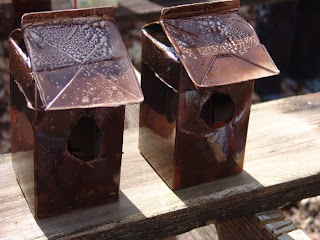
Project PROTHO nest box construction at Audubon's Francis Beidler Forest by Mark Musselman


Once the painting began, several lessons were quickly learned...1) point the can away from one's face before attempting to apply paint, 2) do not set up downwind from a group of spray painters, and 3) short bursts and a light coat followed by a second coat minutes later is infinitely more effective than a firehose-like application method. Many hands make quick (and humorous) work! Once the paint had dried, the bottoms of the boxes were mark, so that students can be informed when THEIR nest box has been adopted by a pair of Prothonotary Warblers or possibly another bird species.

Yesterday, a few of the boxes were placed on the posts of the interpretive signs around the boardwalk. Last year, several pairs attempted to nest on top of the posts behind the signs. One pair did so successfully behind the sign at #3 and fledged three chicks. However, since some failed to complete the nest building behind the signs, we decided to provide a cavity option. Additionally, the nest boxes near the boardwalk will allow visitors and students to observe some Prothonotary Warbler nesting behavior and allow the education staff the opportunity to discuss Project PROTHO and bird conservation.

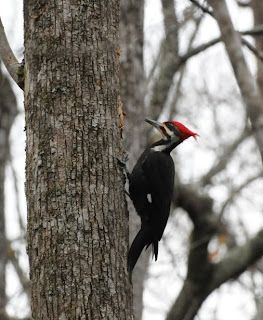
Today, it looked as if a Pileated Woodpecker (Dryocopus pileatus) was attempting to create its own nesting site. Can you get an ice cream headache from pounding your head against the tree in the near-freezing temperature?
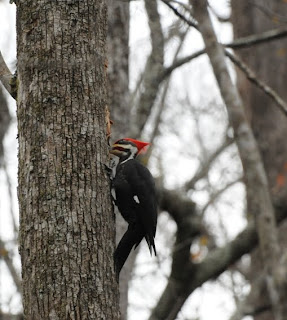
Pileated Woodpecker at Audubon's Francis Beidler Forest by Mark Musselman


Pileated Woodpecker at Audubon's Francis Beidler Forest by Mark Musselman

Images by Mark Musselman

Tuesday, August 11, 2009

Project PROTHO Funded for Second Year!


In 2009, with help from TogetherGreen, Audubon South Carolina successfully initiated Project PROTHO, an innovative citizen-science project which is helping us learn more about the breeding biology of Prothonotary Warblers within old-growth forested wetlands at Francis Beidler Forest while educating visitors and students about their habitat requirements. Last year, we requested funds to build a foundation for Project PROTHO, this year we will restore 103 acres of Prothonotary Warbler breeding habitat within Four Holes Swamp. The innovative nest box design we are to use will be constructed from recycled materials. This year's summer campers created nearly one hundred nest boxes out of recycled ½ gallon milk/juice cartons.

Our target is the Prothonotary Warbler (Protonotaria citrea), a vibrant yellow, cavity-nesting bird that breeds in forested wetlands throughout the eastern United States. Point counts conducted in Beidler Forest during 2008 suggest that we may have as many as 2,000 pairs of Prothonotary Warblers breeding within the sanctuary. Due to its striking plumage and high nesting density along the boardwalk at Beidler Forest, the Prothonotary Warbler has become one of the bird species that most visitor’s associate with our sanctuary.

Prothonotary Warblers are neotropical migrants with wintering grounds from southern Mexico to northern South America. These birds are listed as yellow on the Audubon WatchList and as a high priority species on federal conservation plans for the southeastern United States. Breeding Bird Survey (BBS) data suggest that Prothonotary Warblers have declined in number by nearly 40% since 1966. Prothonotary Warbler population declines are likely a result of habitat loss and degradation. From 1960 to 1990 nearly 7.5 million acres of forested wetlands were lost in the United States, a decline of nearly 13% (Tulloch 1994). There are precious few forested wetlands left in the U.S. that support old-growth forest, the ideal nesting habitat of the Prothonotary Warbler because of its abundance of nesting cavities.

On their breeding grounds, the highest densities of Prothonotary Warblers are often found in mature forests, where there are abundant tree cavities. However, it is well-documented that Prothonotary Warblers will use nest boxes, particularly in areas that lack natural cavities.

Two hundred nest boxes will be placed on 69 acres of disturbed wetlands within the Francis Beidler Forest, while one hundred nest boxes will be placed on 34 acres of disturbed wetlands on private lands within the Four Holes Swamp watershed. While Beidler Forest contains 1,700 acres of old-growth, bald cypress-tupelo swamp, most of the remaining forest has been logged during the last 100 years. In these young forested wetlands, the natural nest cavities that Prothonotary Warblers require for nesting are less abundant than in the old-growth portions of the swamp. Studies have shown that installing nest boxes in these areas will increase nesting density and reproductive success.

Twenty five to fifty volunteers from the South Carolina Master Naturalist program will help us install the nest boxes at the five sites within the Four Holes Swamp watershed. A Project PROTHO intern will be hired to monitor the boxes throughout the nesting season. Upon conclusion of the 2010 breeding season, we will hold a meeting for private landowners in the Four Holes Swamp watershed to recruit additional landowners to participate in the nest box program and restore Prothonotary Warbler breeding habitat in 2011.

Images by Mark Musselman

Tuesday, April 14, 2015

Project PROTHO - 2015 update and the return of "Longshot"

In 2008, Audubon South Carolina began what is still known today as Project PROTHO, a citizen science endeavor to learn more about the population of Prothonotary Warblers living in the swamp at Francis Beidler Forest. This project has continued off and on since then - for a comprehensive history of Project PROTHO, see past posts written by former Education Director Mark Musselman here: http://beidlerforest.blogspot.com/2013_04_01_archive.html.

After a gap in 2012 and 2013, this project picked back up in 2014 with our interest in geolocator technology. A geolocator is a light-sensing device that is (currently) the most advanced technology available to track the movements of a small bird like the Prothonotary Warbler. These devices take light level readings each day that are ultimately used to determine the bird's estimated latitude/longitude position. The geolocators are worn as a "backpack," with a harness securing the geolocator to the bird and a small light stock sticking out of the end. The biggest catch with using geolocators is that they don't work in real time - birds must be caught, fitted with a geolocator, then captured again the following year to have the device removed!

So why use these devices at all? There's a big question that Audubon SC hasn't been able to answer: where do our birds go when they leave the swamp? We like to think that we keep the swamp a healthy place for these warblers, but we only host them for less than half of the year. In the winter, Prothonotaries spend their time in Central and South America (see our previous post here about a recent trip to Panama to see these birds). But what area specifically? Is it a healthy ecosystem? Is it threatened by development as so many coastal mangroves are? Is there something that we could be doing in another country that would help these birds?

There are many questions still to answer, so in 2014 we began banding birds again to establish a population of known individuals that we could potentially use as candidates to wear geolocators. The permitting and timing in 2014 left us in a bit of a bind so while we were planning to deploy four geolocators as part of a pilot project, we were only able to deploy one.

A Prothonotary Warbler about to be fitted with the only geolocator we deployed. We captured, attached the geolocator, and released this bird in July 2014.

The odds of ever seeing a banded bird again once it leaves to migrate are very low, less than a 1% chance. Prothonotary Warblers, however, make good candidates for geolocators because they show high site fidelity (fancy term meaning that they like to return to the same wetlands from year to year).

Imagine our surprise when a group of bird-watchers saw this very special bird on April 4th, 2015....in EXACTLY the same spot on the boardwalk where we captured it last July! This bird likely traveled a round-trip flight of approximately 3,000 miles - only to come back again to the same section of Beidler Forest. And for the first time ever, he's carrying technology that will hopefully tell us precisely where he went...and how he got there!

Our returning "geolocated" bird (aka Longshot) seen on April 4th at Francis Beidler Forest. Note the small white blob on his back - that's the light stock of the geolocator!

Like male Prothonotaries are apt to do, here's a picture of our geolocated bird carrying nesting materials to a cavity. Males usually arrive at Beidler before the females and will choose a handful of cavities to line with mosses and other materials...then they let the females choose which one they like best!

Another angle of "Longshot" and his geolocator. Note that he, like many of the birds we're studying, is color banded. Each bird gets a unique 3-band combination so that we can identify each one individually.

So, remember the "catch" that we mentioned? That's right, we still have to catch this little guy again to get the geolocator off before we can learn anything. We'll be trying to do that this week, so stay tuned to this blog for updates!

Wednesday, August 10, 2016

Project PROTHO Intern


Thanks to Mr. and Mrs. Anderson for their generous donation to Audubon South Carolina in memory Lloyd and Margaret Cone, we were able to fund a seasonal internship aimed at increasing our monitor efforts of the Prothonotary Warbler at three locations across Four Holes Swamp – two areas in old growth and one area that was logged onceHeather VanTassel, our intern, received her bachelor’s degree in Biology from Carlow University. She went on to obtain her PhD in Ecology from the University of California Riverside focusing on understanding wildlife responses to anthropogenic disturbances in the southwest.
Old-growth Swamp - Heather VanTassel
With Heather's assistance, we have learned that while Prothonotary Warbler densities may not seem to be as high in the logged areas as they are in the old-growth swamp, the once-logged areas still maintain healthy densities of Prothonotary Warblers. These results reinforce our efforts to conserve Four Holes Swamp and allow once-disturbed sites to return to their natural state in order to support healthy bird communities. We also plan to put out 50 Prothonotary Warbler nest boxes in the logged locations, which will provide additional nesting cavities and help maintain Prothonotary Warbler densities in the future.

Project PROTHO Nest Box - Heather VanTassel
You can follow what we are doing with Project PROTHO on our webpage.


Prothonotary Warbler Nestlings - Heather VanTassel


Tuesday, April 23, 2013

Birds of Project PROTHO

The old-growth, bald cypress-tupelo swamp at the Audubon Center at Francis Beidler Forest contains some of the highest densities of breeding Prothonotary Warblers (Protonotaria citrea) in South Carolina.

Project PROTHO was an effort to learn more about the breeding biology of these warblers within our unique ecosystem and to support our conservation efforts, we captured and banded a number of birds.  You can read more in previous blog entries.  Each Prothonotary Warbler has a unique color-band combination that allows the identification of individual birds.


A257 with prey - Mark Musselman

Banding Color Scheme

COLOR
NUMBER
Purple/white
0
Red/white
1
Pink
2
Light Green
3
Yellow
4
Red
5
Light Blue
6
Black
7
Orange
8
Dark Blue
9
Aluminum
A


Bands are read from lower left to upper left to upper right to lower right.


Although we no longer have a permitted bird bander at the center, sightings of color-banded birds continue to provide valuable data on site fidelity, territory size, daily and seasonal movements, and nest success rates. Your recorded data (ask for a data sheet) will add to the scientific knowledge about these birds.

If you have seen or photographed banded Prothonotary Warblers and are interested in the details we have obtained regarding their bandings, territories and nesting attempts, you can use the links on the Project PROTHO page to navigate to each bird's page.

We are in the process of building the pages, so let us know if your bird is not yet shown and we will give that bird priority treatment!.

Friday, March 26, 2010

Nest Box Installation

With the imminent arrival of the Prothonotary Warblers (Protonotaria citrea), we have been eagerly completing preparations for Project PROTHO (Year II) at the Audubon Center at Francis Beidler Forest!
As previously written here, with a great deal of help from our volunteers, South Carolina Master Naturalists and 5th grade students at Orangeburg County's St. James Gaillard Elementary School, we have been able to assemble 250 nest boxes for the Prothonotary Warblers and Project PROTHO! Over several days earlier this month, Audubon staff and volunteers trekked out into the swamp laden with these same bird houses. We picked tracts of swamp that were previously logged of Bald Cypress (Taxodium distichum) trees.  Prothonotary Warblers love to nest cavities. Unfortunately, trees tend to only develop cavities as they become older.  Therefore, where the swamp has been logged and trees are absent or too young to have cavities, Prothonotary Warblers cannot find adequate nesting sites to raise their young. Project PROTHO is attempting to increase Prothonotary Warbler numbers in these degraded areas by putting in substitute nesting cavities.  Cue the fabulously refurbished milk/juice carton nesting boxes! 
Volunteers and staff have gone out on four occasions to place nest boxes.  Last week, we went to a site south of Hwy 453 and waded out into the thigh-deep and cold water. Jeff Mollenhauer, Audubon South Carolina's Director of Bird Conservation, directed the placement of the nest boxes. Boxes were placed every 25 meters along the creek channel and secured with strapping tape to the trunks of trees that appeared likely to have water at their bases once the water level inevitably drops in the warmer weather. Distance is necessary between boxes so pairs of nesting Prothonotary Warblers won’t be competing over the same space.


Volunteers were able to get into the ‘heart of the swamp’ and see places not seen when visiting our boardwalk or paddling on our canoe trips.  However, it was not all fun and games.  A few were unlucky enough to find out how cold the water is during the month of March. Beware folks!  When wading through thigh-deep water, cypress knees and underwater obstacles add to the challenge of staying on your feet!


With our nest boxes up and ready throughout the swamp, we eagerly await, with binoculars and camera in hand, for the return of the first Prothonotary Warbler. Let spring migration and the breeding season begin!

Images by Mark Musselman and John Fisk (he's been on every installation trip!)

Monday, March 30, 2009

Project PROTHO Has Begun!

We spent all day along the 1.75-mile boardwalk at the Audubon Center at Francis Beidler Forest for the first day of Project PROTHO! We were able to capture and band five Prothonotary Warblers (4 male, 1 female) and a Northern Parula Warbler (a.k.a. "Project PROTHO by-catch").

Details and images, including the other wildlife observed during the day, will be posted tomorrow.

Tuesday, May 05, 2009

She's Back!

Monday, at the Audubon Center at Francis Beidler Forest, was spent banding Prothonotary Warblers (Protonotaria citrea) in support of Project PROTHO. After a month of once-a-week banding, we have banded 29 new Prothonotary Warblers to go with the two birds banded at the end of last year's season. Below are the Twitter updates sent from the boardwalk that winds through the old-growth swamp with this blog's comments in italics. We were out from 9:30 am to 3:00 pm with volunteers coming and going during that period. Note that there was no lunch break this time as our banding manhoods were called into question after the last banding session.


TheSwampThingMale prothonotary at #104 plus 2 white-eyed vireos


The Prothonotary Warbler received the metal USGS bird lab band with the 9-digit identification number and three colored bands for identification at Beidler Forest without the need to recapture. The White-eyed Vireo pair (male and female) received only the metal USGS identification band after flying into the net as we banded the Prothonotary Warbler.


TheSwampThingTerritorial dispute at #135. Net going up.

This spot appears to be at the edge of two banded birds' territories, but there was also an unbanded male accompanying an unbanded female. The males were too busy harassing each other and did not respond to the recording of a male Prothonotary Warbler singing.


TheSwampThingSaw 1 of 2 prothos banded last yr! First time!

At the "T" in the boardwalk near #142, there has been plenty of action. This appears to be prime Prothonotary Warbler territory as it was the first place the birds appeared and remains densely populated. Territories appear to be much smaller as there are more birds competing for space in this area. With all the Prothonotary Warbler activity, both banded and unbanded, we have actively observed and netted in this area and volunteers/guests have submitted numerous observation data sheets for this area. Therefore, it is puzzling as to whey A002 has yet to be observed and identified.

A002 is special because she is one of two birds banded at the end of the last season before the Prothonotary Warblers migrated to Central America and northern South America! This is the first bird sighted in a subsequent year. A002 was captured on 7/28/08 on the fire lines that separate the dense, recently-logged (approx. 10 years) land from the upland forest that surrounds the nature center. There are no Prothonotary Warblers in that area at this time of the year. A002 weighs less than a dozen raisins, flew 1000-2000 miles south and then the same distance to return to Beidler Forest!


TheSwampThingProtho pair feeding chicks near #144.

Only the female was banded and she was banded on the first day of this banding season. The male was already accompanying her, but he eluded capture. Repeated attempts on subsequent banding days failed to capture this male. It appeared that he could see the mist net and made distinct maneuvers around the net. However, with a nest and chicks, we hoped he might get careless and fly into the net.


TheSwampThingMale protho finally in net! Wily! Nest pair banded.


The banded pair at the nest are female = A028 (pink over orange) and male = A057 (red over black). This is the first nest pair banded. The male, A057, did not make it easy. He was interest in the recording of a male Prothonotary Warbler singing, but he simply perched nearby and looked at the CD player on the handrail of the boardwalk. The mist net was set up directly under the nest, which is approximately 12 feet off the ground in the cavity of a thin snag. Once we put a museum specimen into the net, even though it was a female Prothonotary Warbler, the unbanded male made closer and closer passes. However, it remained apparent that the bird either saw the net or suspected the trap as it hovered and moved in slowly. As it turned out, too slowly to fall into the pockets of the net and he was able to disengage himself and fly off. This happened three times before an aggressive pass trapped him in the net's pocket.

If possible, we will band the chicks after their legs have reached adult size, but before they can leave the nest. Due to the nest's height above the ground and the likely weakness of the thin, rotted trunk in which it is located, it may not be possible to safely reach the nest.


TheSwampThingFemale protho taking nest material 30m up! What?


TheSwampThingCorrection: 10m or 30ft

Lesson learned: text slowly and proofread before hitting the "send" button. The nest in the bend of a tupelo gum tree was 30 feet or 10 meters above the ground (red dot in image). Even though the initial message reported an erroneous height, 30 feet (10m) is still much higher than we thought Prothonotary Warblers would nest.

We first observed the unbanded female seconds before she mated with a banded male, A024 (pink over yellow), near #148. After mating, the female began gathering nesting material and flew high into the canopy. We lost sight of her, but assumed that she flew some distance, because Prothonotary Warblers don't nest that high! However, we observed numerous trips to gather nesting material under the watchful eye of male A024 and return trips to the same cavity high in the tupelo tree. She remained in the cavity for extended periods of time, so one can assume that she was making something out of the materials she carried there. We'll be looking into Prothonotary Warbler research to see if there are other reports of high-nesting birds of this species. We can say with certainty that we will not be banding any chicks raised in that nest!


TheSwampThingBarred owls hooting. Unbanded male protho at #167

This unbanded male was a surprise as this marginal territory at the edge of the swamp appeared to be claimed and well-defended by another banded male. We decided to set up the mist net and see if we could entice the unbanded male bird into the net.


TheSwampThingProtho in net less than 10 sec after cd played!

Jeff, director of bird conservation for Audubon South Carolina, had not even cleared the net after turning on the CD player when the unbanded male Prothonotary Warbler flew into the mist net! Easily a new record for capture speed.

Another day of banding and more questions generated than answered! You can help answer some of these questions by taking a Project PROTHO observation sheet along with you as you tour the boardwalk. Any data that you can collect will help us determine the size of the birds' territories at various locations along the boardwalk, help us identify nest sites, and help us identify relationships between birds. Soon you will also be able to check on any banded bird by visiting that bird's webpage!

Images by Mark Musselman

Monday, November 30, 2009

Project PROTHO Intern Position


Always wanted to work with the National Audubon Society, especially in South Carolina? Here's your chance!


Description: Audubon South Carolina is seeking a field technician from March 1 – August 15, 2010. The technician will be assisting Audubon South Carolina’s Director of Bird Conservation with Project PROTHO, a citizen science project targeting Prothonotary Warblers at the Audubon Center at Francis Beidler Forest in Harleyville, South Carolina. The technician’s main duties (>80% of time) will consist of monitoring 300 nest boxes for Prothonotary Warblers, mist-netting and banding Prothonotary Warblers, conducting point counts, and data entry. Other duties (<20%) education programs for students and adults; boardwalk, trail, and visitor center maintenance; and assisting at the front desk in the visitor center.

Qualifications: Must have a valid drivers license. Must be comfortable working alone in remote areas. Must have a willingness to work in tough field conditions. Experience with banding, mist netting, point counts, and identifying eastern birds by sight and sound is preferred, but not necessary to apply.

Salary: $7.25/hour. 40 hours per week. On-site housing is provided.

To apply please send a cover letter, resume, and 3 references no later than January 4, 2010 to:

Jeff Mollenhauer
jmollenhauer@audubon.org
or

Audubon South Carolina
336 Sanctuary Road
Harleyville, SC 29448

Image by Mark Musselman

Friday, January 22, 2010

Bird Migration

Male Prothonotary Warbler at nest along boardwalk at Audubon's Francis Beidler Forest by Mark Musselman
At the Audubon Center at Francis Beidler Forest, we are set to begin the second year of Project PROTHO. With the help of schools like R. H. Rollings Middle School of the Arts, we are collecting 1/2-gallon milk/juice cartons that will be transformed into nest boxes by students, including 5th graders from St. James Gaillard Elementary School in Orangeburg Consolidated School District Three. Master Naturalists, including graduates from the Lowcountry Institute on Spring Island and Coastal Master Naturalists from the Caw Caw program, will be volunteering to place the nest boxes in degraded areas of the swamp where Prothonotary Warblers cavity sites for nesting. Project PROTHO is truly a CITIZEN-science project!

The only component that we are missing is the Prothonotary Warblers (Protonotaria citrea)! Of course, like other species, these birds have migrated south for the winter and will not return until the last week of March. We'll be ready! In the meantime, we would be keenly interested in where the Francis Beidler Forest birds winter in Central America or the northern coast of South America. It is possible that a banded bird could be captured or a dead bird found and that information relayed to the Bird Banding Laboratory (North America), but it is unlikely due to the limited number of birds we have banded and the lack of studies on their wintering grounds. It would be nice to outfit the Beidler Forest birds with tracking devices similar to the ones used to map the migration patterns of the Arctic Terns.

While we wait, students will continue to construct nest boxes and we'll debate which one of us will see the first flash of yellow or hear the first "tsweet tsweet tsweet tsweet!"


Image by Mark Musselman

Monday, June 29, 2009

End of Summer Camp Session #1


The first session of summer camp 2009 at the Audubon Center at Francis Beidler Forest is over! The third session is already full, but there are still a few spaces open in the second session. A registration form can be found here as well as the schedule of events for the camp week.

The first half of summer camp was covered in the previous
entry. The images below tell the story better than any prose.


Finding the other member of their bird species by sound alone.


Capturing and observing insects under the powerline as insects are a critical component of the habitat, especially for birds with chicks to feed! Non-native insects compete with native insects for food and have been known to introduce disease into the native plant community. Non-native plants cannot or are not eaten by native insects, which limits the supply of food available to native insects. Additionally, non-native insects may not be eaten by native wildlife thus allowing those insect populations to increase unchecked.


Using the low boardwalk, campers created an event map, which included anything of interest that they heard, saw, smelled or experienced.


On Friday, campers were back on the main boardwalk to count bird species for the end-of-camp birdathon. Although, we only identified 10 species of birds, including the Barred Owl (Strix varia) taken by Don Wuori, we saw several species of well-fed snakes.


Additionally, the process of counting birds to raise funds for conservation (one penny per species) helped to reinforce the fact that conservation does not just happen...it takes a commitment of time and resources to ensure the protection of vital habitat and the life within it.


The brown-painted nest boxes constructed from two juice cartons will be used next spring in Project PROTHO to help Prothonotary Warblers find suitable nesting sites in areas of the swamp that were logged prior to becoming part of the Francis Beidler Forest's 16,000+ acres. Not only did campers help with the Project PROTHO science by observing banded birds along the boardwalk and recording the data, their nest boxes will become an integral component in next spring's research efforts!


Finally, it was time for lunch with the family, a recap of the week's events, and swamp camp graduation certificates.


Images by Mark Musselman

Barred Owl image by Don Wuori