Showing posts with label nest. Show all posts

Saturday, August 18, 2012

NestWatch - Citizen Science

Wondering how you can get involved in bird conservation?  The Christmas Bird Count, the Great Backyard Bird Count, and Project FeederWatch not enough for you?  Well, you have some time before the next nesting season to become better acquainted with the birds in your local habitat in order to participate in NestWatch from the Cornell Lab of Ornithology.


After reading the Code of Conduct designed to protect both you and the birds and taking a brief quiz, you will be certified to record your nest sightings and observations. Observations include the location of the nest, the habitat around the nest, the birds species, the date of the first egg, the clutch size, the date of the first hatching, the date of the the fledgling, whether or not the nest was a success, what led to a failed nest, and any other data you may wish to add in the comments section.  The nests you observe in your area may seem "ornithologically" insignificant, but when compiled with all other sightings across North America, a clearer picture emerges for the bird breeding season.

Here at the Audubon Center at Francis Beidler Forest, we just entered the Carolina Wren (Thryothorus ludovicianus) nest in the cigarette disposal container as our first observation.  Even though the nest did not succeed, the data are useful for those studying birds throughout North America.
Carolina Wren nest - Mark Musselman

Thursday, June 07, 2012

Wading Bird Rookeries

Wading birds of different species can be found nesting in the same rookery.  An ideal rookery location would be an island that would prevent or limit access by mammalian predators like raccoons.  If not an island, then trees or vegetation that provide nest sites over water inhabited by alligators that would eat any predator swimming or falling into the water under the rookery.

Even if the various wading bird species (Wood Storks, Great Egrets, Great Blue Herons, Little Blue Herons, Snowy Egrets, Tri-colored Herons, Cattle Egret, White Ibis, Yellow-crowned Night Herons, and Black-crowned Night Herons) find suitable nesting sites, they still need to feed themselves and their chicks.  Therefore, quality foraging habitat needs to be located nearby.

The old-growth, cypress-tupelo swamp at the Audubon Center at the Francis Beidler Forest provides foraging habitat, especially for Yellow-crowned Night Herons and for White Ibis whose chicks cannot tolerate the salt contained in a marsh diet.  The ponds (Storks & Corks) at the Silver Bluff Audubon Center and Sanctuary are maintained and manipulated specifically for young Wood Storks, but all wading species benefit from the concentration of prey available in the shallow water.  Although both Audubon sites are high in quality, neither have the salt marsh, which is packed full of food sought by many wading bird species.  We found rookeries and high-quality salt marsh when we visited our friends at the Lowcountry Institute on Spring Island and the new boardwalk at the Cypress Wetlands Nature Trail (see video) in Port Royal.

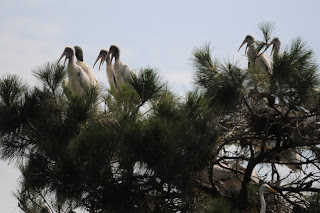
Here are images of Wood Storks nesting along with other species in a pond along golf course on Spring Island.

Little Blue Herons- Mark Musselman
Black-crowned Night Heron - Mark Musselman
Anhingas and Great Egret- Mark Musselman
Little Blue Heron - Mark Musselman
Little Blue Heron and Cattle Egret - Mark Musselman
Wood Stork - Mark Musselman

Great Egret chicks - Mark Musselman
Great Egrets - Mark Musselman
Great Egret chicks - Mark Musselman
Wood Stork rookery - Mark Musselman
Little Blue Heron - Mark Musselman
Cattle Egret - Mark Musselman
Wood Stork rookery - Mark Musselman
Wading bird rookery - Mark Musselman

 Here are images of birds nesting taken during our quick peek at Cypress Wetlands Trail in Port Royal.

Cypress Wetlands Trail - Mark Musselman
Cypress Wetlands Trail boardwalk - Mark Musselman
Green Heron - Mark Musselman
Tri-colored Heron chick - Mark Musselman
Tri-colored Heron - Mark Musselman
Tri-colored Heron on nest - Mark Musselman

Wednesday, April 04, 2012

Bird Cams

As bird species continue to return (today, Hooded Warbler and Great-crested Flycatcher) to the Audubon Center at Francis Beidler Forest, here are some bird cams to explore.

The Cornell Lab of Ornithology has two choices from the campus property:

Red-tailed Hawk nest on a light pole here.


Great Blue Heron nest within Sapsucker Pond here.


Bald Eagle nest in a cottonwood tree on private property near the Decorah Fish Hatchery (operated by the Iowa Department of Natural Resources), on the banks of the babbling waters of Trout Run in extreme northeast Iowa.   Video here.


Another Bald Eagle nest at the National Conservation Training Center in West Virginia can be seen here.


There are plenty more out there.  Use the comment section to put a link to your favorite bird cam!


Thursday, May 19, 2011

Red-shouldered Hawk Nest

http://sc.audubon.org/Centers_FBF_Educators_Species-Birds.html#TanagerWhile eating lunch at one of the picnic tables under the trees in the parking area at the Audubon Center at Francis Beidler Forest, we noticed a Red-shouldered Hawk (Buteo lineatus) fly through the trees along the edge of the swamp.  In less than five minutes, we saw a Red-shouldered Hawk fly in the other direction with what appeared to be a lizard in its beak.  We have learned that birds flying with food in their bills are almost always heading toward a nest.  Therefore, we watched.

Our watching paid off when we finally spied the nest in a crook high in a Loblolly Pine.


If you are having difficulty seeing the chick on the nest, follow the arrow! This view is from the parking slot in the bus loop where the ROC is stored.


There appeared to be only one chick in the nest.


An adult returned approximately every five minutes, though we could never see what was being brought as a meal.


Just beyond the entrance ramp at the center, is a Summer Tanager (Piranga rubra) nest in a Horse Sugar leaning over the driveway.  The female has only been sitting on eggs for a few days.


Near #121 on the boardwalk, we spotted A250 foraging.  A250 was the male with the nest in the cypress knee in the channel near the Meeting Tree at #120.  The chicks were gone from the nest sometime this weekend, but we could not confirm that they had successfully fledged.  However, following close behind A250 was a fledgling , so at least one of the chicks is still in the game!


Beidler Forest is always full of life, but spring accentuates that fact!

Images by Mark Musselman

Wednesday, June 30, 2010

Carolina Wren Nest

Over the years, the sand-filled cigarette disposal container by the front door of the Audubon Center at Francis Beidler Forest has been selected as a nest site by Carolina Wrens (Thryothorus ludovicianus).  Although eggs are laid and incubated for two weeks before the chicks hatch, a predator (raccoon or snake) makes a meal of the brood within the first few days.  Additionally, the nest is located in a high-traffic area, which has to be stressful on a predator-paranoid parent!


This morning, we arrived to find a two leaves in the sand meant for cigarette butts.  With frequent, short forays, the pair or wrens quickly incorporated the two starter leaves into a small pile of other leaves, rootlets, and moss.  The video below shows only a few seconds of their feverish activity!


Hopefully, this pair will have better luck.

Video and images by Mark Musselman

Friday, March 19, 2010

Barred Owl Nest

Barred Owls (Strix varia) are frequently observed from the boardwalk at the Audubon Center at Francis Beidler Forest.  We have witnessed one owl take a Yellow-bellied Sapsucker (Sphyrapicus varius) from a tree, but usually the owls are seen hunting, catching, and eating crayfish.  This week was no exception.

Almost everyone coming off the boardwalk reported seeing a Barred Owl.  Many saw owls catching crayfish.  However, we were able to see an adult owl catch, declaw, and carry a crayfish to the bird's nest within a Bald Cypress (Taxodium distichum) cavity.


On a previous trip around the boardwalk, we observed an owl hunting crayfish near the edge of the swamp by #3.  Once the owl had captured a crayfish, we watched it fly to two separate perches within nearby trees, each perch slightly higher than the last.  Eventually, the owl flew up high into a Bald Cypress, but out of view.  By the time we were able to move to a vantage point with a clear view of the tree's east side, the owl had flown in the opposite direction.  We took note of where we were standing.

This week, we saw the owl in the images, watched it catch a crayfish and prepare it for consumption by another individual.  Knowing where we needed to be, we quickly moved to the point with the best view of the suspected nest tree while the owl cautiously worked its way higher up the nearby trees.  Right on cue, the owl flew to the cavity opening and delivered the crayfish meal to its mate or possible one of its offspring!  Look closely at the arrows and you will see that more of the cavity is visible by the right arrow.  The owl is present at the left arrow and blocks a portion of the cavity, but the owl's color and pattern camouflage its presence.  The entire tree (in the distance) is shown in the right image.


Images by Mark Musselman