Showing posts sorted by relevance for query burn. Sort by date Show all posts

Monday, January 30, 2012

Burning Longleaf Pine Stands

Although weather conditions most of last week prevented the burning of some larger grassland tracts, the staff at the Audubon Center at Francis Beidler Forest was able to burn a small Longleaf Pine (Pinus palustris) stand when conditions improved on Thursday.  There are numerous reasons for denying a burning permit, but last week it was cool air aloft that would prevent the smoke from rising thereby causing a low-visibility driving hazard to nearby motorists.

Starting prescribed burn - Image by Mark Musselman
Longleaf Pine evolved with periodic fires that burned low to the ground, eliminated competing tree species, and exposed the soil to receive Longleaf Pine seeds. Longleaf Pine has thick bark to protect the trees from low-intensity fires that readily kill or burn other tree species.  The stand we burned on Thursday is the same stand where we planted wiregrass (Aristida stricta) and burned in November 2008 (blog entry).

Today, longleaf pine is an ecosystem in trouble everywhere in the South. Of the estimated 90 million acres in the pre-settlement forests, only about 2 million acres of mostly second-growth longleaf pine remain in scattered patches. Less than half of that is found on public lands. Those stands of longleaf in private ownership continue to decline, as landowners replace the longleaf with faster growing species such as loblolly pine. And, despite our increasing knowledge about the beneficial role of fire, especially fire during the growing season, many landowners still do not burn their longleaf pine forests, or do not burn them often enough. -- U. S. Fish & Wildlife

The key to keeping the fires low in intensity is to ensure that the excess fuel (leaves, needles, dead branches) does not accumulate on the forest floor. Note the difference in the before and after sections of the images taken during the burn.

Longleaf Pine pre-burn - Image by Mark Musselman
Longleaf Pine during burn - Image by Mark Musselman
Drip torches containing a 4:1 mixture of diesel to gasoline were used to set the fire on the downwind side of the stand, which allowed the fire to burn into the wind at a slower, steadier pace than if the fire were started on the upwind side of the stand. 

Drip torch - Image by Mark Musselman
Prescribed burn - Image by Mark Musselman
A fire break was plowed around the entire stand to ensure the fire did not migrate beyond the stand's boundaries.

Fire break - Image by Mark Musselman
Once the fire began in earnest, the smoke rising into the clear blue sky was undoubtedly visible from a great distance, especially if one had a seat high in that sky.  At one point, the roar of engines could be heard approaching at jet-like speed.  As the planes neared our burn site, the engines slowed and two pairs of F-16s circled leisurely around the pine stand.  After apparently sating their curiosity, the jets accelerated and made a thunderous exit to the west.

Pilot's log: Investigated fire...everything normal.  That's how we like it!

Monday, March 04, 2013

Prescribed Burning

After the rain during the previous weeks, last week turned out to be a good week to burn with the season drawing to a close.  At Audubon's Francis Beidler Forest, we were able to burn two tracts, as was the Charleston Audubon and Natural History Society at their McAlhaney Nature Preserve.  Charleston Audubon posted images and descriptions of the procedures and goals for their burning.

As we have noted in previous posts, the main purpose of burning forest land is to reduce the fuel load and prevent disastrous wildfires like the one near Myrtle Beach four years ago.  Whether by lightning or careless human activity, forests will burn at some point.  Not only does less fuel equal a less intense fire, some ecosystems, like the Longleaf Pine savanna, have evolved with periodic fire and require fire to maintain their health.

The first site we burned was the Longleaf Pine restoration tract we planted in January 2007.
Longleaf restoration site preburn - Mark Musselman
Longleaf restoration site (wiregrass) preburn - Mark Musselman
It appears that fire is essential for production of viable seed by these plants. Wire grass may actually be the most important, if not the most obvious, species in a longleaf pine savanna, because it is the plant that produces most of the fuel for the fires that sustain the community. Longleaf pines themselves do not produce enough fuel to keep their “home fires” burning. If it weren’t for wire grass and the fires it sustains, the savannas would cease to exist. That is exactly what happens when fire is suppressed in these communities. -- Carolina Environmental Diversity Explorations

Starting fire with drip torch - Mark Musselman
Drip torches containing a 4:1 mixture of diesel to gasoline were used to set the fire on the downwind side of the stand, which allowed the fire to burn into the wind at a slower, steadier pace than if the fire were started on the upwind side of the stand.
Burning into wind - Mark Musselman
A fire break was plowed around the entire stand to ensure the fire did not migrate beyond the stand's boundaries and interior dirt roads allowed the stand to be burned in seven separate sections.  However, in the event that fire were to find a way across a break, volunteers were ready to extinguish the flames by smothering the fire with flappers or shoveled soil or by spraying the errant fire with water.
Volunteers Howard Bridgman and Paul Cooler - Mark Musselman
Although ascetically unattractive immediately after the burn, wiregrass and forbs will quickly begin to sprout producing an enhanced habitat for wildlife like wild turkeys, bobwhite quail, and fox squirrels.  Longleaf Pine benefit from the elimination of competing hardwood tree species and the reduction of fuel on the ground, which if allowed to accumulate could generate a fire too hot for the Longleaf Pines to withstand.

Longleaf restoration site postburn - Mark Musselman

The next day we burned a Loblolly Pine stand at the northern end of the Francis Beidler Forest.  The 37 acres were divided by fire breaks into three unequal units.  We began with the smallest (3 acres) to see how the fire would travel through the stand.  The fire burned slowly into the gentle west wind.

Loblolly Pine stand preburn - Mark Musselman
Recent rains kept the site moist and east-west running furrows between the rows of planted pine kept the fire from burning south to north.
Loblolly Pine stand preburn - Mark Musselman
Loblolly Pine stand slowly burning - Mark Musselman
Fire burned slowly and steadily where not stymied by standing water.

Loblolly Pine stand slowly burning - Mark Musselman
In the end 75-80% of the fuel was burned across the site.  In drier areas, the burn rate was 100%, while other areas (image below) did not burn in the low, wet areas.

Loblolly Pine stand postburn - Mark Musselman

Both burns successfully accomplished our goal of fuel reduction and exceeded our expectations considering the moist conditions.  However, hazards remain until all the hot spots are extinguished and all of the equipment is properly stored back at the center.  There is little room for error when driving the ATV up the ramp into the bed of the pickup.  Pushing the accelerator lever instead of gripping the brake lever results in spectacular damage to the toolbox and quality entertainment for the bystanders.  To quote Homer Simpson, "Doh!"

ATV vs toolbox - Mark Musselman

Saturday, January 19, 2013

Grassland Burn

Previously, we have reported how the Audubon Center at Francis Beidler Forest is working to restore grassland habitat for birds and other wildlife.  This week, we burned approximately 25 acres of grassland near the intersection of I-26 and Hwy 15.

Grassland plants have adapted to periodic dramatic change whether that change was caused by lightning-strike fires, fires set by Native Americans to manage their hunting grounds, or herds of grazing bison. As Native Americans learned, fire is an effective and beneficial land management tool.  In grassland ecosystems, fire prevents trees from invading and dominating the habitat, returns nutrients to the soil, and stimulates growth in native grassland plants.  The tender new growth, flowers, seeds, and fruit provide food for a variety of animals that are in turn food for other animals.  By spring, the site will be prime for grassland bird species returning from their wintering grounds in search of breeding territory.

Prescribed burns are well-planned events.  In fact, this burn was delayed by several days until the winds shifted out of the southwest, which allowed the smoke to travel northeast over the swamp and away from nearby I-26 and US Hwy 15.  Using drip torches containing a mixture of diesel fuel and gasoline, the northeast corner of the plot was lit so that the fire burned back into the wind, which helped to keep the fire slow and steady.

Grassland Prescribed Burn - Mark Musselman
Volunteers and staff patrolled the borders of the burn plot to ensure flames did not cross the plowed fire breaks.  If any breaches were to occur, backpack water sprayers, ATV-mounted water sprayers, rakes, flappers, and shovels were available to quickly snuff out the errant flames.
Ricky Covey Monitoring Burn - Mark Musselman

Grassland Prescribed Burn - Mark Musselman

Ricky Covey Monitoring Burn - Mark Musselman

It was a full day (45 volunteer hours, 38 staff hours) of hard work, but all went well and we were treated to a beautiful sunset.

Sunset - Mark Musselman

Monday, October 17, 2016

GP Longleaf Pine Burn

Hurricane Matthew brought wind and rain to the southeast. Four Holes Swamp filled short of last October's record water levels, but rose over the deck of the boardwalk and overflowed swamp-crossing roads like US Hwy 78. However, the weather after the storm has been cooler, less humid, without precipitation and with winds generally out of the northeast.
Map of tract, Image Mark Musselman
To conduct a prescribed fire at the GP longleaf pine tract, the first tract planted at the Francis Beidler Forest, wind direction is important. Due to the tract's location on the west side of Hwy 27, the winds must be from the northeast or east to prevent smoke from crossing the highway and presenting a danger to drivers. However, northeast winds are not the common wind direction for our area and are often preceded by or accompanied by precipitation.  Spoiler alert: precipitation tends to put a damper on fires and fuels.

Therefore, after clearing the nature center's driveway of fallen trees and the fire break around the GP tract of several stout fallen oaks, we sent out a call for volunteers to help with the prescribed fire on Friday.
Volunteers! (l to r) Bob, Bob, Michael, and Joe; Image Mark Musselman
With the fire break disced, the middle fire break was cleared with a leaf blower in order to burn the 21-acre tract in two units. A test fire was started along the east side of the middle fire break in unit A in order to determine how the fuels would burn. Normally, a test fire is started in a corner in order to allow a rapid extinguishing of the fire should it behave contrary to expectations. However, water oaks have been allowed to infest this tract and are especially dense around the edges. The flat oak leaves do not burn well unless licked by a hot fire pushed by the wind, which allows the fuels to be preheated and dried. Additionally, the majority of fuels on the tract were pine straw and small woody materials, so a test fire in the oak leaves would not reflect conditions across most of the tract.

Test fire, Image Mark Musselman
Note the circular shape of the test fire as it slowly burns evenly in all directions in the absence of wind.

Being satisfied with the fire behavior at the test fire site, we used drip torches to light a line of along the line 2-6. We chose to burn unit A first as it is the closest to the highway and completing it before conditions changed was preferable. Additionally, unit A had been burned two years ago, while unit B had not been burned for 6.5 years, which meant that there would be more fuel on the ground in unit B and the possibility of a larger fire. With a swamp full of water to the west and a burned out unit A to the east, a larger fire in unit B would be easier to contain. As the fire slowly backed into the wind from the eastnortheast within unit A, we began lighting spot strip fires at 20-meter intervals toward the highway. Below is an example from later in the day when we burned unit B.

Spot strip fire in unit B, Image Mark Musselman
Dropping a continuous line of fire uses more diesel/gas fuel and creates a curtain of fire that generates more heat than is desired. By dropping spots of fuel from the drip torches every 10-15 meters, the spots burn out in all directions, like the test fire image, at a lower intensity. Eventually, the spots burn together and the fire briefly intensifies before consuming all the fuel and extinguishing itself.
Spot strip fires burning (left), burned unit A (right), Image Mark Musselman
The result of the fire is a reduction of fuel on the ground, which will limit damage from a wildfire caused by lightning or human negligence. The next rain will help wash the nitrogen from the burnt fuels back into the soil. The bare mineral soil will provide the necessary conditions for longleaf pine seeds to germinate and survive. The seeds can germinate in the duff that existed prior to the fire, but survival is less likely as the duff layer can dry more quickly than the soil allowing the seedling to desiccate. Competing loblolly pines and hardwoods are killed outright or top-killed as they are not adapted to fire like longleaf pines. Grasses and other forbs are invigorated by fire and immediately begin sending out softer material more palatable to deer and other wildlife. Not all desirable plants and animals survive, but on balance, fire is overwhelmingly beneficial to the longleaf pine ecosystem.

At the end of the day, approximately 75% of the 21 acres burned and no smoke reached the highway. Success!
Burned unit A, Image Mark Musselman
Burned area between units (see volunteer image above), Image Mark Musselman
Smoke free!, Image Mark Musselman


Thursday, January 26, 2017

Grassland Burning

In the previous post, we showed the grasslands that Audubon South Carolina established in the fields across from the driveway at the Francis Beidler Forest. Earlier this month, we were able to burn all three fields.

Grassland burn - Image by Mark Musselman

Grassland burn - Image by Mark Musselman

Grassland burn - Image by Mark Musselman

Grassland burn - Image by Mark Musselman

Burning the fields reduces the fuels on site by consuming the dead plant material, returns nutrients to the soil, and invigorates plant growth. New growth is more palatable to wildlife, including seeds and fruits. We look forward to what will emerge during the spring flush. We are also hopeful that the habitat improvements will attract Northern Bobwhite Quail as there are a few in the neighborhood.

Monday, July 18, 2016

Warm Season Burn - Update

One month ago (see previous post), we attempted a warm season burn on 29 acres of old agricultural fields in which our planted longleaf pines were being crowded by other vegetation, mainly dog fennel. Last Thursday, we checked on the progress of the longleaf pines and grasses in the field where the burn was successful.
Grasses under dead dog fennel - Mark Musselman
In areas where the burning was complete, the dog fennel remains dead or absent and the grasses have pushed out new green blades.

With most of the vegetation burned away and the longleaf pine pushing out new needles of a brighter green than the grasses, the longleaf pines are more easily located than before the burn.

Longleaf pine growth after fire - Mark Musselman
With the majority of the competition removed, especially the tall dog fennel, the young longleaf pine are in full sunlight and should grow rapidly over the coming months. By spring, many will have a root collar of one inch and will begin vertical growth leaving the grass stage behind. We look forward to the day when the longleaf pine stand taller than the neighboring grasses!

Monday, February 01, 2010

Playing Catch Up

It was a busy week at the Audubon Center at Francis Beidler Forest, but we were not in the office and the blog reflects that fact. Therefore, today's entry will address a variety of topics.


Last Thursday, we spent the whole day burning the Longleaf Pine (Pinus palustris)
stands at the Till property (owned by Audubon SC) southwest of Williams, SC (see Google Earth maps). Longleaf Pine evolved with periodic fires that burned low to the ground, eliminated competing tree species, and exposed the soil to receive Longleaf Pine seeds. Longleaf Pines thick bark protects the trees from low-intensity fires that readily kill or burn other tree species. The key to keeping the fires low in intensity is to ensure that the excess fuel (leaves, needles, dead branches) does not accumulate on the forest floor. As can be seen in the before and after images of the Till burn, fuel was eliminated, Sweetgum and Lobllolly Pine trees were burnt, and the Longleaf Pine trees were given space grown.


Audubon SC burning Longleaf Pine by Mark Musselman


Audubon SC burning Longleaf Pine by Mark Musselman


Drip torches for burning longleaf pine by Mark Musselman
Drip torches containing a 4:1 mixture of diesel to gasoline were used to set the fire on the downwind side of the stand, which allowed the fire to burn into the wind at a slower, steadier pace than if the fire were started on the upwind side of the stand. Cotton Rats had to find cover somewhere else and were the most-frequently seen wildlife as they exited the burning areas, although a variety of birds and a family of armadillos were also spotted. Here are some other longleaf-related blog entries.

On Friday, we were at the Sangaree Intermediate School's career day. The former director of a speed-dating service must have set the schedule for the morning. We presented to 175 students in seven 20-minute sessions during three straight hours. We had just enough time between the sessions to reset the PowerPoint. Deja vu was a recurring phenomenon. Hopefully, we were still talking about the swamp in the last sessions! We think we were.

Finally, yesterday the Coastal Master Naturalists Association held their first meeting and began soliciting membership. Beside electing a slate of officers, establishing the bylaws, and planning field activities for the year, we made a Project PROTHO presentation detailing the research and the upcoming opportunities for master naturalists to satisfy some or all of their volunteer service requirements. Here are some previous blog entries regarding Project PROTHO.


Images by Mark Musselman

Monday, December 12, 2016

Grassland Restoration

Grassland bird species are in decline, mainly from loss of habitat, which is why grassland conservation and restoration are part of the National Audubon Society's strategic plan.

With a cost-share grant from the United States Fish and Wildlife Service (USFWS), Audubon South Carolina committed to convert recently purchased agricultural fields to grasslands. These fields are adjacent to Mims Road across from the driveway entrance to the Francis Beidler Forest.

After decades of use for agriculture, the fields held few desirable plant species in the soil seed bank. Most of what volunteered was dog fennel (Eupatorium capillifolium), which would form a dense, sun-blocking thicket having little wildlife value. Therefore, the first step in the conversion was to herbicide the emerging vegetation in order to clear the site for the introduction of desirable grassland plant species.

Plants referred to as "ag weeds" in fallow field - Image by Mark Musselman
The fields one month after planting.

Field across from driveway - Image by Mark Musselman
Field across and right from driveway - Image by Mark Musselman
Field right from driveway across Cantley Rd. - Image by Mark Musselman
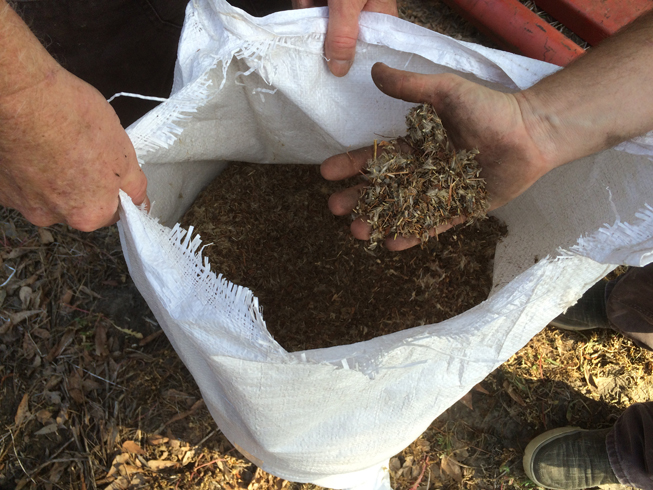
The first two fields shown above were planted in grassland mixes (Showy Wildflower and Mixed Meadow). The third field will receive longleaf pine seedlings this winter, so it was planted in a longleaf pine understory mix. The plantings were accomplished through the use of the USFWS seed drill, which was towed behind our tractor. Seeds are placed in the hopper where agitators feed seed into separate tubes leading to the seed drills. A harrow disturbs the soil ahead of the seed drills. The seed drills place the seed at the proper depth below the soil surface before a set of compacting wheels ensure the seeds are covered and in good contact with the soil.

Seed drill on transport trailer - Image by Mark Musselman
Seed mix prior to loading into seed drill - Image by Mark Musselman
After three month, the fields showed green with a mix of wildflower colors vying for attention.

Field across from driveway - Image by Mark Musselman
Butterfly Milkweed (Asclepias tuberosa) - Image by Mark Musselman
False Sunflower (Heliopsis helianthoides) - Image by Mark Musselman
Partridge Pea (Chamaecrista fasciculata) - Image by Mark Musselman
Indian Blanket (Gaillardia pulchella) - Image by Mark Musselman
The grasslands will be burned annually to prevent trees from becoming established, to reduce fuel (dead plant material), and to invigorate new plant growth. Due to the dry weather since Hurricane Matthew, we have been waiting for some precipitation to fall before conducting a prescribed burn. The rain over the last week certainly fits that bill, so now we wait for the next day with winds out of the south or southwest to ensure any smoke blows toward the swamp and away from neighbors' homes.

Ready for winter burn - Image by Mark Musselman