Showing posts sorted by date for query grassland. Sort by relevance Show all posts

Tuesday, May 23, 2017

Northern Bobwhite in The Bend

Northern bobwhite quail have been steadily declining in numbers due to habitat loss brought on by changes in how humans manage the land.

From Northern Bobwhite Conservation Initiative (NBCI): [which] is the unified strategic effort of 25 state fish and wildlife agencies and various conservation organizations — all under the umbrella of the National Bobwhite Technical Committee — to restore wild populations of bobwhite quail in this country to levels comparable to 1980.

Bobwhites signify the decline of an entire suite of species adapted to grassland ecosystems in the United States. The root causes of the declines are the same, habitat loss at the continental scale: the near demise of the pine-barrens of the northeast; longleaf pine-wiregrass ecosystem of the south; the oak savannas of the central hardwoods; the shortleaf pine-bluestem ecosystem of the midwest; or the prairies of the southwest. These ecosystems were once maintained through fire and grazing which sustained a ground cover of vegetation with the appropriate structure and composition for bobwhites. The habitats bobwhites rely on have structural and plant composition characteristics that are shared by a myriad of species which, unfortunately, are also sharing a similar fate as bobwhites. 

Bobwhites and grassland birds can be increased and sustained on working public and private lands across their range by improving and managing native grassland and early successional habitats, accomplished through modest, voluntary adjustments in how humans manage rural land.

In order to understand habitat from the perspective of a bobwhite, you need to lie down and put one cheek of your face on the ground. This is a quail’s eye view of the world. For a bobwhite to survive, everything they need must be found within 6-10 inches of the ground, whether it is a clump of bunchgrass to nest in, a patch of ragweed or Croton to forage for insects and seeds with broods in, or a patch of brush for escape or loafing cover.

At the Francis Beidler Forest, we are focusing our northern bobwhite restoration efforts in The Bend, which is generally the land contained between I-26 and Four Holes Swamp where the swamp "bends" to the south on its run to the Edisto River. This area falls within South Carolina Department of Natural Resources Central Focal Region. We have begun identifying the types of land use within The Bend (yellow=residential; pink=agriculture; purple=loblolly pine stand; etc.) in order to see where restoration efforts should logically begin. The long-range plan is to create suitable habitat within The Bend or create corridors between suitable habitat which may already exists.
Land use map for The Bend - Map by Mark Musselman
In previous blog posts, we have described how we are restoring longleaf pine habitat, which will benefit northern bobwhites and other species. However, much of this habitat restoration occurs in areas inaccessible to the general public. Therefore, we have created several grassland and longleaf pine demonstration sites from old agricultural fields located along the road near the entrance to the Francis Beidler Forest. Here are blog posts detailing the grassland restoration and burning.

In April, various coreopsis species began flowering...

Longleaf pine/grassland at Cantley Rd. - Image by Mark Musselman
Coreopsis flowering - Image by Mark Musselman
 ...and by May the fields were full of flowers and the associated insect activity.

Grassland at end of driveway - Image by Mark Musselman
For the patient visitor, Painted Buntings, Blue Grosbeaks, Indigo Buntings and other bird species can be seen and heard in and around the grassland parcels. Two weeks ago, a visiting master naturalist group watched a Swallow-tailed Kite forage for, catch, and eat at least three large insects over the grassland parcel at the end of the driveway.

Last week, while checking on the longleaf pine planted in the field along Cantley Rd., a small group of flushed birds rose and dropped in short flight and ran about the fire break foraging like bobwhites. Could it be already?! Upon a closer look through squinted eyes, the "quail" turned out to be wild turkey chicks old enough for short flights. Scanning the higher vegetation in the grassland, the fleshy head of a hen strained tall to watch us. Eventually, the hen and 12 chicks moved across Cantley Rd. to one of the grassland parcels along Mims Rd.

Turkey hen and chicks - Image by Mark Musselman
Turkey chicks in flight - Image by Mark Musselman
In the following days, visitors and staff alike saw three hens with 20 chicks moving together between the various grassland parcels. As wild turkeys and northern bobwhite quails have similar habitat requirements, hopefully the quail are not far behind!

Thursday, January 26, 2017

Grassland Burning

In the previous post, we showed the grasslands that Audubon South Carolina established in the fields across from the driveway at the Francis Beidler Forest. Earlier this month, we were able to burn all three fields.

Grassland burn - Image by Mark Musselman

Grassland burn - Image by Mark Musselman

Grassland burn - Image by Mark Musselman

Grassland burn - Image by Mark Musselman

Burning the fields reduces the fuels on site by consuming the dead plant material, returns nutrients to the soil, and invigorates plant growth. New growth is more palatable to wildlife, including seeds and fruits. We look forward to what will emerge during the spring flush. We are also hopeful that the habitat improvements will attract Northern Bobwhite Quail as there are a few in the neighborhood.

Monday, December 12, 2016

Grassland Restoration

Grassland bird species are in decline, mainly from loss of habitat, which is why grassland conservation and restoration are part of the National Audubon Society's strategic plan.

With a cost-share grant from the United States Fish and Wildlife Service (USFWS), Audubon South Carolina committed to convert recently purchased agricultural fields to grasslands. These fields are adjacent to Mims Road across from the driveway entrance to the Francis Beidler Forest.

After decades of use for agriculture, the fields held few desirable plant species in the soil seed bank. Most of what volunteered was dog fennel (Eupatorium capillifolium), which would form a dense, sun-blocking thicket having little wildlife value. Therefore, the first step in the conversion was to herbicide the emerging vegetation in order to clear the site for the introduction of desirable grassland plant species.

Plants referred to as "ag weeds" in fallow field - Image by Mark Musselman
The fields one month after planting.

Field across from driveway - Image by Mark Musselman
Field across and right from driveway - Image by Mark Musselman
Field right from driveway across Cantley Rd. - Image by Mark Musselman
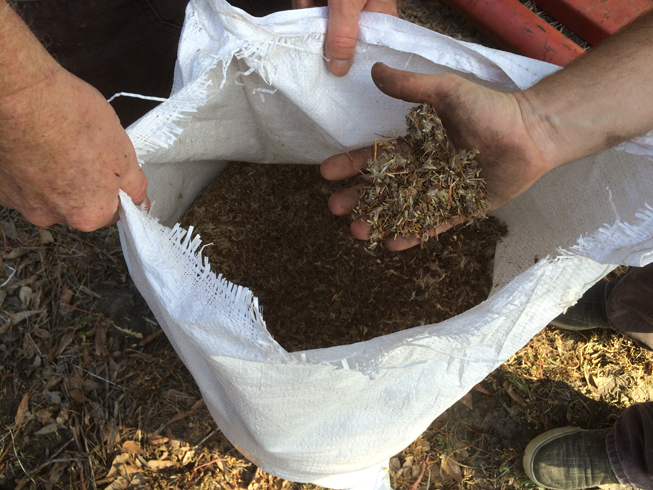
The first two fields shown above were planted in grassland mixes (Showy Wildflower and Mixed Meadow). The third field will receive longleaf pine seedlings this winter, so it was planted in a longleaf pine understory mix. The plantings were accomplished through the use of the USFWS seed drill, which was towed behind our tractor. Seeds are placed in the hopper where agitators feed seed into separate tubes leading to the seed drills. A harrow disturbs the soil ahead of the seed drills. The seed drills place the seed at the proper depth below the soil surface before a set of compacting wheels ensure the seeds are covered and in good contact with the soil.

Seed drill on transport trailer - Image by Mark Musselman
Seed mix prior to loading into seed drill - Image by Mark Musselman
After three month, the fields showed green with a mix of wildflower colors vying for attention.

Field across from driveway - Image by Mark Musselman
Butterfly Milkweed (Asclepias tuberosa) - Image by Mark Musselman
False Sunflower (Heliopsis helianthoides) - Image by Mark Musselman
Partridge Pea (Chamaecrista fasciculata) - Image by Mark Musselman
Indian Blanket (Gaillardia pulchella) - Image by Mark Musselman
The grasslands will be burned annually to prevent trees from becoming established, to reduce fuel (dead plant material), and to invigorate new plant growth. Due to the dry weather since Hurricane Matthew, we have been waiting for some precipitation to fall before conducting a prescribed burn. The rain over the last week certainly fits that bill, so now we wait for the next day with winds out of the south or southwest to ensure any smoke blows toward the swamp and away from neighbors' homes.

Ready for winter burn - Image by Mark Musselman


Friday, June 14, 2013

Changes in the Swamp

This blog has been rather silent for the last month.  Since January, the education director has also been the land manager.  Collis Boyd, the part-time land manager, retired and the land manager position became a full-time position.  The last three weeks of May saw 638 students and 166 adult teachers/chaperones take the boardwalk tour and this week began three weeks of summer camp at the Audubon Center at Francis Beidler Forest.  Needless to say, blog writing time has been tough to schedule.

On June 21st, Matt Johnson will assume the position of education manager and on July 1st, Mark Musselman will assume sole responsibility as the land manager of the 17,000+ acres of the Francis Beidler Forest.  Therefore, we would like to introduce Matt Johnson.

Matt Johnson
Matt Johnson, new Education Manager, was born and raised in West Columbia, SC, where he spent most of his time fishing and exploring Congaree National Park with his father. Matt attended Clemson University in 2003, where he earned a degree in Wildlife and Fisheries Biology. After finishing his undergraduate degree, Matt pursued a graduate degree in Biology, which he completed in 2009. While working on both degrees at Clemson, Matt worked as a producer for the Emmy award-winning nature documentary “Expeditions with Patrick McMillan.” In 2011, Matt started working as a Lecturer in the department of Biological Sciences at Clemson, where he taught undergraduate courses relating to botany, science writing, and current events in science. Matt also helped initiate the Keowee-Clemson Bird Club while living in the upstate, a group that now boasts about 100 members. In his free time, Matt enjoys bird-watching, hiking, reading, and learning more about the natural world. Matt is eager to start working for the National Audubon Society and looks forward to taking up residence in the Lowcountry.

Matt Johnson
Other changes include Prothonotary Warblers leaving the nest, fawns navigating the hazards of the swamp, higher water levels due to the recent rains, and new property at the entrance and along the driveway.  First, several of the Prothonotary Warbler nests we noted previously have fledged their chicks.  We had observed A037  earlier in the spring, but he disappeared sometime in April.  We do not know where he nested, but on Wednesday we spotted A037 with two fledglings at #146 along the boardwalk.

White-tailed Deer fawn - Mark Musselman
Before the last round of heavy rains, earlier rains had bumped up the water levels in the swamp.  A fawn that appeared to be only several days old failed to navigate over a branch wedged between several cypress knees.  Visitors saw the fawn step over the branch, but fail to touch bottom on the other side.  With its belly on the branch and zero hooves on the hard bottom, the fawn was stuck.  The White-tailed Deer doe may have returned and nudged the fawn off of the branch, but after an hour, we decided to help the fawn to dry land to avoid hypothermia.


White-tailed Deer fawn - Mark Musselman
Currently, the water is high enough to cover all land and most fallen trees.  There are few places in the swamp to haul out of the water and any dens, like those of the Nine-banded Armadillo which we noted had arrived in 2008, are flooded.  High though it may be, the water has not reached the nature center and the armadillo den under the front ramp. 

Young Nine-banded Armadillo - Mark Musselman
Young Nine-banded Armadillo through humidity-fogged lens - Mark Musselman
Finally, Francis Beidler Forest increased in size by 67 acres with the acquisition of land across from our entrance and along the north side of the driveway (shown shaded in yellow).

Latest Land Acquisition - Mark Musselman
Currently all in soybeans, the smaller parcel across from the entrance will be converted to a native grassland demonstration site and the fields within the larger parcel will be planted with Longleaf Pine.  You can read more about our other Longleaf Pine tracts and management here on this blog.

One of the best aspects of nature is that it is always changing...never static!

Tuesday, March 12, 2013

Hiring for Education Manager Position

Position Description

Location:
Audubon Center at Francis Beidler Forest

Immediate Supervisor:
Michael Dawson

Purpose of the position:

The EDUCATION MANAGER plans, creates and supervises the day to day operation of the full spectrum of educational offerings available both at and away from the Audubon Center at Francis Beidler Forest. He/She will pay particular attention to the Center’s alignment with National Audubon’s Strategic Plan.  He/She will also assist the Center Director with Beidler Forest Sanctuary management and protection, as well as State Office support as needed.

Essential Functions:

1.  To oversee and supervise the day-to-day development, implementation, and delivery of a wide variety of general visitor educational activities which are designed to bring people and the resources/facilities of the sanctuary together for positive experiences and move them along the continuum from understanding to appreciation to conservation action.

2.  To oversee and supervise the development, implementation and delivery of a curriculum of educational programming created for school children that is tied directly to state Education Standards, while contributing to Audubon’ Strategic Plan and conservation outcomes.

3.  Participate as a member of a team to conduct education and cultivation activities for key constituencies such as private landowners and foresters.

4.  To respond to National Audubon’s lead on aligning Center activities to its strategic plan and to develop, implement and deliver programs and projects in support of the Plan’s conservation outcomes. Particular attention will be paid to the Bird Friendly Communities goals and objectives.

5.  Take responsibility for the scheduling, pre/post information, guide/speaker assignment, etc. for all guided programming and off site outreach for the Beidler Forest.

6.  To create, plan, promote and conduct special events, walks, and programs designed to encourage visitation and participation at the Center.

7.  Build and maintain the Beidler Forest pages of the Audubon South Carolina website, assuring its current content, “tourist friendliness” and teacher usefulness.

8.  Assist the Center Director in the recruiting, training, scheduling, recognizing and keeping of volunteers to the Center. Assist the Center Director in the recruiting, training and scheduling of Seasonal Naturalists in the spring and fall.

9.  To serve as the principal "go to" staff member for all things bird related (identification, biology, monitoring, etc.) out of the Beidler Forest office, as well as assisting the state team in conducting Bird Friendly Bottomland Forest Management site visits, grassland/shrubland bird studies, and assisting with the shore bird Beach Stewards program.

10.  To act as part of the Audubon South Carolina team, endeavoring to achieve its conservation outcomes as addressed in National Audubon’s Strategic Plan.

Additional Functions:

1. Assist Center Director and/or Land Manager as needed with sanctuary facilities and equipment maintenance, biological monitoring and field biology/research.

2. Run the visitor center desk one weekend per month.

3. Plan, promote and conduct a series of at least three weeks of summer day camps for area children with themes and activities in support of Strategic Plan Conservation Outcomes.

Relationships:

Internal:
Center Director
State Office Director
Development Director
Office Manager
Finance Manager
Seasonal Naturalists
Land Manager
Volunteers
Part-time staff
NAS Centers and Education Staff

External:
Area teachers
Area school administrators
Staff from other education providers
Sanctuary neighbors
Staff from other area non-profits, governmental agencies, resource or educational organizations
Local media
Local Civic and Service Clubs

Equipment: (e.g., computer, typewriter, calculator, copy machines, telephone, etc.)

Computer, copy machine, GPS unit, digital camera, hand power tools and other maintenance equipment, canoe/kayak, video projector. Trucks (some with standard shift).
Qualifications: (e.g., education, training, experience, licenses and skills)

Minimum of a Bachelor’s degree in Biology, one of the Natural Sciences, or Education and previous experience as a Naturalist. Demonstrated passion for birds at a minimum and experience with avian research/monitoring would be a plus. Familiarity with promotions, good writing and public speaking skills, and sense of humor. Demonstrated ability to self start and work with little supervision.

Physical Requirements: (e.g., lifting, reaching, climb, push/pull, etc.)

Must be able to routinely walk the 1.75 mile boardwalk.
Must be able to canoe or kayak.
Must be able to lift 50 lbs. or more.
Must be able to reach, push a garden cart, wield a machete or bush ax, and accomplish
other fairly physical tasks..
Must be able to tolerate the heat and humidity of a South Carolina summer while outside
for hours at a time.
Must be able to endure bugs (especially chiggers, yellow flies, occasionally mosquitoes)

Application:

Applicants MUST apply through the Audubon Career Center at the following link…
https://careers-audubon.icims.com/jobs/1679/job?mode=view

Wednesday, February 06, 2013

Sparrow Banding

Between January 26th and January 29th, we were banding sparrow species in a variety of habitats.  Mark LaBarr, Audubon Vermont and a federally certified bird bander, flew down to coordinate the proceedings and band the captured sparrows.

In the eastern United States, grassland habitat continues to disappear and consequently bird species that prefer that habitat are also in decline.  Previously, we have reported on our efforts to restore grassland habitats within the Francis Beidler Forest.

The four days of banding began at the recently burned Spring Branch grassland restoration site.

Unburned and burned Spring Branch - Mark Musselman
Lex Glover removing sparrow - Mark Musselman
Other certified banders, Lex Glover of the South Carolina Department of Natural Resources (SCDNR) and Aaron Given of the Town of Kiawah, were on site to assist with the banding and data collection, but the significant help came from the Summerville High School Navy Junior ROTC volunteers.  The effort to capture and band sparrow species is not like some netting stations which are situated to be in the flight paths of birds conducting their normal activities.  Sparrows spend the majority of their time on or quite close to the ground, so they need to be flushed from their cover towards the mist nets.  That is where the extra bodies proved to be invaluable.

Purple line shows track of Mark Musselman during the day of banding
The middle of the three sections shown above in orange was the only section not burned.  The nets were initially set along the fire break to the west and set later along the fire break to the east.
Summerville HS NJROTC volunteers - Mark Musselman
With the large grassland habitat and small coverage area of the mist nets, the sparrows would have had no trouble leaking around the three banders and three Audubon staff members trying to drive the birds towards the nets.  However, with the quantity of high school volunteers joining the effort, we were able to cover a wide swath of the grassland and curl in the ends of the line to keep the birds moving directly away from the noise and humans and towards the waiting nets

The majority of the approximately 60 sparrows captured were Song Sparrows and Swamp Sparrows.  However, there were also several Savannah Sparrows and one Grasshopper Sparrow as well as an overly curious Northern Mockingbird.  The mockingbird was shown to the students and released without any bands, but all sparrows were given an official United State Geologic Survey (USGS) band.  You can read more about the North American bird banding program here.

Mark LaBarr with Northern Mockingbird - Mark Musselman
Savannah Sparrow - Mark Musselman
Grasshopper Sparrow - Mark Musselman
The second day of banding include a shut-out at the Longleaf Pine restoration site.  The emerging pine habitat still has a significant number of short oaks and wiregrass ground cover, which is clumpy and not nearly as dense as the grassland habitat at Spring Branch.  A return to Spring Branch later in the day resulted in additional sparrows being captured and banded, but without the large number of volunteers, we did not capture anything close to the numbers we saw flying over and around the nets and the six humans.
Clark tract - Longleaf Pine restoration
Days three and four were spent at the Oakridge landfill in Dorchester County and the Bees Ferry landfill in Charleston County.  Although landfills seldom, if ever, evoke images of wildlife habitat, they can be beneficial to some species once portions or the entire landfill have been closed.  Once a section or cell of the landfill has been capped, grasses are encouraged to grow on top and on the sloped sides in order to prevent erosion of the capping material.  Trees, however, are no allowed to grow as their roots would penetrate the capping material, which would allow water in and pollutants out of the waste cell.  Driving the mist net poles in to the ground would have the same effect as tree roots, so the poles needed to be set in buckets of sand.  This sounds good in principle, but the occasional gust of wind would topple at least one pole, which would in turn pull down several others.  Valuable time was then spent picking grass, twigs, and blackberry stems from the delicate nets.
Oakridge Landfill
Oakridge landfill has the distinction of having the highest point in Dorchester County at an elevation of 255 feet.  The small grassy lump in the left half of the panorama below is that high point.

Panoramic view from top of Oakridge landfill - Mark Musselman

Methane capture - Mark Musselman
Mark LaBarr removing sparrow - Mark Musselman
Setting mist nets - Mark Musselman
House Wren - Mark Musselman
Although we did not take pictures of the second site closer to the top of the landfill (see panorama above) was much more like an open grassland.  The site was full of sparrows, but we were again plagued with a limited number of bird drivers.  Additionally, the steep slope worked in the birds' favor.  When flushed from their cover, the birds flew straight out before diving back down for cover.  Unfortunately, straight out put them over the top of the mist nets running parallel to the contour of the hill.  The sparrows were not captured and banded, but their presence was noted and the habitat deemed suitable for grassland sparrow species.

Bees Ferry landfill was the site of the final day of banding.
Bees Ferry Landfill
Help from a variety of volunteers made it possible to set the poles and nets on an increasingly windy day.  Like the Oakridge landfill, poles could not be set into the ground to avoid puncturing the cap and or lining material.  Now, with an ample force of volunteer bird drivers, we lacked the bird numbers we had seen on previous days!

Mark LaBarr removing sparrow - Mark Musselman
Mark LaBarr setting nets - Mark Musselman
Volunteers helping set nets - Mark Musselman
First for Mark LaBarr, Le Conte's Sparrow - Mark Musselman
The day began with a breeze and the winds continued to increase in advance of the approaching cold front.  Setting the nets, already difficult with the sand-in-bucket system, was all the more frustrating due to the random gusts of wind.  However, Mark LaBarr was able to band his first Le Conte's Sparrow and landfill supervisor, Ron Tibbetts, was able to release one of the banded sparrows.
Mark LaBarr helps Ron Tibbetts release sparrow - Mark Musselman
Setting net at second site - Mark Musselman
Although wind and manpower prevented all of the observed sparrows from being captured and banded, we were successful in determining the general usefulness of a variety of grassland habitats to support wintering sparrow species.  In the end, sites like the landfills might mow less, which would save them money (salaries, fuel, maintenance) and provide better habitat for bird species in search of a winter home.

The birds banded over the four days will soon be heading north to establish breeding territories.  It's a long shot, but it is possible that Mark LaBarr could capture in his springtime nets a bird he first met here in South Carolina!