Showing posts sorted by date for query ipod. Sort by relevance Show all posts

Tuesday, December 11, 2012

GPS Units Coming to Ashley Ridge High School

Ashley Ridge High School has received a grant from Lowcountry Resource Conservation and Development (RC&D) to purchase six or more global positioning system (GPS) units.  Students will be able to use the GPS units to capture latitude/longitude coordinates for points of interest along the nature trail, including the abundant wildlife they encounter, or habitat enhancement sites they create.  Bill Salisbury, representing Dorchester County, presented the check to the grant writers Amy Litz,  Jerry Kociuruba, and Natalie Tarpein after taking a quick tour of the nature trail to see the many possibilities for integrating the GPS technology into the biology and environmental sciences classes.

(l to r) Natalie Tarpein, Bill Salisbury, Jerry Kociuruba, Amy Litz on nature trail
Over the last two years, students in the environmental science and AP biology classes have received GPS training (see Summerville Journal Scene article) as well as geographic information systems (GIS) training, which they used to create maps with the GPS data they had collected.  The training and GPS units used were provided by the education department at the Audubon Center at Francis Beidler Forest and had been purchased with a grant from the South Carolina Geographic Alliance.

As an organization, Lowcountry RC&D sells year-old seed to individuals who wish to plant feed plots for wildlife.  Any profits are distributed to projects aimed at teaching students about the environment.   Previous Lowcountry RC&D grants to the education department at Francis Beidler Forest have gone toward the purchase of iPod Touches and binoculars (see below), which also have been used with ARHS students during various on-campus visits.

Ms. Tarpein and class learning birding basics
Geography is everywhere!  Thanks to Lowcountry RC&D, students at Ashley Ridge High School have some new tools to help them explore, map, and understand their environment.

Monday, April 09, 2012

Prothonotary Warblers at Ashley Ridge High School

The Prothonotary Warblers (Protonotaria citrea) in the old-growth swamp at the Audubon Center at Francis Beidler Forest began defending territories last week.  Before that, males could be heard singing, but they remained in the mid-story of the swamp, possibly for better foraging while competition territory remained low as birds were still migrating.  However, today's report involve Prothonotary Warblers in far different setting.

Today while scouting the Ashley Ridge High School campus for a Global Positioning System (GPS) activity on Thursday, we spotted a wide variety of wildlife, including the first reported sighting of Prothonotary Warblers.  During her first trip to the site last summer, Denise Ecker noted that the swamp at the south end of the campus and adjoining the nature trail constructed by students was suitable Prothonotary Warbler habitat.  Indeed it is.  Using a Prothonotary Warbler song on our iPod, we were able to entice four male Prothonotary Warblers to fly in for a closer look.  Based on that density and the size of the swamp on the campus, it does not appear likely that students need do anything to improve the nesting capacity within the habitat.
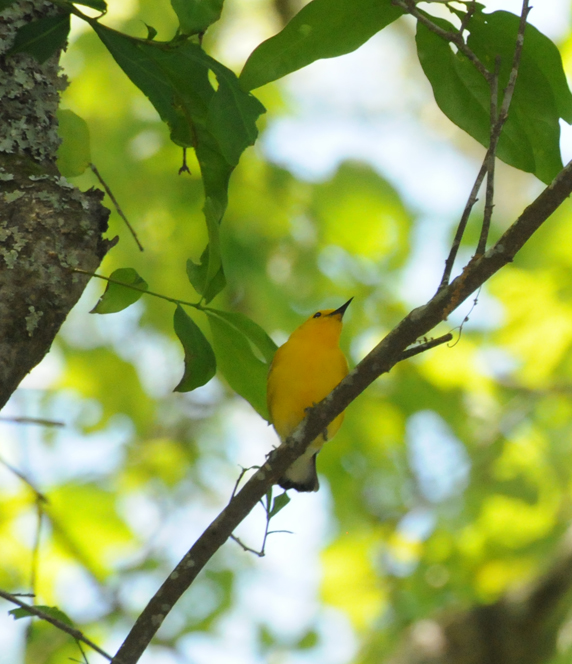
Male Prothonotary Warbler - Mark Musselman
Swamp (east end) - Mark Musselman
Swamp (west end) - Mark Musselman
 In addition to the Prothonotary Warblers, we saw and heard plenty of wildlife along the trail.  The swamp image above was taken at the west end of the trail just as a Wood Stork took flight from the shallow water.  That is another first species for the trail!

Great Egret - Mark Musselman
A Great Egret also stalked prey in the shallow water.  We saw small fish swimming and heard frogs chirp as our presence caused them to launch from the banks of the trail and into the water.

Northern Parula - Mark Musselman
There was a constant chorus of Northern Parula songs and one came close when we played the Prothonotary Warbler track.  Parulas will often nest in Spanish Moss that hangs from many a Lowcountry branch.

On the trail itself, we saw the following:

Little Wood Satyr - Mark Musselman
Question Mark Butterfly - Mark Musselman
Monarch on Red Buckeye - Mark Musselman
Southern Black Racer - Mark Musselman
Otter scat - Mark Musselman
The racer was peacefully basking in one of the few sunlight patches on the trail.  Although it is not venomous and most likely to flee than to fight, we tried to give the snake a wide berth in hopes of not disturbing its rest.  No such luck.  True to its name, the racer shot down the trail like greased lightning and disappeared.  A few steps farther along the trail we could not help but notice the freshly deposited and still pungent otter scat.  The otter marks its territory with its scat, which in this case appears to consist mainly of crayfish.  The Wood Stork and the White Ibis we saw are also hunters of crayfish.

Finally, we spotted Squaw-root making an appearance.  This flowering plant lacks chlorophyll.  How then does it nourish itself?  The flowers appear five years after the plant has attached itself to the roots of a host tree.  Squaw-root specializes in trees of the red oak family.  As a parasite, Squaw-root does not require chlorophyll as the oak tree does that work for both plants.

Squaw-root - Mark Musselman
Below is the complete list of bird species observed:


Friday, January 27, 2012

GIS at Ft. Dorchester High School

In 2011, Mark Musselman, education director at the Audubon Center at Francis Beidler Forest was awarded a $1000 grant by the South Carolina Geographic Alliance (SCGA).  The grant went toward the purchase of Global Positioning System (GPS) units that could be used to collect data for use in Geographic Information Systems (GIS).  Not only is that a mouthful of acronyms, it is incredibly powerful technology!

Just about everyone is familiar with GPS technology, but GPS latitude/longitude coordinates for where you are and where you wish to go have little meaning without all the GIS layers that get lumped under “GPS technology.”  The road map the shows on the navigator screen is a GIS data layer.  All the buildings shown on the map, including the critical brand name coffee shops along the way, are part of GIS data layers.  Picking a hotel that is within walking distance of your favorite coffee shop as well as a movie theater and a pizza parlor, is possible using data layers overlapping in a GIS database…and you thought you would never again use a Venn diagram.

On Tuesday, Mark Musselman took GIS data files for species and trails in the swamp and traveled to Dr. Michael Becwar’s environmentalstudies classes at Fort Dorchester High School.  In the computer lab, students began creating their own maps using the www.arcgis.com/home/ site.  With a satellite image as a base map, students could differentiate between the wetter and drier areas in the swamp based on the color of vegetative green.  The wetter areas are dominated by bald cypress and tupelo gum trees, which show as a lighter green in the image, while the slightly higher, drier areas support oaks and other trees showing as darker green on the image.  After loading the alligator sightings data layer, students discovered that alligators are not seen throughout the swamp, but found only in deep water areas where trees are not growing and sunlight can reach the Earth’s surface.  Based on that knowledge and without ever traveling to the Congaree National Park, students were able to predict where in the park’s boundaries alligators would likely be found.

Image by Mark Musselman
Later, students loaded snake data layers and discovered that brown water snakes remain toward the middle of the swamp while cottonmouths tend to be found closer to the edges of the swamp.  Referring to the free Beidler Forest app on an iPod Touch (initial units purchased with a previous SCGA grant), students learned that brown water snakes only eat fish, so they stay close to their prey in areas of deeper water.  Meanwhile, cottonmouths eat fish, frogs, snakes, birds, and rodents, so they exploit larger areas of the swamp even when those areas become dry.

Image by Mark Musselman
Finally, a quick glance at a map showing a variety of Prothonotary Warbler breeding territories was all that was necessary for students to see that all territories, and therefore all areas of the swamp, are not equal.  Territories around the nature center were shown to be exceeding large and isolated, while territories deep within the swamp at the eastern end of the boardwalk were small and densely packed.  Why?  A check of the iPod app showed that Prothonotary Warblers prefer to nest in cavities over or near water.  The western territories around the nature center consisted of dry, upland areas and therefore elicited little competition allowing for preposterous land claims.  On the other hand, territories at the eastern end of the boardwalk consisted of prime wetland habitat forcing males to settle for smaller (and quite sufficient) territories lest they exhaust themselves fruitlessly attempting to defend larger claims.


Students were able to make all of the swampy deductions noted above without leaving their school.  According to Dr. Joseph Kerski, Curriculum Development Manager for ESRI and recent president of the National Council forGeographic Education, “Accelerating globalization means that we can no longer be complacent about increasing the amount of spatial thinking in the educational curriculum at all levels.  We're also starting to realize that global issues, such as biodiversity loss, urban sprawl, energy needs, water quality and availability, natural hazards, and human health, are becoming increasingly complex and beginning to affect our everyday lives.  Moreover, they all have a spatial component.  To grapple with these issues for the 21st century requires a populace that's adept at using GIS and other geotechnologies.”  Students at Fort Dorchester High School have begun moving in that direction!

You can interact with the map and all the data layers at http://bit.ly/ycL36U.

Friday, December 02, 2011

Focus on Birds

Winter does not conjure within most people thoughts of birding.  However, the Audubon Center at Francis Beidler Forest will certainly be focusing on birds over the next few months.


First, from the Lowcountry Resource Conservation and Development (RC&D) Youth Grant Committee, we received $2000.00 to purchase 26 pairs of 8x40 binoculars. The binoculars will be used to launch a program to develop young birders.

Image by Mike Dawson

This birding program will enhance the boardwalk experience for students by allowing them to see and identify birds that would remain elusive to the naked eye. Albert Einstein said, "Joy in looking and comprehending is nature's most beautiful gift." We can provide the old-growth forest in which a density and variety of birds exists throughout the year. However, we cannot bring the birds close enough for young (or old) eyes to see sufficiently in order for the observer to appreciate a bird's beauty or the subtle field markings necessary for proper identification. Lightweight, yet powerful binoculars allow students to use their observation skills to obtain the information necessary to identify a bird using a field guide like the one loaded to all of our iPod Touches


With the ability to look using binoculars, students will have the tools necessary to move toward comprehension, which we believe leads to appreciation and a desire to conserve the resource for future generations.

Next, the Christmas Bird Count (CBC) is rapidly approaching.  We will be conducting the Four Holes Swamp CBC on December 19th.  To conduct a count, CBC volunteers follow specified routes through a designated 15-mile (24-km) diameter circle, counting every bird they see or hear all day. It’s not just a species tally—all birds are counted all day, giving an indication of the total number of birds in the circle that day.

From David Yarnold, Audubon president:
Both Audubon and the CBC trace their roots to the late 19th and early 20th centuries. The Audubon movement grew out of public outrage at the slaughter of wild birds, killed so that their feathers could be used to decorate the hats of fashionable women. This was the case with the magnificent Great Egret, hunted to near extinction in the early 1900s, and now the symbol of the National Audubon Society.

The Christmas Bird Count, proposed by one of Audubon’s founders, Frank Chapman, began in 1900 as an alternative to bird-hunting competitions. In these contests, called side-hunts, hunters would choose sides to see who could kill the most birds. Chapman challenged birders to count rather than kill birds. This “new kind of hunt” became the Christmas Bird Count.

Finally, it is not too early to begin thinking of the Great Backyard Bird Count (Feb. 17-20, 2012)!


The Great Backyard Bird Count is an annual four-day event that engages bird watchers of all ages in counting birds to create a real-time snapshot of where the birds are across the continent. Anyone can participate, from beginning bird watchers to experts. It takes as little as 15 minutes or longer, if one wishes, on a single day or on each day of the event. It’s free, fun, and easy—and it helps the birds.

Mark Musselman, education director at the Francis Beidler Forest, will be birding at various sites around Summerville on Day 1 (Friday, February 17th).  The count will begin at the parking area near the tennis courts in Azalea Park at 8:30 a.m.  Other stops will include Ashley Ridge High School, The Ponds and Middleton Place. Anyone can join this group for all or part of the day, especially those looking to learn about birding or improve their bird identification skills.  Anyone wishing to join this group or simply to follow the progress can check @TheSwampThing (http://twitter.com/#!/TheSwampThing) on Twitter.

Go forth and bird! 

Images (#2, #3) by Mark Musselman

Wednesday, November 02, 2011

Wildlife Along the Boardwalk

With few visitors enjoying the cool, sunny day in the swamp and with our necks getting stiff from sitting in front of computers at the Audubon Center at Francis Beidler Forest, we decided to take a stroll along the 1.75-mile boardwalk to count birds for our weekly entry on the eBird web site.  What birds we saw or heard are listed below.


Although the time of year and the breezy conditions were not conducive to great birdwatching, we were able to catch glimpses of some other swamp residents.  Near #136, we were observing three Turkey Vultures (Cathartes aura) soaring just above the treetops unable to find any rising warm air.  As we were about to continue our walk, we detected the subtle motion of a White-tailed Deer (Odocoileus virginianus) browsing quietly 20 meters north of the boardwalk.  The first section of the video below shows a portion of our time with the deer.

As soon as we reached Goodson Lake, we noticed the water rippling along the far bank.  A quick look through the binoculars revealed a Raccoon (Procyon lotor) using its extremely sensitive paws to probe for food in the shallow water.  As the small animal was too far away to effectively video with the iPod Touch in our pocket, we made a video through the binoculars.  The second section of the video below shows the foraging raccoon.

Finally, we used the iPod Touch/binocular combination to show the main threat to the raccoon in and around the holes (deep spots) like Goodson Lake...the American Alligator (Alligator mississippiensis)!  It may be cool enough now that the alligator will not eat again until spring, but is it worth the risk?


Video by Mark Musselman

Tuesday, September 20, 2011

Snake in a Tree

No, it's not the latest Hollywood movie title and snakes in trees are not unusual occurrences, but a Timber Rattlesnake (Crotalus horridus) in a tree was a surprise.

On Friday, the Audubon Center at Francis Beidler Forest hosted two students from Ashley Ridge High School's workplace shadow program. In the morning, we walked the 1.75-mile boardwalk through the old-growth, cypress-tupelo swamp and discuss the varied aspects of work at the center.  After lunch, since the young men came wearing snake boots, we walked out to see the beaver dam and generally explored the off-boardwalk areas. We headed back to the center along the south side of the boardwalk in order to explore the area where we had earlier seen two fawns.

As we were walking 25 feet from the boardwalk, one student said, "Snake."  We stopped. We had been watching the ground carefully, so we were somewhat surprised that we had missed it.  Camouflage is what makes some snakes difficult to see (bad news for prey), so missing a snake was not impossible.  We were still looking ahead when the student said, "No, back here."  We looked back where we had walked and saw nothing.  The student again gave direction, "No, up here."  The Timber Rattlesnake (1-1/2' to 2') in the images was above the ground between a vine and a sapling.  We only had the iPod Touch camera and the snake had moved elsewhere by the time we returned with a better camera.


We were also able to capture a brief video.


No matter how many times we walk out along the boardwalk, we invariably see something new or something old doing something new or in a different place.  Never a dull moment!

Images and video by Mark Musselman

Friday, September 09, 2011

Geographic Technology & SC Teachers

Tomorrow, the education department at the Audubon Center at Francis Beidler Forest will be making a "Geographic Technology:  GPS, GIS, & iPod Touch" presentation at the South Carolina Geographic Alliance's Geofest 42.  Teachers will be introduced to the technologies, including learning how to navigate with a GPS unit, learning how to create basic maps using free online software, and how to integrate iPod Touch devices into educational programs.


View Larger Map
A demonstration map for Geofest 42


View Larger Map
The watershed basins of South Carolina using data downloaded from the USC Geography Department GIS webpage.

Beyond our free boardwalk-specific app, we are using our 20 iPod Touches in a variety of ways.  We can tailor the use of the iPod Touch to any topic you wish to cover during a visit to the old-growth swamp!

Maps by Mark Musselman

Tuesday, July 12, 2011

Education Department Honored

The education department at the Francis Beidler Forest has garnered the attention of the Roger Tory Peterson Institute of Natural History for its iPod Touch program.  The program had its start with a Teacher Consultant grant from the South Carolina Geographic Alliance.


Sunday, March 27, 2011

Prothonotary Warblers Are Back!

The Prothonotary Warblers (Protonotaria citrea) have returned to the Audubon Center at Francis Beidler Forest for the 2011 breeding season!  Yesterday, Sally and Tracy Barnes spotted and photographed the first Prothonotary Warbler, which was an unbanded male.  He may or may not be a resident for the summer, but he signals the beginning of the Project PROTHO season.

However, the first Prothonotary Warbler spotted by the staff of Audubon South Carolina was an unbanded male quietly foraging in the beaver-dammed area at the east end of Old Levi Mill Lake at Poinsett State Park.  The best camera available was an iPod Touch, but the male Prothonotary Warbler can be seen in the zoom view.


If you would like a much better look at a Prothonotary Warbler, give the birds a week to settle into their territories and then take a stroll along the 1.75-mile, elevated boardwalk the old-growth swamp at the Francis Beidler Forest!

Images by Mark Musselman

Saturday, March 05, 2011

School visits to Francis Beidler Forest and wildlife sightings

As a computer virus continues to hold the education department computer hostage, posting to the blog has been difficult for the last two weeks.  Therefore, this posting will contain vignettes from that period.

The Great Backyard Bird Count (GBBC) was held Feb. 18-21.  Details of the count can be found on the GBBC webpage as well as results from previous years via tables and maps.  On Feb. 18th, we spent the day counting birds in Summerville.  Our day began at Azalea Park from 8:30 am to 9:15 am.  We walked clockwise around the perimeter of the park on both sides of Main Street.  We saw the typical collection of backyard birds.

At 9:30 am we arrived at the Ashley Ridge High School and met Ms. Amy Litz's AP biology class of 24 students.  After a brief explanation of the GBBC, some basic bird identification techniques, basic binocular usage, and the various bird-related apps on the iPod Touches, we walked around the perimeter of the campus.  In the open and seemingly-inhospitable parking area, we spotted Killdeer.  Around the retention pond and the wetland forest beyond, we saw or heard a variety of backyard birds, including Northern Cardinal, Red-bellied Woodpecker, Carolina Wren and Blue Jay.  Overhead, a half a dozen or more Turkey Vultures and Black Vultures slowing rose on the rising warm air "thermals" patiently waiting for something to die.  During the second group, Ms. Minde Wheeler's environmental science class, we spotted a Loggerhead Shrike, which impales insects and small mammals on thorns or barbed wire as gifts to impress a female.  Suddenly, birds became more interesting to some in the group.

By 12:30 pm, we were by the old Murray Sand pits off of US Hwy 17-A.  We saw Canada Geese, Double-crested Cormorants, an American Kestrel and a Bald Eagle screaming by thousands of feet overhead.  After lunch, we headed to Middleton Place and its mix of forest, garden, freshwater, and salt marsh.  Some of the birds that we saw were the only ones of those species reported in the "Charleston" (any associated zip codes) location.

These were all in the old rice field:
Blue-winged Teal         5        1     
Green-winged Teal       9        1     
Ring-necked Duck       1        1  

This was in a garden pond:
Mute Swan        1        1   

On Saturday, Feb. 19th, we hosted two walks around the boardwalk at the Audubon Center at Francis Beidler Forest.  Although the day did not prove fruitful in the swamp (many species that we normally see and hear went undetected), we did spot 20 Sandhill Cranes in a field of Henbit just down the road from the sanctuary.


Last weekend was warm, which lured many reptiles out of their winter shelters.  Visitors coming off the boardwalk reported seeing the alligator swimming in Goodson Lake, several species of turtles (Eastern Mud, Spotted, Common Snapping, and Yellow-bellied Slider), numerous lizards (skinks and anoles) and four of the five species of snakes (Eastern Cottonmouth, Brown Water Snake, Banded Water Snake, and Greenish Rat Snake) that one would expect to see in the swamp.  The least numerous of the snake species, the Red-bellied Water Snake, is the only species yet to be seen this year.  Most of the snakes are not moving around, but remain just outside their wintering den as nights can still be cold and all the cool days have yet to pass.

Tuesday was the first day of work for our new seasonal naturalist, Sarah Todd.  We'll introduce her in the coming week.  Much of this week was spent getting Sarah ready to lead groups around the boardwalk and along the canoe trail.  Both along the boardwalk and the canoe trail, Yellow-throated Warblers are singing.  With the leaves still off the trees and other birds not back from migration, it is possible to get good shots of these birds, especially as they sometimes move well down from the tops of the trees.  Warmer days have the alligators more active and visible.  Sarah stated, "How dramatic." as a 8-foot alligator launched off the bank at our passing and rocked our canoe with the water it disturbed.  Blue-gray Gnatcatchers are also singing while Atamasco Lilies, though not in bloom, are showing themselves above the ground.  Finally, Barred Owls are active as the female is either sitting on eggs and requiring her mate to feed her or chicks have already hatched.  Along with visitors, we have had excellent photographic opportunities of owls catching and eating crayfish along the boardwalk between #12 and #15.

Yesterday's canoe trip yielded only one snake and alligator sighting, but several fine looks at birds of prey.  At two locations, Barred Owls flew silently overhead and perched in nearby trees.  Our passing may have disturbed their crayfish hunting.  Without leaves on the trees, we had a clear look at a Red-shouldered Hawk as it wheeled overhead possibly calling to its mate.  Finally, as we entered Singletary Lake, we flushed what appeared to be a Cooper's Hawk from the lake's edge.  The bird had difficulty taking off, so we investigated the site.  We found a prodigious pile of feathers and the cranium and upper bill of what may be a female Wood Duck.  A solitary male Wood Duck flew from the lake as we entered.  As they are often seen in pairs, his mate may have been lunch for the hawk.  No other parts of the body were left, so it seems the hawk was able to depart with its meal.

Today, we posted a pre-visit video for teachers to use to introduce students to the old-growth, cypress-tupelo swamp.  Currently, the video is located on YouTube, but will be posted soon to the educators page on the Francis Beidler Forest webpage.  If you know a teacher, please let them know what and where we are, so that we can share the old-growth forest with their students!


Image and video by Mark Musselman

Friday, October 01, 2010

Students Study Beaver Engineers

Today, 4th grade students from Harleyville-Ridgeville Elementary School visited the Audubon Center at the Francis Beidler Forest.

As noted previously in this blog, beavers (Castor canadensishave constructed a dam in the swamp. Unfortunately, the dam cannot be seen from the boardwalk and it is not feasible to take 70 students off the boardwalk along the rain-soaked swamp edge to see it.  However, the recent rains have created drainage channels along the low, educational boardwalk next to the nature center.  Using the natural terrain and drainage pattern along the low boardwalk, students were given the opportunity to direct their guide in constructing dams of sticks and leaves.  Two sites, one with a single channel and one with a broad flood plain, were used to demonstrate how a beaver dam can change the habitat.

The South Carolina science standard addressed was:
4-2.6            Explain how organisms cause changes in their environment.

Once at the first site, students were asked to discuss the following within their small groups:

  1. What do beavers eat? (plant material, especially cambium)
  2. What do beavers build? (dams, lodges)
  3. How do beavers build their structures? (using logs, branches, mud, leaves)
  4. Where do beavers build their structures? (dams in channels of flowing water, lodges in pooled water)
Once students shared their answers, each group had the opportunity to suggest where a beaver might construct a dam at the site.  Though most would have preferred to jump off the boardwalk and into the water and mud, we were certain that those responsible for the laundry would want to have a word or two with us.  Therefore, we opted for the next best thing.  With great excitement, students/beaver engineers directed their guide on how and where to construct the dams using nearby sticks and leaves. Who knew there were so many expert dam makers in our community?

After observing the results, the group moved to the second site and repeat dam construction procedures.  The second site was a better representation of what the beavers have accomplished in the swamp.  There was not one obvious channel to block and natural features (trees, logs, and high ground) were incorporated into the dam's construction.  After observing the results of the second dam, students discussed the following questions within their small groups:

  1. How did the dams immediately affect the habitat upstream from the dam? (water pooled; deeper, more-consistent levels of water behind the dam; some plants may be in the water more often than before)
  2. What species might benefit from the change in habitat? (trees or aquatic plants that need or can tolerate constant flooding; fish; frogs; water snakes; wading birds that eat those species; dabbling ducks and geese; bitterns that like thicker, marsh-like habitat)
  3. How do dams immediately affect the habitat downstream from the dam? (less water, other plant species may be able to grow in the drier conditions)
  4. Over time, how will the habitat behind the dam change? (sedimentation will fill the pool and create higher ground and meadow-like conditions and eventually habitat as seen along the swamp’s edge; or the habitat may attract the attention of an alligator, which may eat the beavers allowing the dams to fall into disrepair and the swamp to reclaim the area)
Since the actual beaver dam would remain out-of-sight, students used the iPod Touches to view the beaver dam video and peruse the beaver-related images.  Students could also look in the other image folders for species that they previously identified as having benefited from the beavers’ damming activity.

By the end of the activity and boardwalk tour, the students were expert dam engineers and had no problems writing a letter to the editor for or against the presence of beavers and their construction work in the swamp.

Friday, September 17, 2010

iPod Touch Grant Presentation

As the education director at the Audubon Center at Francis Beidler Forest and a teacher consultant (TC) for the South Carolina Geographic Alliance (SCGA), Mark Musselman was awarded a $1000 SCGA teacher grant in 2009.

One requirement of the grant is a presentation to teachers at the Fall 2010 Geofest.  The iPod Touch allows us to put an incredible amount of data into the hands of students while they are on the boardwalk and in the middle of the old-growth, cypress-tupelo swamp.  For example, students can call up the satellite image shown below and see the boardwalk drawn onto the swamp.  If we are standing on the backside of the boardwalk south of the fork, we can ask the students, "Why does the image look lighter to the west of the boardwalk than it does to the east of the boardwalk?"  From the boardwalk, a quick glance to the west reveals that the elevation of the land is slightly higher causing the area to be dry, which in turn allows different types of vegetation to grow in that area.  Looking to the east, students can see land at a slightly lower elevation, which allows water to accumulate thereby allowing wetland-adapted species of plants to dominate.  Seems like a simple concept, but it would be difficult for most students to visualize, if they had the same satellite image, but were sitting at their desk in a classroom.


The iPod Touch can also hold gigabytes worth of data in the form of images, video, audio, field guides, research projects, student-generated text or audio, a seemingly-infinite number of apps, and our own boardwalk-specific app.  With these tools, especially our boardwalk-specific app, we provide students the ability to answer our questions as well as those that they develop.


Although the Francis Beidler Forest is unique and we find it to be a wonderful place to work, there would be little incentive for students to visit if they already knew all the answers regarding the swamp and the rest of our natural environments.  However, without the ability for students to find the answers on their own, the only other form of instructional delivery is for the guide to verbally present all the information.  Not all students learn well that way and even those that do will appreciate some instructional variety.


We currently have 10 iPod Touches available for use with visiting school groups and are working towards a set of 25 (2 students per unit).  Check our education department calendar to see what dates are available for your students to visit!

Images by Mark Musselman

Wednesday, July 21, 2010

Summer Camp Session #3

Summer camp session #3 is underway at the Audubon Center at Francis Beidler Forest.  The heat and humidity are slowing down everything, including the reptiles and amphibians, but we did manage to collect a few specimens for the campers to identify.


Spotted Turtle


Green Treefrog


Three-lined Salamander


Carolina Anole


Musk Turtle


iPod Touch with Audubon field guides


Eastern Mud Turtle


Tomorrow, we will check the baited minnow traps.  Hopefully, the sardines have attracted something other than crayfish and diving beetles.  During session #1, we caught a Lesser Siren and hopes are high that a Greater Siren is out there or even a snake not yet seen by the campers.


Maybe the incoming storm front will cool down things in the swamp, bump up the water level and get some creatures moving about!

Images by Mark Musselman

Tuesday, June 15, 2010

Summer Camp - Session 1

The first session of summer camp at the Audubon Center at Francis Beidler Forest is in the books!  Reptiles, amphibians and campers kept us busy last week, so we failed to make an entry on this blog.  However, we'll make a week's-worth of entries today!

The week-long camp began (schedule here) with an overview of the continuing Project PROTHO.  We discussed the purpose of the project, the banding and identification process, and this year's nest box component.  Since the camp's theme is herps, we noted that Greenish Rat Snakes (Elaphe obsoleta x quadrivittata) take their share of Prothonotary Warbler eggs and chicks, but enough nesting attempts are successful.  Although the old-growth swamp offers plenty of natural cavities in which the Prothonotary Warblers (Protonotaria citrea) can nest, one pair used a student-made nest box behind the sign at #17 along the boardwalk.  Denise Ecker banded two of the four chicks as their legs were adult size, but they were not yet capable of leaving the nest.


After lunch on the first day, Dennis Blejski brought a collection of herps from his collection.  Pictured are a Milk Snake, non-native Cane Toad, Siren, Diamondback Terrapin, and American Alligator.  Dennis also had a Rough-green Snake, Copperhead, Timber Rattlesnake, Scarlet Kingsnake, Corn Snake, Hognose Snake, Yellow-bellied Slider, Spotted Turtle, Fence Lizard, Bullfrog, and Southern Toads.  Dennis had no problems keeping the attention of the campers!


On Day 2, with low water levels due to a lack of rain, we had difficulty finding reptiles and amphibians during our walk along the 1.75-mile boardwalk.  However, as we walked back toward the nature center along the edge of the swamp, one sharp-eyed camper spotted a Southern Copperhead (Agkistrodon contortrix contortrix) sunning on a log ten feet off the boardwalk.  For those animals that we did not see, campers could use the iPod Touches and the boardwalk app to see the images.


After the boardwalk tour and lunch, campers had the opportunity to inspect and identify a variety of amphibians and reptiles that we had previously captured.  The species included Southern Toad, Southern Cricket Frog, Squirrel Treefrog, Spotted Turtle, Musk Turtle, Yellow-bellied Slider, Narrowmouth Toad, Southern Dusky Salamander, Three-lined Salamander, Bullfrog tadpole, and some unidentified frog eggs and tadpoles.  Campers rotated through the eleven stations and used a variety of resources (field guides, keys, iPod Touch apps) to identify the animals.


Wednesday, we were off the boardwalk to check the 14 coverboards that were placed at the swamp's edge and in higher, drier sites.  Amphibians and reptiles will seek shelter under boards, but we found nothing beyond a few beetles and spiders.  However, campers were able to see the beaver dam and the quantity of water pooled behind the dam, which has created a habitat suitable to amphibians and reptiles and those animals that may eat them.


The afternoon was spent learning various frog and toad calls loaded to the iPod Touches with a team frog/toad call competition to end the day.


While inspecting the minnow traps on Thursday morning, we discovered that we had captured an Eastern Lesser Siren (Siren intermedia intermedia).  The siren is an amphibian that preys on a variety of aquatic animals and spends nearly its entire life in the water.  Sirens lack rear legs and have relatively-weak front legs, so travel over land is nearly impossible.  If a body of water begins to dry, sirens can bury themselves in the mud in a protective slimy "cocoon" and aestivate for up to a year or until the water returns.


A game of Jeopardy on Thursday afternoon helped campers demonstrate what they had learned during the week.  The game is played just like the famous television gameshow with one camper from each of the three teams trying to buzz in when they know the answer.  Age was not a disadvantage for campers as it appeared that younger campers paid better attention during the week and cleaned up with the 1000-point answers!


Throughout the week, campers created a variety of art/craft items, including pot frogs, minnow traps, and garden stepping stones. 


Camp ended on Friday with a herpathon along the boardwalk, lunch with families, and the presentation of diplomas and a CD of the week's images and sounds.

The next session begins on Monday and the third session will be the third week of July.  We're looking forward to all the new faces in the swamp!
Images by Mark Musselman