Friday, May 21, 2010

Wannamaker Nature Preserve

Today at the Wannamaker Nature Preserve, Audubon South Carolina hosted 4th graders from Guinyard Elementary School in St. Matthews, SC.  In the past, the lack of restroom facilities have limited access to the nature preserve, but the site now has a restroom, shelter, bus parking, and miles of trails.


The first activity was the mammal track activity.  Students moved between the eleven stations and used the track key to determine the identity of the animal track in the clay.  The rubber scat at some stations was an extra clue.  The size of the scat for the feral hog and the black bear were big hits with the boys.

After the track activity, the six Ss of birding were discussed.  The six Ss are size, shape (body, head, wing, leg, and tail), shade (color and markings), surroundings, style (behaviors and how they are performed), and sound.  The heat of the day kept the birds to a minimum, but students did identify by sound a Blue Jay, Mourning Dove, American Crow, Northern Cardinal and Carolina Wren.  A Turkey Vulture was spotted soaring overhead and a variety of food items (berries, seeds, insects, and spiders) were identified in the habitat.  Several students asked if any birds eat the ubiquitous ticks!

Images by Mark Musselman

Wednesday, May 19, 2010

SC LIFE Beginner Bird Course

The education staff at the Audubon Center at Francis Beidler Forest continues to learn in order to better serve our audiences!  On Monday, we completed the SC LIFE course Introductory Birding for Teachers.

On of the requirements was the birdwatching.  Tough stuff!  We documented some of what we saw in the following video:


Another requirement was participation in citizen science.  Again, tough stuff!  Project PROTHO was a given, but we also participated in the Great Backyard Bird Count and the Deveaux Bank nest counting highlighted in yesterday's blog entry.  We documented our citizen science in the following video:


Images and videos by Mark Musselman

Tuesday, May 18, 2010

Deveaux Bank and Birds

Some poor soul had to back out of nest counting at the Deveaux Bank Seabird Sanctuary with SC DNR.  We were asked if we wanted to take their place.  It was not likely a serious question.  The old-growth swamp at the Audubon Center at Francis Beidler Forest is awesome, but so is a chance to visited a closed seabird rookery and participate in some citizen science!

From the SC DNR webpage:
Deveaux Bank Seabird Sanctuary was established to protect significant nesting habitat of sea and shorebirds. Deveaux Bank Seabird Sanctuary encompasses approximately 215 acres at the mouth of the North Edisto River in Charleston County. The size of this sanctuary varies and may sometimes disappear entirely. Deveaux Bank is an estuarine island that was first documented in 1921. It has been documented as a seabird rookery since the 1930s. Nesting was temporarily halted during World War II due to the island's use as a bombing range. The island is part of a dynamic system; it completely subsided in 1980 due to erosion from Hurricane David. It has slowly reemerged and seabirds began nesting on the island again in 1983.

The Seabird Sanctuaries are sandspit islands formed by deposits from their associated river systems. The islands are dynamic and shift in position and structure due to erosion and deposition of sand.

Deveaux Bank supports colonies of nesting waterbirds because of its isolated nature and lack of mammalian predators. Although all species may not nest on the island each year, examples of species that have used the island include: brown pelican, least tern, royal tern, black skimmer, gull-billed tern, sandwich tern, common tern, laughing gull, Wilson's plover, American oystercatcher, willet, great egret, snowy egret, tricolored heron and ibis. Besides providing nesting habitat, the sanctuary provides winter loafing and feeding areas for numerous species, including the federally-threatened piping plover.

The colonial nesting behavior of these birds makes them very susceptible to disturbance. Birds are densely packed into breeding sites during the nesting season, rendering the entire colony susceptible to disruption or destruction. Therefore, the sanctuary is open only below the high tide line except in the designated recreation area. Dogs are prohibited year round.


We arrived by boat from the Rockville boat landing and walked to the ocean side of the bank.  We then moved in a line through the Brown Pelican nesting site counting all of the nests to our right as far as the next person in the line.  Not only did we need to pay close attention to the the nests in our zone, but we needed to watch for smaller ground nest like those of the Laughing Gull.


Although not eager to do so, the pelicans flushed from their nests before we walked carefully through the site.  Not waiting for the large birds to depart, one runs the risk of getting hit by the bird as it struggles for lift and altitude, having the birds panic and injure chicks or damage eggs, and/or being immediately down range of jettisoned waste.


Sometimes, pelicans disgorged their load of fish before flying off.  Laughing Gulls quickly moved in for the free meal.


The rookery is a noisy and dangerous place.  Eggs or chicks left unattended are easy targets for the abundant Laughing Gulls.  Therefore, even if a dog or curious human doesn't step on any eggs or capture any birds, the disturbance in the rookery causes eggs and chicks to be exposed to predators and the elements.  The Snowy Egret chicks shown below have grown to a sufficient size that they are not likely to be attacked by gulls.


Images by Mark Musselman

Friday, May 14, 2010

Summer Camp - Herps!

Summer camp at the Audubon Center at Francis Beidler Forest is rapidly approaching!  This year's theme is HERPS, which includes reptiles and amphibians.  The three one-week (9am-2pm) sessions are filling quickly, so call (843-462-2150) now to reserve a spot for your child.  The cost is $85 and the enrollment form can be found here.

The tentative camp schedule can be viewed here.
June 7-11
June 21-25
July 19-23

Even if you will not be sending a child to camp, you can help by donating some of your trash.  Campers will each need two 2-Liter, green soda bottles and not everyone will arrive at camp with those items.  We also need old or damaged pieces of plywood.  We won't simply talk about reptiles and amphibians, we will be looking for them from the boardwalk and we will be looking for them under plywood cover boards.

As the name implies, small reptiles and amphibians will seek cover under a piece of plywood set out in the forest and along the edge of the swamp.  Cover boards will be placed in low, wet areas and higher, dry areas near the edge of the swamp and farther up in the pine/mixed-hardwood forest.  Although adults will be checking under the boards and collecting any specimens, the campers will be able to get up close looks at the various species once the reptiles or amphibians are placed in an observation container.  Campers will keep track of what we find and where we find the herps, so that they can compare and contrast the number of individuals and species found at the various sites.


If you can help us by providing green, 2-Liter soda bottles or scraps of plywood, please give us a call!

Images by Mark Musselman

Thursday, May 13, 2010

One Hour on the Boardwalk

Part of what makes the Audubon Center at Francis Beidler Forest a wonderful place to work is the fact that no two days are alike.  Even though we've walk the 1.75-mile boardwalk through the old-growth, cypress-tupelo swamp at least one thousand times, we always see something new or something in a new place or something behaving in a new manner.  It is never a question of "if" something will be different, it is always a question of "what" will be different.  Yesterday was no exception.

We went out to check the Prothonotary Warbler (Protonotaria citrea) nest in the creek channel next to the Meeting Tree.  The eggs were on schedule to hatch and we wanted to verify the event for our records.  Unfortunately, when Denise checked the cypress knee nest site, she found it had been tossed by an intruder and all eggs (or possibly chicks) were gone.  What would the soap opera in the swamp be if not for some death or tragedy?

As this was Denise's only mission this time on the boardwalk, she headed back to the nature center to annotate the loss on the nest card.  A Yellow-billed Cuckoo (Coccyzus americanus) called out midway up the canopy.  We do not have any good Yellow-billed Cuckoo images, since they are an elusive bird, so we opted to remain on the boardwalk in hopes of capturing one good image.  It turned out that there was a pair of cuckoos and they offered plenty of clear shots.  However, they offered those clear views for but microseconds.  In the end, we did get a shot or two to go with the crick in our neck.


We also capturing images of the "Pizza!"-calling Acadian Flycatcher (Empidonax virescens).  The Yellow-crowned Night Heron (Nyctanassa violacea) and the Barred Owl (Strix varia) hunting crayfish in the water behind the beaver dam were too deep into the swamp from the boardwalk to take any quality images.

While scanning for another cuckoo shot, a olive-green-and-yellow blur zipped by at eye level.  One more step forward and we may well have caught a female Prothonotary Warbler in the left ear!  She landed on the remnants of a small tree's trunk that has nearly rotted through at the base.  The overpowering pink bands on her legs identified her as A022, the recent victim from the Meeting Tree nest.  She was already building a nest in the new site!  Apparently, she high-stepped through the stages of grief.


On the way out to the original nest, we stopped to take a picture of a Gray Squirrel (Sciurus carolinensis) that was not concerned with our proximity to its dining area.  Obviously, we need to work on our intimidating predator image.  Only the youngest of kids visiting the swamp get excited about seeing squirrels, but we could not pass on a clear image for our stock photo files.  Looking more closely today, we noticed that the squirrel had company...on its head!

All of this took place during one hour on the boardwalk.  Imagine what we could see if they let us out of the office ALL day!

Images by Mark Musselman

Tuesday, May 11, 2010

On the Way to Work

On the way to work at the Audubon Center at Francis Beidler Forest, we drive along the lightly-traveled Mims Road between Beidler Forest Road and our driveway.  There are a few houses along the road, but it is mostly forest and fields on either side of the pavement.  Therefore, we are afforded daily looks at birds not found in the swamp.

On Friday, we caught a patch of bright blue in the grass off the left side of the road.  We stopped and backed up for a closer look, which is usually when the bird of interest departs.  However, on this day the Blue Grosbeak (Guiraca caerulea) remained perched on a stem of grass contently eating the seeds.  Although widespread across their range (southern half of the lower 48 states and up the Mississippi River valley), very little is known about this species' biology.  Contrary to what the images show, Blue Grosbeaks eat mostly insects (grasshoppers and crickets).  They also appear to be frequent cowbird hosts.


On the way to work Sunday morning, we spotted a pair of Wild Turkeys (Meleagris gallopavo) in the same field.  The male appeared to be doing his best to impress the hen, but she appeared to be more interested in finding things to eat, which would mainly be vegetable matter with some small amounts of animal matter (invertebrates and cold-blooded vertebrates).  At one point, the tom can be seen watching the disinterested female walk away.  Maybe, she's read the books and realizes that it is beyond the typical breeding season.


Images by Mark Musselman

Saturday, May 08, 2010

Boardwalk App v1.1

Version 1.1 of the Francis Beidler Forest boardwalk-specific app is now available for free at iTunes.  A tab bar has been added to make navigation easier between the information, guidebook, and species menus.

The homepage contains links to information related to the Audubon Center at Francis Beidler Forest.


The guidebook menu contains links to all the information in our printed guidebook plus additional images and information for the areas between the marked guidebook stops.


The species menu contains links to images and information for the species that one is likely to see from the boardwalk.


We are building a set of iPod Touches for use by school groups when they visit the swamp.  Currently, we have 8 units with each unit containing the boardwalk app and the Audubon bird guide app.  We need to 25 devices in order to host school groups of up to 100 students (4 students per device).

If you are interested in supporting this program, a $250 donation will allow us to purchase one complete set (8MB iPod Touch, sturdy/water-resistant carrier, and microphone).

Wednesday, May 05, 2010

Bowfin Problem Solver

After all the rain in December and January, we did not think we would be discussing low water levels at the Audubon Center at Francis Beidler Forest by the end of April.  Canoe trips are no longer feasible and the swamp looks less and less swamp-like as the water level continues to drop.  The light rain we received yesterday did little to change that situation.  However, the shallow water is a boon for some predators.

The the water level in the swamp drops, some of the shallow channels get cut off from the deeper channels.  Without water flowing in to replenish water lost to evaporation or transporation, the cut off channels become smaller and smaller pools of water.  Any fish or crayfish caught in those shallow pools become easy prey for owls, raccoons, herons, ibis, egrets, otters, snakes, and other fish.  Other fish?

While on the boardwalk observing Prothonotary Warblers (Protonotaria citrea) for Project PROTHO, we saw a Bowfin (Amia calva) moving up a shallow channel.  A third of the fish's body was out of the water when it met an obstacle to its upstream movement.  A log across the channel caused the fish to stop and probe the length of the log in search of upstream access.  We're not sure what the large fish was seeking in the increasingly shallow water, but we have observed Bowfin eating crayfish and there are plenty of crayfish in the diminishing water.  After finding no path through the water, the Bowfin leapt over the log and continued on its way.  The video below consists of a series of still images showing the event.


Images and video by Mark Musselman

Monday, May 03, 2010

Lake Conestee

On Saturday, we attended a SCLIFE ornithology field trip at the Lake Conestee Nature Park outside of Greenville, SC.

From the Lake Conestee Nature Park webpage:  Lake Conestee Nature Park consists of approximately 400 acres of beautiful natural habitat on the Reedy River just 6 miles south of downtown Greenville, South Carolina. The park contains both hardwood and evergreen forest, extensive wetlands, 3 miles of the Reedy River, and a rich diversity of wildlife habitat. Deer, raccoon, beaver, fox, river otter, and various small mammals inhabit the park, along with numerous species of reptiles and amphibians. Over 160 bird species have been reported by the Greenville County Bird Club. The park has been designated as an Important Bird Area by the National Audubon Society.

A detailed history of the site can be found here.  Lake Conestee was a Superfund site and monitoring of the environment continues.  "It has been determined that because the majority of the former lakebed has naturally filled in and the historical sediments have become capped with a bottomland forest, there are no significant human health risks associated with use of the woodland areas for passive recreation (i.e. hiking trails)."  However, fishing is not allowed as the fish are considered contaiminated.  The quality of the Reedy River still has plenty of room to improve.

Information regarding the birding at Lake Conestee Nature Park can be found here.  We had an excellent morning of birding with more than 50 species identified.  Below are some images from our outing.  Due to the threat of rain, we did not have the camera the entire time and missed the opportunity to take some fine Veery images.  The normally secretive bird put on quite show for the group.

Beavers have created extensive dams and a lodge in the lake.  We even saw a beaver (second image).


Blue-winged Teals
Eastern Bluebird
Wetland at lake's edge
Downy Woodpecker
Canada Goose
Gray-cheeked Thrush
Great Blue Heron
Mallard Ducks
Great Blue Heron nest
Eastern Phoebe with insect
American Redstart
Solitary Sandpiper
Cedar Waxwing
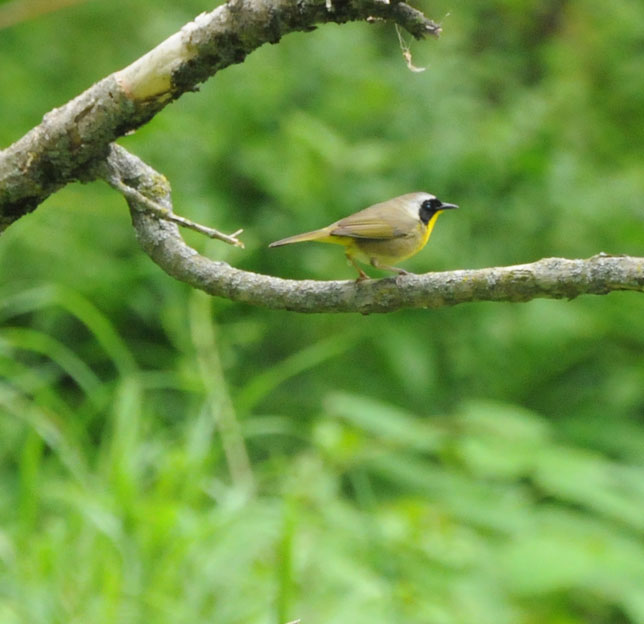
Common Yellowthroat

Images by Mark Musselman