Summer camp at the Audubon Center at Francis Beidler Forest is rapidly approaching! This year's theme is HERPS, which includes reptiles and amphibians. The three one-week (9am-2pm) sessions are filling quickly, so call (843-462-2150) now to reserve a spot for your child. The cost is $85 and the enrollment form can be found here.
The tentative camp schedule can be viewed here.
June 7-11
June 21-25
July 19-23
Even if you will not be sending a child to camp, you can help by donating some of your trash. Campers will each need two 2-Liter, green soda bottles and not everyone will arrive at camp with those items. We also need old or damaged pieces of plywood. We won't simply talk about reptiles and amphibians, we will be looking for them from the boardwalk and we will be looking for them under plywood cover boards.
As the name implies, small reptiles and amphibians will seek cover under a piece of plywood set out in the forest and along the edge of the swamp. Cover boards will be placed in low, wet areas and higher, dry areas near the edge of the swamp and farther up in the pine/mixed-hardwood forest. Although adults will be checking under the boards and collecting any specimens, the campers will be able to get up close looks at the various species once the reptiles or amphibians are placed in an observation container. Campers will keep track of what we find and where we find the herps, so that they can compare and contrast the number of individuals and species found at the various sites.
If you can help us by providing green, 2-Liter soda bottles or scraps of plywood, please give us a call!
Images by Mark Musselman
Friday, May 14, 2010
Thursday, May 13, 2010
One Hour on the Boardwalk
Part of what makes the Audubon Center at Francis Beidler Forest a wonderful place to work is the fact that no two days are alike. Even though we've walk the 1.75-mile boardwalk through the old-growth, cypress-tupelo swamp at least one thousand times, we always see something new or something in a new place or something behaving in a new manner. It is never a question of "if" something will be different, it is always a question of "what" will be different. Yesterday was no exception.
We went out to check the Prothonotary Warbler (Protonotaria citrea) nest in the creek channel next to the Meeting Tree. The eggs were on schedule to hatch and we wanted to verify the event for our records. Unfortunately, when Denise checked the cypress knee nest site, she found it had been tossed by an intruder and all eggs (or possibly chicks) were gone. What would the soap opera in the swamp be if not for some death or tragedy?
As this was Denise's only mission this time on the boardwalk, she headed back to the nature center to annotate the loss on the nest card. A Yellow-billed Cuckoo (Coccyzus americanus) called out midway up the canopy. We do not have any good Yellow-billed Cuckoo images, since they are an elusive bird, so we opted to remain on the boardwalk in hopes of capturing one good image. It turned out that there was a pair of cuckoos and they offered plenty of clear shots. However, they offered those clear views for but microseconds. In the end, we did get a shot or two to go with the crick in our neck.
We also capturing images of the "Pizza!"-calling Acadian Flycatcher (Empidonax virescens). The Yellow-crowned Night Heron (Nyctanassa violacea) and the Barred Owl (Strix varia) hunting crayfish in the water behind the beaver dam were too deep into the swamp from the boardwalk to take any quality images.
While scanning for another cuckoo shot, a olive-green-and-yellow blur zipped by at eye level. One more step forward and we may well have caught a female Prothonotary Warbler in the left ear! She landed on the remnants of a small tree's trunk that has nearly rotted through at the base. The overpowering pink bands on her legs identified her as A022, the recent victim from the Meeting Tree nest. She was already building a nest in the new site! Apparently, she high-stepped through the stages of grief.
On the way out to the original nest, we stopped to take a picture of a Gray Squirrel (Sciurus carolinensis) that was not concerned with our proximity to its dining area. Obviously, we need to work on our intimidating predator image. Only the youngest of kids visiting the swamp get excited about seeing squirrels, but we could not pass on a clear image for our stock photo files. Looking more closely today, we noticed that the squirrel had company...on its head!
All of this took place during one hour on the boardwalk. Imagine what we could see if they let us out of the office ALL day!
Images by Mark Musselman
We went out to check the Prothonotary Warbler (Protonotaria citrea) nest in the creek channel next to the Meeting Tree. The eggs were on schedule to hatch and we wanted to verify the event for our records. Unfortunately, when Denise checked the cypress knee nest site, she found it had been tossed by an intruder and all eggs (or possibly chicks) were gone. What would the soap opera in the swamp be if not for some death or tragedy?
As this was Denise's only mission this time on the boardwalk, she headed back to the nature center to annotate the loss on the nest card. A Yellow-billed Cuckoo (Coccyzus americanus) called out midway up the canopy. We do not have any good Yellow-billed Cuckoo images, since they are an elusive bird, so we opted to remain on the boardwalk in hopes of capturing one good image. It turned out that there was a pair of cuckoos and they offered plenty of clear shots. However, they offered those clear views for but microseconds. In the end, we did get a shot or two to go with the crick in our neck.
We also capturing images of the "Pizza!"-calling Acadian Flycatcher (Empidonax virescens). The Yellow-crowned Night Heron (Nyctanassa violacea) and the Barred Owl (Strix varia) hunting crayfish in the water behind the beaver dam were too deep into the swamp from the boardwalk to take any quality images.
While scanning for another cuckoo shot, a olive-green-and-yellow blur zipped by at eye level. One more step forward and we may well have caught a female Prothonotary Warbler in the left ear! She landed on the remnants of a small tree's trunk that has nearly rotted through at the base. The overpowering pink bands on her legs identified her as A022, the recent victim from the Meeting Tree nest. She was already building a nest in the new site! Apparently, she high-stepped through the stages of grief.
On the way out to the original nest, we stopped to take a picture of a Gray Squirrel (Sciurus carolinensis) that was not concerned with our proximity to its dining area. Obviously, we need to work on our intimidating predator image. Only the youngest of kids visiting the swamp get excited about seeing squirrels, but we could not pass on a clear image for our stock photo files. Looking more closely today, we noticed that the squirrel had company...on its head!
All of this took place during one hour on the boardwalk. Imagine what we could see if they let us out of the office ALL day!
Images by Mark Musselman
Tuesday, May 11, 2010
On the Way to Work
On the way to work at the Audubon Center at Francis Beidler Forest, we drive along the lightly-traveled Mims Road between Beidler Forest Road and our driveway. There are a few houses along the road, but it is mostly forest and fields on either side of the pavement. Therefore, we are afforded daily looks at birds not found in the swamp.
On Friday, we caught a patch of bright blue in the grass off the left side of the road. We stopped and backed up for a closer look, which is usually when the bird of interest departs. However, on this day the Blue Grosbeak (Guiraca caerulea) remained perched on a stem of grass contently eating the seeds. Although widespread across their range (southern half of the lower 48 states and up the Mississippi River valley), very little is known about this species' biology. Contrary to what the images show, Blue Grosbeaks eat mostly insects (grasshoppers and crickets). They also appear to be frequent cowbird hosts.
On the way to work Sunday morning, we spotted a pair of Wild Turkeys (Meleagris gallopavo) in the same field. The male appeared to be doing his best to impress the hen, but she appeared to be more interested in finding things to eat, which would mainly be vegetable matter with some small amounts of animal matter (invertebrates and cold-blooded vertebrates). At one point, the tom can be seen watching the disinterested female walk away. Maybe, she's read the books and realizes that it is beyond the typical breeding season.
Images by Mark Musselman
On Friday, we caught a patch of bright blue in the grass off the left side of the road. We stopped and backed up for a closer look, which is usually when the bird of interest departs. However, on this day the Blue Grosbeak (Guiraca caerulea) remained perched on a stem of grass contently eating the seeds. Although widespread across their range (southern half of the lower 48 states and up the Mississippi River valley), very little is known about this species' biology. Contrary to what the images show, Blue Grosbeaks eat mostly insects (grasshoppers and crickets). They also appear to be frequent cowbird hosts.
On the way to work Sunday morning, we spotted a pair of Wild Turkeys (Meleagris gallopavo) in the same field. The male appeared to be doing his best to impress the hen, but she appeared to be more interested in finding things to eat, which would mainly be vegetable matter with some small amounts of animal matter (invertebrates and cold-blooded vertebrates). At one point, the tom can be seen watching the disinterested female walk away. Maybe, she's read the books and realizes that it is beyond the typical breeding season.
Images by Mark Musselman
Saturday, May 08, 2010
Boardwalk App v1.1
Version 1.1 of the Francis Beidler Forest boardwalk-specific app is now available for free at iTunes. A tab bar has been added to make navigation easier between the information, guidebook, and species menus.
The homepage contains links to information related to the Audubon Center at Francis Beidler Forest.
The guidebook menu contains links to all the information in our printed guidebook plus additional images and information for the areas between the marked guidebook stops.
The species menu contains links to images and information for the species that one is likely to see from the boardwalk.
We are building a set of iPod Touches for use by school groups when they visit the swamp. Currently, we have 8 units with each unit containing the boardwalk app and the Audubon bird guide app. We need to 25 devices in order to host school groups of up to 100 students (4 students per device).
If you are interested in supporting this program, a $250 donation will allow us to purchase one complete set (8MB iPod Touch, sturdy/water-resistant carrier, and microphone).
The homepage contains links to information related to the Audubon Center at Francis Beidler Forest.
The guidebook menu contains links to all the information in our printed guidebook plus additional images and information for the areas between the marked guidebook stops.
The species menu contains links to images and information for the species that one is likely to see from the boardwalk.
We are building a set of iPod Touches for use by school groups when they visit the swamp. Currently, we have 8 units with each unit containing the boardwalk app and the Audubon bird guide app. We need to 25 devices in order to host school groups of up to 100 students (4 students per device).
If you are interested in supporting this program, a $250 donation will allow us to purchase one complete set (8MB iPod Touch, sturdy/water-resistant carrier, and microphone).
Wednesday, May 05, 2010
Bowfin Problem Solver
After all the rain in December and January, we did not think we would be discussing low water levels at the Audubon Center at Francis Beidler Forest by the end of April. Canoe trips are no longer feasible and the swamp looks less and less swamp-like as the water level continues to drop. The light rain we received yesterday did little to change that situation. However, the shallow water is a boon for some predators.
The the water level in the swamp drops, some of the shallow channels get cut off from the deeper channels. Without water flowing in to replenish water lost to evaporation or transporation, the cut off channels become smaller and smaller pools of water. Any fish or crayfish caught in those shallow pools become easy prey for owls, raccoons, herons, ibis, egrets, otters, snakes, and other fish. Other fish?
While on the boardwalk observing Prothonotary Warblers (Protonotaria citrea) for Project PROTHO, we saw a Bowfin (Amia calva) moving up a shallow channel. A third of the fish's body was out of the water when it met an obstacle to its upstream movement. A log across the channel caused the fish to stop and probe the length of the log in search of upstream access. We're not sure what the large fish was seeking in the increasingly shallow water, but we have observed Bowfin eating crayfish and there are plenty of crayfish in the diminishing water. After finding no path through the water, the Bowfin leapt over the log and continued on its way. The video below consists of a series of still images showing the event.
Images and video by Mark Musselman
The the water level in the swamp drops, some of the shallow channels get cut off from the deeper channels. Without water flowing in to replenish water lost to evaporation or transporation, the cut off channels become smaller and smaller pools of water. Any fish or crayfish caught in those shallow pools become easy prey for owls, raccoons, herons, ibis, egrets, otters, snakes, and other fish. Other fish?
While on the boardwalk observing Prothonotary Warblers (Protonotaria citrea) for Project PROTHO, we saw a Bowfin (Amia calva) moving up a shallow channel. A third of the fish's body was out of the water when it met an obstacle to its upstream movement. A log across the channel caused the fish to stop and probe the length of the log in search of upstream access. We're not sure what the large fish was seeking in the increasingly shallow water, but we have observed Bowfin eating crayfish and there are plenty of crayfish in the diminishing water. After finding no path through the water, the Bowfin leapt over the log and continued on its way. The video below consists of a series of still images showing the event.
Images and video by Mark Musselman
Monday, May 03, 2010
Lake Conestee
On Saturday, we attended a SCLIFE ornithology field trip at the Lake Conestee Nature Park outside of Greenville, SC.
From the Lake Conestee Nature Park webpage: Lake Conestee Nature Park consists of approximately 400 acres of beautiful natural habitat on the Reedy River just 6 miles south of downtown Greenville, South Carolina. The park contains both hardwood and evergreen forest, extensive wetlands, 3 miles of the Reedy River, and a rich diversity of wildlife habitat. Deer, raccoon, beaver, fox, river otter, and various small mammals inhabit the park, along with numerous species of reptiles and amphibians. Over 160 bird species have been reported by the Greenville County Bird Club. The park has been designated as an Important Bird Area by the National Audubon Society.
A detailed history of the site can be found here. Lake Conestee was a Superfund site and monitoring of the environment continues. "It has been determined that because the majority of the former lakebed has naturally filled in and the historical sediments have become capped with a bottomland forest, there are no significant human health risks associated with use of the woodland areas for passive recreation (i.e. hiking trails)." However, fishing is not allowed as the fish are considered contaiminated. The quality of the Reedy River still has plenty of room to improve.
Information regarding the birding at Lake Conestee Nature Park can be found here. We had an excellent morning of birding with more than 50 species identified. Below are some images from our outing. Due to the threat of rain, we did not have the camera the entire time and missed the opportunity to take some fine Veery images. The normally secretive bird put on quite show for the group.
Beavers have created extensive dams and a lodge in the lake. We even saw a beaver (second image).
Images by Mark Musselman
From the Lake Conestee Nature Park webpage: Lake Conestee Nature Park consists of approximately 400 acres of beautiful natural habitat on the Reedy River just 6 miles south of downtown Greenville, South Carolina. The park contains both hardwood and evergreen forest, extensive wetlands, 3 miles of the Reedy River, and a rich diversity of wildlife habitat. Deer, raccoon, beaver, fox, river otter, and various small mammals inhabit the park, along with numerous species of reptiles and amphibians. Over 160 bird species have been reported by the Greenville County Bird Club. The park has been designated as an Important Bird Area by the National Audubon Society.
A detailed history of the site can be found here. Lake Conestee was a Superfund site and monitoring of the environment continues. "It has been determined that because the majority of the former lakebed has naturally filled in and the historical sediments have become capped with a bottomland forest, there are no significant human health risks associated with use of the woodland areas for passive recreation (i.e. hiking trails)." However, fishing is not allowed as the fish are considered contaiminated. The quality of the Reedy River still has plenty of room to improve.
Information regarding the birding at Lake Conestee Nature Park can be found here. We had an excellent morning of birding with more than 50 species identified. Below are some images from our outing. Due to the threat of rain, we did not have the camera the entire time and missed the opportunity to take some fine Veery images. The normally secretive bird put on quite show for the group.
Beavers have created extensive dams and a lodge in the lake. We even saw a beaver (second image).
Blue-winged Teals
Eastern Bluebird
Wetland at lake's edge
Downy Woodpecker
Canada Goose
Gray-cheeked Thrush
Great Blue Heron
Mallard Ducks
Great Blue Heron nest
Eastern Phoebe with insect
American Redstart
Solitary Sandpiper
Cedar Waxwing
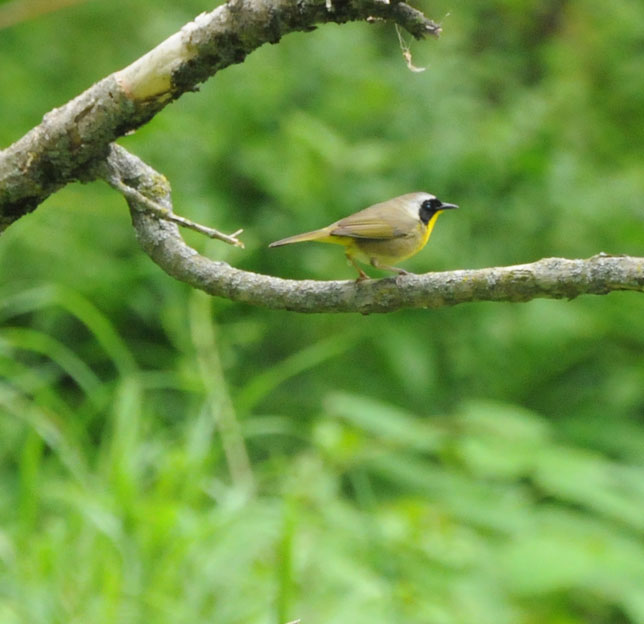
Common Yellowthroat
Friday, April 30, 2010
Out The Office Window
There have been plenty of "out our office window" blog entries for the Audubon Center at Francis Beidler Forest, but yesterday we added another species.
Although Summer Tanagers (Piranga rubra) have been around the nature center for a number of years, the male often was singing high in the canopy and obscured by layers of leaves. This year the male has been low in the trees around the nature center and has been gleaning insects or spiders from the window casings. We cannot identify the prey items in his bill, but the fact that he has failed to eat them suggests that he will be taking them back to a female on the nest. When not cleaning the exterior of the nature center, Summer Tanagers will raid beehives and paper wasp nests to capture adults and larvae.
The male Summer Tanager is red like a male Northern Cardinal minus the crest. As Northern Cardinals are common, the Summer Tanager may be overlooked due to a case of mistaken identity. However, the Summer Tanager's call "Picky-tucky-tuck" won't be confused with the Northern Cardinal's call or song. The female Summer Tanager can be greenish-yellow over her body or greenish-yellow with orange blotches. Side note: The cover of Jeff Mollenhauer's book Birding South Carolina: A Guide to 40 Premier Birding Sites (available in our gift shop or at Amazon.com) shows a Summer Tanager in molt.
Images by Mark Musselman
Although Summer Tanagers (Piranga rubra) have been around the nature center for a number of years, the male often was singing high in the canopy and obscured by layers of leaves. This year the male has been low in the trees around the nature center and has been gleaning insects or spiders from the window casings. We cannot identify the prey items in his bill, but the fact that he has failed to eat them suggests that he will be taking them back to a female on the nest. When not cleaning the exterior of the nature center, Summer Tanagers will raid beehives and paper wasp nests to capture adults and larvae.
The male Summer Tanager is red like a male Northern Cardinal minus the crest. As Northern Cardinals are common, the Summer Tanager may be overlooked due to a case of mistaken identity. However, the Summer Tanager's call "Picky-tucky-tuck" won't be confused with the Northern Cardinal's call or song. The female Summer Tanager can be greenish-yellow over her body or greenish-yellow with orange blotches. Side note: The cover of Jeff Mollenhauer's book Birding South Carolina: A Guide to 40 Premier Birding Sites (available in our gift shop or at Amazon.com) shows a Summer Tanager in molt.
Images by Mark Musselman
Computer Returns
Yesterday, the UPS man delivered the Audubon Center at Francis Beidler Forest education department computer, which had been absent for repairs for two and a half weeks. With the computer and software back in the office, this blog can get back in business. We'll begin with by pulling images from the collection that accumulated while our computer was inoperable.
Nature is full of examples demonstrating that nothing goes to waste...even waste. While in the swamp north of the boardwalk and powerline looking for Prothonotary Warblers (Protonotaria citrea) for Project PROTHO, we came upon a log covered in FRESH River Otter (Lutra canadensis) scat. The moist scat reeked of fish and crayfish (think of discarded shrimp parts sitting in the sun for a few days) and was just starting to attract flies. As we inspected the scat (yes, we do that), a male Eastern Tiger Swallowtail (Pterourus glaucus) flew in and began sampling the buffet. How does that saying go? When life give you...er, lemons, make lemonade. Yeah, that's it.
Now, back to cataloging the backlog of images!
Images by Mark Musselman
Nature is full of examples demonstrating that nothing goes to waste...even waste. While in the swamp north of the boardwalk and powerline looking for Prothonotary Warblers (Protonotaria citrea) for Project PROTHO, we came upon a log covered in FRESH River Otter (Lutra canadensis) scat. The moist scat reeked of fish and crayfish (think of discarded shrimp parts sitting in the sun for a few days) and was just starting to attract flies. As we inspected the scat (yes, we do that), a male Eastern Tiger Swallowtail (Pterourus glaucus) flew in and began sampling the buffet. How does that saying go? When life give you...er, lemons, make lemonade. Yeah, that's it.
Now, back to cataloging the backlog of images!
Images by Mark Musselman
Saturday, April 24, 2010
Computer Issues Continue
Our computer continues to reside in the Audubon repair shop. We'll use a home computer to prepare some of this week's images and post them on Monday. In the meantime, here is an image and description from an Audubon Center at Francis Beidler Forest visitor.
I took the picture attached on 4/20 between 9:30 and 10:00 in the morning. This owl appeared out of the woods at about stop 2 on the boardwalk and followed along with my wife and me for about 20 or 30 minutes until we got to stop 4. I was about 20 feet from the owl when I took this picture, and apart from having my camera at full zoom (16X), it's a totally undoctored picture. Since we heard another barred nearby and the receptionist told us that there were owlets in a nest in that area, I'm guessing that this owl was following us to make sure that we didn't make any threatening moves in the direction of the nest. Even without a close encounter with the owl, Beidler Forest would have been a jaw-dropping experience for us. The owl just put the experience off the charts.
Indeed, there is a Barred Owl (Strix varia) nest north (left) of #116 along the boardwalk. The nest is in a hollow section of a tall Bald Cypress tree, but is no longer visible from the boardwalk due to the leaves that have appeared on the trees between the boardwalk and nest tree. Especially now that the owlets are growing, the adult owls will be increasingly visible as they hunt during the day in the shallow, crayfish-filled pools of water.
Although this nest site information did not make version 1.0 of our iPhone/iPod Touch app, it is the type of bonus coverage you will receive if you download the free app prior to visiting the old-growth swamp!
Image by Leon Galis
Tuesday, April 20, 2010
We're Still Here
Spring is a busy time of year at the Audubon Center at Francis Beidler Forest. Unfortunately, after returning from vacation, we found our computer had died. Although we have all of our files backed up, all of the software and bookmarked webpages that we use to efficiently manipulate images and research topics remain trapped on the inoperable computer. Good news is that the issue is simply a bad power supply and can be easily repaired.
The cool spring seems to have slowed everything in the swamp. Only a few Easter Lilies (Zephyranthes atamasco) have emerged, reptiles are few and far between, and Prothonotary Warbler (Protonotaria citrea) battles for breeding territory have been less frantic. Although everything may be moving at a slower pace, there is still plenty of action.
The slam of the car door as we reported for work last Sunday triggered a response from a male Wild Turkey (Meleagris gallopavo). The call was startling in the relative quiet of the early morning and was quickly answered by a distant male. As soon as the camera could be assembled, the gobbler emerged from the middle of the parking area and moved toward the upland area along the swamp's edge, possibly to investigate that distant response.
Hopefully, by the end of the week, we will be calling again from the swamp!
Images by Mark Musselman
The cool spring seems to have slowed everything in the swamp. Only a few Easter Lilies (Zephyranthes atamasco) have emerged, reptiles are few and far between, and Prothonotary Warbler (Protonotaria citrea) battles for breeding territory have been less frantic. Although everything may be moving at a slower pace, there is still plenty of action.
The slam of the car door as we reported for work last Sunday triggered a response from a male Wild Turkey (Meleagris gallopavo). The call was startling in the relative quiet of the early morning and was quickly answered by a distant male. As soon as the camera could be assembled, the gobbler emerged from the middle of the parking area and moved toward the upland area along the swamp's edge, possibly to investigate that distant response.
Hopefully, by the end of the week, we will be calling again from the swamp!
Images by Mark Musselman
Monday, April 05, 2010
Spring Break
This blog will be silent for the remainder of the week as the principal contributor will be on vacation.
Last week, we took some images of the Southern Fence Lizard (Sceloporus undulatus) in the burned section of a Longleaf Pine (Pinus palustris) stand. When looking at the images, we thought the eye looked "off." With our best CSI skills, we magnified the image and caught the photographer reflected in the reptile's eye.
We will be back on April 10th in time for Wine & Warblers at the Audubon Center at Francis Beidler Forest!
$40 per person. Reservations and advance payment are required. Walks begin at 5:00 p.m. Please make reservations for your time slot by calling (843) 462-2150.
See you there!
Images by Mark Musselman
Last week, we took some images of the Southern Fence Lizard (Sceloporus undulatus) in the burned section of a Longleaf Pine (Pinus palustris) stand. When looking at the images, we thought the eye looked "off." With our best CSI skills, we magnified the image and caught the photographer reflected in the reptile's eye.
We will be back on April 10th in time for Wine & Warblers at the Audubon Center at Francis Beidler Forest!
Join expert birdwatchers for an evening on the boardwalk and explore the wide variety of songbirds that travel to Beidler Forest each Spring. Enjoy hors d'oeuvres and wine tastings as you explore the ancient swamp forest. Proceeds benefit Audubon South Carolina.
$40 per person. Reservations and advance payment are required. Walks begin at 5:00 p.m. Please make reservations for your time slot by calling (843) 462-2150.
See you there!
Images by Mark Musselman
Friday, April 02, 2010
Luna Moth
The Luna Moth (Actias luna) in the image was spotted on a Sweetgum (Liquadambar styraciflua) in the parking area at the Audubon Center at Francis Beidler Forest.
The Sweetgum is a host tree for the Luna Moth. The adult Luna Moth does not eat. The adult's mission is to find a mate and reproduce. Based on this individual's fresh look, it likely emerged from its cocoon recently and has not yet had time to tatter its wings in search of a mate.
Images by Mark Musselman
The Sweetgum is a host tree for the Luna Moth. The adult Luna Moth does not eat. The adult's mission is to find a mate and reproduce. Based on this individual's fresh look, it likely emerged from its cocoon recently and has not yet had time to tatter its wings in search of a mate.
Images by Mark Musselman
Subscribe to:
Posts (Atom)