Showing posts sorted by relevance for query window. Sort by date Show all posts
Wednesday, October 05, 2011
Rose-breasted Grosbeak on Migration
Another first for the education department's office window at the Audubon Center at Francis Beidler Forest!
While working on the computer, movement outside our window caught our eye. Earlier, an adult and a first-year Pine Warbler posed outside the window comfortable in the knowledge that our camera was still in the bag. Naturally, once the camera was out and ready, the birds found a better place to be. Throughout the day, birds, mainly Northern Cardinals of which we have plenty of pictures, had been clearing the Flowering Dogwood of its fruit. However, the combination of black, white, and red in the last mass of movement must have set off alarms in our subconscious. Looking up, there was no mistaking the rose-colored breast and the need to get the camera into position.
Funny thing about preparation...it gives you the opportunity to make something happen, but you still need make it happen. We failed to adequately navigate the space between our window and the male Rose-breasted Grosbeak. A small twig was all that was necessary to blur our shot before the bird went about his business beyond our sight. Patience, however, is said to be a virtue.
Within the hour, a male Rose-breasted Grosbeak returned with a female to dine on the fruit of the Flowering Dogwood. Not only did we have our camera ready, we had our window open, which eliminated one obstacle to a clear picture.
The swamp has been getting a touch of red from Poison Ivy, Cardinal Flower, Flowering Dogwood fruit, but the Rose-breasted Grosbeak is a treat!
Images by Mark Musselman
While working on the computer, movement outside our window caught our eye. Earlier, an adult and a first-year Pine Warbler posed outside the window comfortable in the knowledge that our camera was still in the bag. Naturally, once the camera was out and ready, the birds found a better place to be. Throughout the day, birds, mainly Northern Cardinals of which we have plenty of pictures, had been clearing the Flowering Dogwood of its fruit. However, the combination of black, white, and red in the last mass of movement must have set off alarms in our subconscious. Looking up, there was no mistaking the rose-colored breast and the need to get the camera into position.
Funny thing about preparation...it gives you the opportunity to make something happen, but you still need make it happen. We failed to adequately navigate the space between our window and the male Rose-breasted Grosbeak. A small twig was all that was necessary to blur our shot before the bird went about his business beyond our sight. Patience, however, is said to be a virtue.
Within the hour, a male Rose-breasted Grosbeak returned with a female to dine on the fruit of the Flowering Dogwood. Not only did we have our camera ready, we had our window open, which eliminated one obstacle to a clear picture.
The swamp has been getting a touch of red from Poison Ivy, Cardinal Flower, Flowering Dogwood fruit, but the Rose-breasted Grosbeak is a treat!
Images by Mark Musselman
Thursday, May 05, 2011
Birds From the Office Window
Although we would prefer to be outside, the windows at the Audubon Center at Francis Beidler Forest never fail to provide us with an opportunity to vicariously experience nature. Previously, we have reported our sightings out the office window, but yesterday's activity produced an new set of images.
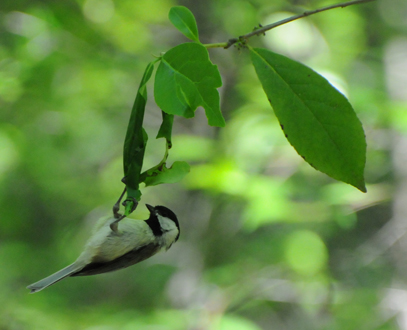
Carolina Chickadee searching curled leaves for a meal and...
being harassed by a male Northern Cardinal.
Although we couldn't get the camera pointed quickly enough, a Red-shouldered Hawk landed within six feet of the window. This image is of one along the boardwalk several years ago. The hawk by the office window may have been attracted by the erratic flights of the young Carolina Wrens. However, our movement within the building, slight though it may have been, was sufficient to alert the hawk and send it flying though the forest.
Although we could not see the waterfowl from our office, we could hear them and we made a quick dash behind the outdoor classroom to take a look. With water pooling behind the beaver dam, the area under the power line looks more like a pond than a swamp. The changing habitat has attracted a Muscovy Duck (Cairina moschata), which based on the color is likely an escaped domesticated bird.
The flooded area under the power line is also favored Wood Ducks, including this hen and her four or five ducklings.
While trying to get the shot of the newly-arrived Muscovy Duck, a Pileated Woodpecker landed overhead.
At the tree line, a male Blue Grosbeak (Guiraca caerulea) ate seeds from the grasses growing in the flooded area. Shortly after spying the grosbeak, a male Indigo Bunting (Passerina cyanea) arrived and kept watch nearby.
To put a wrap on today, a Carolina Anole worked his way into the sun to do a few pushups and show off his dewlap. The air temperature may not have reached 70F today, so the lizard was not his bright green self.
Although we would almost always opt to be outdoors, it sure is nice to have an office with a view!
Images by Mark Musselman
Three just-fledged Carolina Wrens learning to dust-bathe from their parents.
Male Northern Parula posing for pictures.
Carolina Chickadee searching curled leaves for a meal and...
being harassed by a male Northern Cardinal.
Although we couldn't get the camera pointed quickly enough, a Red-shouldered Hawk landed within six feet of the window. This image is of one along the boardwalk several years ago. The hawk by the office window may have been attracted by the erratic flights of the young Carolina Wrens. However, our movement within the building, slight though it may have been, was sufficient to alert the hawk and send it flying though the forest.
Although we could not see the waterfowl from our office, we could hear them and we made a quick dash behind the outdoor classroom to take a look. With water pooling behind the beaver dam, the area under the power line looks more like a pond than a swamp. The changing habitat has attracted a Muscovy Duck (Cairina moschata), which based on the color is likely an escaped domesticated bird.
The flooded area under the power line is also favored Wood Ducks, including this hen and her four or five ducklings.
While trying to get the shot of the newly-arrived Muscovy Duck, a Pileated Woodpecker landed overhead.
At the tree line, a male Blue Grosbeak (Guiraca caerulea) ate seeds from the grasses growing in the flooded area. Shortly after spying the grosbeak, a male Indigo Bunting (Passerina cyanea) arrived and kept watch nearby.
To put a wrap on today, a Carolina Anole worked his way into the sun to do a few pushups and show off his dewlap. The air temperature may not have reached 70F today, so the lizard was not his bright green self.
Although we would almost always opt to be outdoors, it sure is nice to have an office with a view!
Images by Mark Musselman
Monday, April 21, 2008
Headache
Continuing with the theme from last week, it's rough out in nature! Today's case is not entirely nature's fault. We put the Audubon Center out here at the Francis Beidler Forest and it got in the way of a low-flying, high-speed Pileated Woodpecker (Dryocopus pileatus). Out our window, we saw it coming hard around the corner of the meeting room but had no way to warn the bird that its flight path was about to be impeded by glass.
The large bird was able to hit the air brakes and reduce its impact velocity, but it was still a jarring blow. After briefly fluttering like a butterfly just beyond the window, the woodpecker flew to a nearby tree to clear its head. One would think, of any bird, a woodpecker would have the easiest time recovering from a blow to the head.
The brain of a woodpecker is packed tightly within its skull with no space to move and be damaged. Additionally, the bones of the skull are spongy to absorb shock along with strong, shock-absorbing neck muscles. The tongue, which exits the back of the skull, wraps over top of the skull and is anchored at the front of the skull near the bill is thought to add another layer of stablilization to the head. Nevertheless, the unexpected collision with the window kept the mohawk-wearing headbanger grounded for some time.
Image by Mark Musselman
Wednesday, March 11, 2009
We Have A Crazy Bird At Our Window!

"Hi, we have a crazy bird at our window. Is there anything you can do?" Staff members at the Audubon Centers at both the Francis Beidler Forest and at Silver Bluff have had to field that question every spring. The birds not suffering mental instability due to disease or an exotic, brain-eating parasite, but they are crazy...crazy serious! This is mating season! Crest up!


So serious are many male birds about passing along their DNA to the next generation, that they will wear themselves out defending their nesting territory and the mate to which they have paired. Any other male of the species is a threat as he could couple with the female of the territory resulting in offspring that are not of the residing male. Reflections in windows or mirrors are perceived as male threats...and what a threat! They are MAGNIFICENT! If the male defending the territory could verbalize its feelings, it might think aloud, "This guy looks as good as me. This is going to be tough! I've got to give it my all!" As the sun's location in the sky changed through the day, the male Northern Cardinal (Cardinalis cardinalis) in the images move to more reflective windows and finally settled down.


The male Hooded Warbler (Wilsonia citrina) carried on in a similar fashion last year, but we eventually learned what else was bothering that individual. The bird's nest was right outside of our office window, so any reflection was a close and immediate threat.
Spring is rapidly approaching and the swamp will only get crazier!
Images by Mark Musselman
Thursday, September 06, 2007
Out the Office Window

Today was spent in front of the computer learning the new ArcGIS software (geographic information systems), which is a complex and powerful mapping tool. A huge upgrade from the 3.2 version that was being used by the office at the Audubon Center at the Francis Beidler Forest. Any movement outside the office window provided an opportunity to connect with the natural world.
The Yellow Passion-flower (Passiflora lutea) fruit continued to be eaten by Red-eyed Vireos (Vireo olivaceus), Blue-gray Gnatcatchers (Polioptila caerulea) foraged along the branches prepared to consume any prey that might be flushed from hiding, and a female Summer Tanager (Piranga rubra) stopped by for a quick look into the building. A male American Redstart (Setophaga ruticilla) (see image) moved rapidly from branch to branch fanning his tail in search of meals to provide energy for his continued migration south.
There is always something happening in the woods outside the office window, including a young couple skirting the nature center and the admission fee to slip seemingly undetected onto the boardwalk. It was 4:05 p.m. and we close, including locking the gate at the end of the driveway, at 5:00 p.m. Besides the obvious safety issues of having people on the boardwalk without our knowledge, those individuals risk being locked in for the night as there is no way to drive a vehicle off the property except through the open gate. Additionally, as a non-profit, the Francis Beidler Forest relies on donations, grants, and admissions to maintain and protect the virgin, old-growth forest the young couple felt compelled to visit.
Come and experience the swamp, but please allow us the pleasure of meeting you first.
Wednesday, May 16, 2007
Hooded Warbler Aggression
Over the last several days, a male Hooded Warbler (Wilsonia citrina) has been aggressively attacking the windows on the north side of the building at the Audubon Center at the Francis Beidler Forest. Robins, Mockingbirds, and Northern Cardinals are especially prone to this type of behavior.
The Hooded Warbler is not celebrating our recent installation of energy-efficient windows. Neither is the bird making a statement regarding our infrequent window cleaning schedule. In fact, a really dirty window would likely prevent the behavior we are observing. The male Hooded Warbler is defending his breeding territory. When he catches sight of another male of his species in his territory, he promptly addresses the situation in an effort to send the other male on his way. However, when our Hooded Warbler pecks at the window, the insolent trespasser pecks right back. This immediately ratchets up the aggression on "both" sides.
Speaking of sides, Gary Larson's The Far Side covered this topic in the attached cartoon.
Friday, April 30, 2010
Out The Office Window
There have been plenty of "out our office window" blog entries for the Audubon Center at Francis Beidler Forest, but yesterday we added another species.
Although Summer Tanagers (Piranga rubra) have been around the nature center for a number of years, the male often was singing high in the canopy and obscured by layers of leaves. This year the male has been low in the trees around the nature center and has been gleaning insects or spiders from the window casings. We cannot identify the prey items in his bill, but the fact that he has failed to eat them suggests that he will be taking them back to a female on the nest. When not cleaning the exterior of the nature center, Summer Tanagers will raid beehives and paper wasp nests to capture adults and larvae.
The male Summer Tanager is red like a male Northern Cardinal minus the crest. As Northern Cardinals are common, the Summer Tanager may be overlooked due to a case of mistaken identity. However, the Summer Tanager's call "Picky-tucky-tuck" won't be confused with the Northern Cardinal's call or song. The female Summer Tanager can be greenish-yellow over her body or greenish-yellow with orange blotches. Side note: The cover of Jeff Mollenhauer's book Birding South Carolina: A Guide to 40 Premier Birding Sites (available in our gift shop or at Amazon.com) shows a Summer Tanager in molt.
Images by Mark Musselman
Although Summer Tanagers (Piranga rubra) have been around the nature center for a number of years, the male often was singing high in the canopy and obscured by layers of leaves. This year the male has been low in the trees around the nature center and has been gleaning insects or spiders from the window casings. We cannot identify the prey items in his bill, but the fact that he has failed to eat them suggests that he will be taking them back to a female on the nest. When not cleaning the exterior of the nature center, Summer Tanagers will raid beehives and paper wasp nests to capture adults and larvae.
The male Summer Tanager is red like a male Northern Cardinal minus the crest. As Northern Cardinals are common, the Summer Tanager may be overlooked due to a case of mistaken identity. However, the Summer Tanager's call "Picky-tucky-tuck" won't be confused with the Northern Cardinal's call or song. The female Summer Tanager can be greenish-yellow over her body or greenish-yellow with orange blotches. Side note: The cover of Jeff Mollenhauer's book Birding South Carolina: A Guide to 40 Premier Birding Sites (available in our gift shop or at Amazon.com) shows a Summer Tanager in molt.
Images by Mark Musselman
Wednesday, February 28, 2007
Who is that in the chimney?
Spring is certainly on the way when the Chimney Swifts (Chaetura pelagica) return with a chorus of song in our chimney. A chimney provides a vertical surface sheltered from the weather just as a hollow tree, which is the bird's natural nesting site. However, as forests are cleared or intensively managed, hollow trees are eliminated or never occur. Therefore, chimneys became an attractive alternative. Today, many chimneys are being capped to prevent animals, such as chimney swifts which can arrive by the hundreds, from entering. As a result, artificial hollow tree-like structures are being constructed and placed outdoors to provide the swifts with suitable nesting sites.
This morning, however, it was not the sound of a swift that echoed from the chimney. The unmistakable "Who, who, who cooks for y'all?" was the call of a trapped Barred Owl (Strix varia). The owl was in the chimney at least two days. Earlier rustling sounds had been dismissed as early-arriving Chimney Swifts. Upon opening the flue, the Barred Owl identification was confirmed. The flue was left open along with the front door. After several minutes, the owl dropped through the flue in a cloud of soot like a tardy Santa Claus. The bird perched on the fire screen and surveyed the possibilities for returning to the natural world. After a few changes in location (lamp, bookshelf, couch, mantle) and a slow-speed collision with a window, the owl made its escape through an open window.
After a humiliating two days in a dark, sooty chimney and a collision with what must have seemed like "hard air", the owl was immediately and loudly set upon by Blue Jays, Tufted Titmice and other anxious backyard birds.
Mark Musselman, education director
Thursday, August 09, 2007
Patient Spider

This morning, the view out of the office window at the Audubon Center at Francis Beidler Forest was slightly obscured by the overnight arrival of a Black-and-yellow Argiope (Argiope aurantia).
Except for the characteristic "writing" in the middle of the web, the deadly silk is nearly invisible. The zig-zag webbing is called a stabilimenta, because it was originally believe to aid in stabilizing the web. There are several hypotheses regarding the purpose of the stabilimenta, but the strongest appears to be that the highly visible threads prevent birds from flying through and destroying the web. Also, only diurnal (in the day) spiders add the stabilimenta to their webs.
This Black-and-yellow Argiope is quite patient. During a day of observation on her web just beyond the computer screen, she has moved exacty twice. Once to pounce on and quickly devour a tiny flying insect and once to pounce on, wrap up, and slowly drain a medium-sized fly. The rest of the day has been spent as seen in the image. Patiently waiting for the next meal to fly through what likely appears to be an opening in the forest though, the web and clean glass would demonstrate otherwise.
Friday, June 24, 2011
Hungry Cowbird
As we closed out the books for the second week of summer camp at the Audubon Center at Francis Beidler Forest, we heard outside the office window the distinctive song of a Northern Parula Warbler (Parula americana). As be brought the camera up for a closeup shot out the window, we noticed that the warbler appeared too large. It took merely a second before we realized it was a Brown-headed Cowbird (Molothrus ater) fledgling in the camera's view finder.
However, it took only a few more seconds to see that the Northern Parula Warbler was busy feeding the parasitic Brown-headed Cowbird fledgling. Cowbirds dump their eggs (up to 40 per season) into the nests of other bird species. Some species recognize the egg as foreign and will abandon the nest or build over top of the eggs to begin again. Others do not seem to realize the deception and will feed the larger cowbird chick at the expense of their own young.
It appears that the Northern Parula raised the cowbird chick. Our question is, "If the Northern Parula nests in Spanish Moss, what bundle of moss was able to support the massive (by comparison) cowbird chick?"
Images by Mark Musselman
However, it took only a few more seconds to see that the Northern Parula Warbler was busy feeding the parasitic Brown-headed Cowbird fledgling. Cowbirds dump their eggs (up to 40 per season) into the nests of other bird species. Some species recognize the egg as foreign and will abandon the nest or build over top of the eggs to begin again. Others do not seem to realize the deception and will feed the larger cowbird chick at the expense of their own young.
It appears that the Northern Parula raised the cowbird chick. Our question is, "If the Northern Parula nests in Spanish Moss, what bundle of moss was able to support the massive (by comparison) cowbird chick?"
Images by Mark Musselman
Wednesday, September 07, 2011
Hungry Birds
With migration on the minds of many birds and water creeping back into the swamp, we at the Audubon Center at Francis Beidler Forest have noticed an exceptional amount of feeding activity. Out our office window, the Horse Sugar (Symplocos tinctoria) fruit hangs as dark purple drupes attracting the attention of several species of birds. Red-eyed Vireos (Vireo olivaceus) are the most frequent visitors, but White-eyed Vireos (Vireo griseus) and Summer Tanagers also partake of the fruit. A few minutes ago, a Veery (Catharus fuscescens) landed on a branch just outside the window, observed the office life and then began swallowing whole Horse Sugar fruits.
Yesterday, along the boardwalk we heard the chatter of a Belted Kingfisher (Ceryle alcyon) hunting at Goodson Lake and we walked up on a Barred Owl (Strix varia) perched on a cypress knee watching intently for a crayfish to betray its position in the water below. We did not see the owl until we were within ten feet of its position. It flew to a new perch ahead of us, but still within a few feet of the boardwalk. As you can see in the video below, we were able to walk slowly as the owl preened and get to within a few feet of its position.
Video by Mark Musselman
Yesterday, along the boardwalk we heard the chatter of a Belted Kingfisher (Ceryle alcyon) hunting at Goodson Lake and we walked up on a Barred Owl (Strix varia) perched on a cypress knee watching intently for a crayfish to betray its position in the water below. We did not see the owl until we were within ten feet of its position. It flew to a new perch ahead of us, but still within a few feet of the boardwalk. As you can see in the video below, we were able to walk slowly as the owl preened and get to within a few feet of its position.
Video by Mark Musselman
Tuesday, September 04, 2012
Rainy Day Migrants
Rain during the past two weeks has often kept us trapped within the building at the Audubon Center at Francis Beidler Forest.
Another unfortunate side effect of the rain is the presence of mosquitoes. As long as there is water flowing in the swamp, mosquitoes are seldom an issue as they prefer standing water. However, a portion of the boardwalk traverses the high, dry forest and later parallels the edge of the swamp. The high volume of rain has filled depressions, like those caused when trees tip over, throughout the dry forest bordering the swamp and mosquitoes have taken advantage of the situation.
Even if adult mosquitoes were not present to lay eggs in the standing water, mosquito eggs can survive dry periods and hatch once water returns...cue the rain. Predators in the water, like mosquito fish or dragonfly nymphs, and predators in the air, like Blue-gray Gnatcachers (Polioptila caerulea) have put a dent in the mosquito population. However, for a time a bloody gauntlet needed to be endured to reach the sanctuary of the swamp. The aberrant situation has nearly returned to normal.
We cannot do anything to manage mosquitoes in the forest, but you can manage them in your yard. Eliminating standing water in any containers is the most effective control. Mosquitoes obtain viruses during feeding on an infected host and then when next feeding they can introduced the virus to humans and pets via the mosquito's salivary glands. Therefore, if mosquitoes are already present, applying insect repellent and wearing clothing that prevents exposed skin are effective defensive strategies.
Poor weather might slow bird migration, but it will not stop migration. Even with the rain, we saw birds foraging outside the office window that likely were not residents during the breeding season. Hooded Warblers (Setophaga citrina), Prothonotary Warblers (Protonotaria citrea), and Worm-eating Warblers (Helmitheros vermivorus) were some examples. A Green Heron (Butorides virescens) spent a few days wading in the shallow water at #104 just behind the nature center. Green Herons are not normally seen along the boardwalk, so it may be a bird migrating from higher latitudes or a local bird that could not resist the glut of fish gorging themselves on mosquito larvae in the shallow water.
Another bird seen out the office window is definitely a migrant. The male American Redstart is black and orange overall, so the bird in the images is likely a female or possibly a juvenile male.
On Friday, we were able to get out on the boardwalk during a break in the weather. Two steps out the door we encountered a Blue-winged Warbler, a Worm-eating Warbler, a Black-and-white Warbler, a Northern Parula, two Red-eyed Vireos, a Downy Woodpecker, several Carolina Wrens, and a White-eyed Vireo. Below, you can see the complete list, including a Veery at #113.
Francis Beidler Forest Audubon Center & Sanctuary, Dorchester, US-SC
Aug 31, 2012 2:00 PM - 4:00 PM
Protocol: Traveling
1.75 mile(s)
Comments: Clear, 80Fs
25 species
Wood Duck (Aix sponsa) 4
Great Egret (Ardea alba) 2
White Ibis (Eudocimus albus) 27
Red-shouldered Hawk (Buteo lineatus) 1
Yellow-billed Cuckoo (Coccyzus americanus) 5
Barred Owl (Strix varia) 2
Red-bellied Woodpecker (Melanerpes carolinus) 6
Downy Woodpecker (Picoides pubescens) 2
Pileated Woodpecker (Dryocopus pileatus) 3
Acadian Flycatcher (Empidonax virescens) 4
Great Crested Flycatcher (Myiarchus crinitus) 1
White-eyed Vireo (Vireo griseus) 10
Red-eyed Vireo (Vireo olivaceus) 2
American Crow (Corvus brachyrhynchos) 4
Carolina Chickadee (Poecile carolinensis) 8
Tufted Titmouse (Baeolophus bicolor) 6
White-breasted Nuthatch (Sitta carolinensis) 2
Carolina Wren (Thryothorus ludovicianus) 9
Blue-gray Gnatcatcher (Polioptila caerulea) 4
Veery (Catharus fuscescens) 1
Worm-eating Warbler (Helmitheros vermivorum) 1
Blue-winged Warbler (Vermivora cyanoptera) 1
Black-and-white Warbler (Mniotilta varia) 1
Northern Parula (Setophaga americana) 7
Northern Cardinal (Cardinalis cardinalis) 2
Another unfortunate side effect of the rain is the presence of mosquitoes. As long as there is water flowing in the swamp, mosquitoes are seldom an issue as they prefer standing water. However, a portion of the boardwalk traverses the high, dry forest and later parallels the edge of the swamp. The high volume of rain has filled depressions, like those caused when trees tip over, throughout the dry forest bordering the swamp and mosquitoes have taken advantage of the situation.
Even if adult mosquitoes were not present to lay eggs in the standing water, mosquito eggs can survive dry periods and hatch once water returns...cue the rain. Predators in the water, like mosquito fish or dragonfly nymphs, and predators in the air, like Blue-gray Gnatcachers (Polioptila caerulea) have put a dent in the mosquito population. However, for a time a bloody gauntlet needed to be endured to reach the sanctuary of the swamp. The aberrant situation has nearly returned to normal.
We cannot do anything to manage mosquitoes in the forest, but you can manage them in your yard. Eliminating standing water in any containers is the most effective control. Mosquitoes obtain viruses during feeding on an infected host and then when next feeding they can introduced the virus to humans and pets via the mosquito's salivary glands. Therefore, if mosquitoes are already present, applying insect repellent and wearing clothing that prevents exposed skin are effective defensive strategies.
Poor weather might slow bird migration, but it will not stop migration. Even with the rain, we saw birds foraging outside the office window that likely were not residents during the breeding season. Hooded Warblers (Setophaga citrina), Prothonotary Warblers (Protonotaria citrea), and Worm-eating Warblers (Helmitheros vermivorus) were some examples. A Green Heron (Butorides virescens) spent a few days wading in the shallow water at #104 just behind the nature center. Green Herons are not normally seen along the boardwalk, so it may be a bird migrating from higher latitudes or a local bird that could not resist the glut of fish gorging themselves on mosquito larvae in the shallow water.
Another bird seen out the office window is definitely a migrant. The male American Redstart is black and orange overall, so the bird in the images is likely a female or possibly a juvenile male.
| American Redstart - Mark Musselman |
| American Redstart - Mark Musselman |
| American Redstart - Mark Musselman |
On Friday, we were able to get out on the boardwalk during a break in the weather. Two steps out the door we encountered a Blue-winged Warbler, a Worm-eating Warbler, a Black-and-white Warbler, a Northern Parula, two Red-eyed Vireos, a Downy Woodpecker, several Carolina Wrens, and a White-eyed Vireo. Below, you can see the complete list, including a Veery at #113.
Francis Beidler Forest Audubon Center & Sanctuary, Dorchester, US-SC
Aug 31, 2012 2:00 PM - 4:00 PM
Protocol: Traveling
1.75 mile(s)
Comments: Clear, 80Fs
25 species
Wood Duck (Aix sponsa) 4
Great Egret (Ardea alba) 2
White Ibis (Eudocimus albus) 27
Red-shouldered Hawk (Buteo lineatus) 1
Yellow-billed Cuckoo (Coccyzus americanus) 5
Barred Owl (Strix varia) 2
Red-bellied Woodpecker (Melanerpes carolinus) 6
Downy Woodpecker (Picoides pubescens) 2
Pileated Woodpecker (Dryocopus pileatus) 3
Acadian Flycatcher (Empidonax virescens) 4
Great Crested Flycatcher (Myiarchus crinitus) 1
White-eyed Vireo (Vireo griseus) 10
Red-eyed Vireo (Vireo olivaceus) 2
American Crow (Corvus brachyrhynchos) 4
Carolina Chickadee (Poecile carolinensis) 8
Tufted Titmouse (Baeolophus bicolor) 6
White-breasted Nuthatch (Sitta carolinensis) 2
Carolina Wren (Thryothorus ludovicianus) 9
Blue-gray Gnatcatcher (Polioptila caerulea) 4
Veery (Catharus fuscescens) 1
Worm-eating Warbler (Helmitheros vermivorum) 1
Blue-winged Warbler (Vermivora cyanoptera) 1
Black-and-white Warbler (Mniotilta varia) 1
Northern Parula (Setophaga americana) 7
Northern Cardinal (Cardinalis cardinalis) 2
Wednesday, October 31, 2007
Birds of Interest
Jeff Mollenhauer, Director or Bird Conservation, noted today:
Two sightings of interest today at Beidler Forest Audubon Sanctuary near Harleyville, SC. A Gray-cheeked Thrush (Catharus minimus) was observed for about 10 minutes feeding on dogwood berries behind the visitor center this afternoon. The late date for GCTH is listed as Nov. 2 in “Status & Distribution of South Carolina Birds”. Interestingly about 10 days ago, we had a GCTH fly into the window of the visitor center. It was a little stunned and wobbly for about 5 minutes, but eventually recovered and flew away. I’m wondering if the GCTH we saw today is the same one that hit our window.
An American Woodcock (Scolopax minor) has been seen repeatedly at the base of the Chestnut Oak sign near #2 on the boardwalk. This is a great opportunity for those who are hoping to
photograph or get a good close-up, day time look at a Woodcock. The bird usually sits completely motionless in the leaves within 5 feet from the boardwalk. It is amazing how well-camouflaged these birds are in this environment! You really have to do a thorough search before you can find it. I saw the Woodcock in this area on 9/24, 10/29, and 10/31. I am pretty confident that it is often in the area, but usually overlooked because of its ability to blend in with the leaves. Also observed today were good numbers of Yellow-bellied Sapsuckers, Eastern Phoebes, Ruby-crowned and Golden-crowned Kinglets, Winter Wrens, and a couple Hermit Thrushes. For more information about Beidler Forest Audubon Sanctuary (including directions and hours of operation) please visit http://www.beidlerforest.com/
Wednesday, July 17, 2013
Summer camps at the Audubon Center at Francis Beidler Forest were completed last month and we were able to avoid the rain during the 9am-2pm window. However, plenty of rain fell outside of that window and continued through the first two weeks of July while we were away on vacation or attending conferences, ESRI International User Conference (view presentation) and the Audubon Convention.
Here are some images from the camp weeks:
A pair of Cotton Mice (Peromyscus gossypinus) were hiding in the storage box at the #6 rest area. They could come and go from under the boardwalk and between the deck boards.
This pair built a nest in the left corner of the storage box. Unfortunately for the mice, Greenish Rat Snakes (Elaphe obsoleta quadrivittata) also have no problem entering the box from below. We do not know their fate, but the mice are no longer in residence. Then again, their average lifespan is 4-5 months, with few living a full year.
With the water level above normal for June, we had no problem navigating to all points along the canoe trail. Unfortunately for the anglers of the advanced summer camp, the fish also had access to the entire swamp and nary a nibble was detected on any wet line.
Though we tempted no fish, Matt Johnson made a tremendous catch when he spotted a female Ruby-throated Hummingbird (Archilochus colubris) returning to her nest on a locust branch hanging above the water. Even with her presence disclosing the general location of the nest, the nest was extremely difficult to detect and photograph. The lichen on the nest's exterior and the nest's low profile provided outstanding camouflage.
During the advanced summer camp's Global Positioning System (GPS)-aided swamp stomp, we encountered a large Eastern Cottonmouth (Agkistrodon piscivorus piscivorus). Although the snake was alert and kept us in focus, it never moved and we proceeded with our walk.
Swallow-tailed Kites (Elanoides forficatus) are likely nesting in the Francis Beidler Forest, possibly near the east end of the boardwalk. The advanced summer campers selected trees from Google Earth imagery that appeared to rise above the canopy, a nesting preference for Swallow-tailed Kites, and loaded the coordinates into GPS units. While navigating through the swamp to visit those selected trees, we came across a variety of creatures, including a distinctively patterned Bronze Frog (Rana clamitans clamitans).
A family of Nine-banded Armadillos (Dasypus novemcinctus) moved in under the ramp leading into the nature center. We noted their arrival in 2008 as they expanded their range from the south.
Armadillos always give birth to quadruplets, which we observed. A
single egg is fertilized and the embryo divides in two before each
embryo again divides in two. Thus, each young armadillo is genetically
identical to its three sisters or three brothers.
Armadillos forage with their snouts for grubs, ants, termites,
beetles and other arthropods. They can also use their powerful legs and
claws to expose a meal. With a low metabolism and limited fat stores,
the armadillo is highly susceptible to cool weather, which will eventually limit their range expansion to the north. In the image above, a young armadillo found an earthworm, which it slurped up like a strand of cooked spaghetti.
Having successfully navigated a 1.5-mile loop through the swamp during the advanced summer camp, we joined the boardwalk near #6 and headed to the nature center for lunch. Near #4, there was the smell of death in the air and a camper spotted the source...a nearly hairless beaver (Castor canadensis) carcass. The image above shows the only signs of injury, but the wound may have been the result of a scavenger.
Turtles and fish likely nibbled at the beaver's feet exposing bone.
American Carrion Beetles (Necrophila americana) and various fly species took the opportunity to lay eggs on the carcass. The resulting larvae will quickly consume the decaying flesh.
A young Eastern Cottonmouth sought refuge from the high water by sliding up the frond of a Dwarf Palmetto.
Several Bronze Frogs, appearing to both be males, stared at each other from perches on neighboring fallen trees.
A Banded Water Snake (Nerodia fasciata fasciata) kept tabs on us from its dry perch on the buttress of a Bald Cypress.
In the end, we had three successful summer camps and participants left with plenty of stories to tell of wildlife and adventure in the swamp!
Here are some images from the camp weeks:
| Cotton Mouse - Mark Musselman |
| Cotton Mouse - Mark Musselman |
| Cotton Mouse - Mark Musselman |
| Cotton Mouse - Mark Musselman |
| Advanced camp fishing/canoeing - Mark Musselman |
| Advanced camp fishing/canoeing - Mark Musselman |
| Ruby-throated Hummingbird nest - Mark Musselman |
| Eastern Cottonmouth - Mark Musselman |
| Bronze Frog - Mark Musselman |
| Bronze Frog - Mark Musselman |
| Young Nine-banded Armadillo - Mark Musselman |
| Young Nine-banded Armadillo - Mark Musselman |
| Young Nine-banded Armadillo - Mark Musselman |
| Beaver - Mark Musselman |
| Beaver - Mark Musselman |
| Beaver - Mark Musselman |
| Beaver - Mark Musselman |
| Eastern Cottonmouth - Mark Musselman |
| Bronze Frog - Mark Musselman |
| Bronze Frog - Mark Musselman |
| Bronze Frog - Mark Musselman |
| Banded Water Snake - Mark Musselman |
Subscribe to:
Posts (Atom)