Tuesday, June 15, 2010

Summer Camp - Session 1

The first session of summer camp at the Audubon Center at Francis Beidler Forest is in the books!  Reptiles, amphibians and campers kept us busy last week, so we failed to make an entry on this blog.  However, we'll make a week's-worth of entries today!

The week-long camp began (schedule here) with an overview of the continuing Project PROTHO.  We discussed the purpose of the project, the banding and identification process, and this year's nest box component.  Since the camp's theme is herps, we noted that Greenish Rat Snakes (Elaphe obsoleta x quadrivittata) take their share of Prothonotary Warbler eggs and chicks, but enough nesting attempts are successful.  Although the old-growth swamp offers plenty of natural cavities in which the Prothonotary Warblers (Protonotaria citrea) can nest, one pair used a student-made nest box behind the sign at #17 along the boardwalk.  Denise Ecker banded two of the four chicks as their legs were adult size, but they were not yet capable of leaving the nest.


After lunch on the first day, Dennis Blejski brought a collection of herps from his collection.  Pictured are a Milk Snake, non-native Cane Toad, Siren, Diamondback Terrapin, and American Alligator.  Dennis also had a Rough-green Snake, Copperhead, Timber Rattlesnake, Scarlet Kingsnake, Corn Snake, Hognose Snake, Yellow-bellied Slider, Spotted Turtle, Fence Lizard, Bullfrog, and Southern Toads.  Dennis had no problems keeping the attention of the campers!


On Day 2, with low water levels due to a lack of rain, we had difficulty finding reptiles and amphibians during our walk along the 1.75-mile boardwalk.  However, as we walked back toward the nature center along the edge of the swamp, one sharp-eyed camper spotted a Southern Copperhead (Agkistrodon contortrix contortrix) sunning on a log ten feet off the boardwalk.  For those animals that we did not see, campers could use the iPod Touches and the boardwalk app to see the images.


After the boardwalk tour and lunch, campers had the opportunity to inspect and identify a variety of amphibians and reptiles that we had previously captured.  The species included Southern Toad, Southern Cricket Frog, Squirrel Treefrog, Spotted Turtle, Musk Turtle, Yellow-bellied Slider, Narrowmouth Toad, Southern Dusky Salamander, Three-lined Salamander, Bullfrog tadpole, and some unidentified frog eggs and tadpoles.  Campers rotated through the eleven stations and used a variety of resources (field guides, keys, iPod Touch apps) to identify the animals.


Wednesday, we were off the boardwalk to check the 14 coverboards that were placed at the swamp's edge and in higher, drier sites.  Amphibians and reptiles will seek shelter under boards, but we found nothing beyond a few beetles and spiders.  However, campers were able to see the beaver dam and the quantity of water pooled behind the dam, which has created a habitat suitable to amphibians and reptiles and those animals that may eat them.


The afternoon was spent learning various frog and toad calls loaded to the iPod Touches with a team frog/toad call competition to end the day.


While inspecting the minnow traps on Thursday morning, we discovered that we had captured an Eastern Lesser Siren (Siren intermedia intermedia).  The siren is an amphibian that preys on a variety of aquatic animals and spends nearly its entire life in the water.  Sirens lack rear legs and have relatively-weak front legs, so travel over land is nearly impossible.  If a body of water begins to dry, sirens can bury themselves in the mud in a protective slimy "cocoon" and aestivate for up to a year or until the water returns.


A game of Jeopardy on Thursday afternoon helped campers demonstrate what they had learned during the week.  The game is played just like the famous television gameshow with one camper from each of the three teams trying to buzz in when they know the answer.  Age was not a disadvantage for campers as it appeared that younger campers paid better attention during the week and cleaned up with the 1000-point answers!


Throughout the week, campers created a variety of art/craft items, including pot frogs, minnow traps, and garden stepping stones. 


Camp ended on Friday with a herpathon along the boardwalk, lunch with families, and the presentation of diplomas and a CD of the week's images and sounds.

The next session begins on Monday and the third session will be the third week of July.  We're looking forward to all the new faces in the swamp!
Images by Mark Musselman

Wednesday, June 02, 2010

Beaver Engineers

The staff at the Audubon Center at Francis Beidler Forest continues to monitor the changes in the swamp that beavers (Castor canadensis) are creating via their water-management engineering.


As many of the animals in the swamp are adapted to the wetland ecosystem, water is a critical component of their life cycles. Though the dam is not tall it is effectively slowing the flow of water.  The upstream side of the dam appears bright green in the video as duckweed has taken hold in the non-flowing water.  The downstream side of the dam is brown exposed swamp bottom with little water outside of the deepest channels.  Obviously, animals that live in water (fish, crayfish, mussels) will continue to thrive in the pool of water created by the beaver dam.  These same prey items will be fewer in number on the downstream side of the dam, so predators will move their hunting efforts to the upstream side of the dam.  The numerous crayfish parts indicate that hunting is good for the Raccoons (Procyon lotor) and Barred Owls (Strix varia), while tracks from Yellow-crowned Night Herons (Nyctanassa violacea) and scat from River Otters (Lutra canadensis) show that they too have discovered the bounty sustained by the beavers' water-management project.

While we were exploring the area around the dam, we flushed eight Wood Ducks (Aix sponsa) that were resting in the quiet backwater and spotted a Greenish Rat Snake (Elaphe obsoleta x quadrivittata) moving rapidly across the weed-covered water.


We will definitely be making this one of the stops during summer camp, which begins next week!

Images and video by Mark Musselman

Tuesday, June 01, 2010

Cryptic Caterpillar

Although today's subject is not as likely as last Friday's subject to raise one's blood pressure, today's subject is no less interesting!

As we were leaving the Audubon Center at Francis Beidler Forest on Friday, we spotted a caterpillar on the handrail.  The caterpillar was relatively flattened, which made it difficult to see.  The caterpillar's coloration is designed to blend into the bark of a tree and not the weathered handrail.  Though the caterpillar was off target, it still was not an obvious prey item as it rested in the open on the handrail.  That was a good plan as there are plenty of hungry reptiles and birds that have chicks to feed.

We check our printed and internet sources and could only narrow the caterpillar's identification down to either Tolype notialis or T. minta.  Both are present in South Carolina, but the Southern Tolype (T. minta) is associated with pond cypress, which some believe is the same species as our Bald Cypress (Taxodium distichum).  No matter which species is finally identified as the caterpillar in the images, it will be a new species for the Francis Beidler Forest insect list!  Let us know if you can make the species identification.


Images by Mark Musselman

Friday, May 28, 2010

Timber Rattlesnake

With school ending this week, we have been busy with school groups at the Audubon Center at Francis Beidler Forest.  It has been a welcome change of pace after a slow April when the weather, water, and wildlife were at their peak!

As we prepare for this year's summer camp and its focus on amphibians and reptiles, it was appropriate that a call came in from one of our naturalists stating that a large Timber Rattlesnake (Crotalus horridus) was moving across the driveway.  We grabbed our cameras and headed out.  We were not disappointed.  The nearly 4-foot snake appeared to be wrapped in a fresh, bright skin.  Although initially distressed by our close inspection, which it demonstrated with a high, buzzing rattle, the snake soon went about searching for food and paid us little attention.

After thoroughly inspecting a hollow log, the snake moved off into the piney woods with apparent purpose.  The line of travel was straight enough, that we could get ahead of the snake and set up the video camera.  What promised to be amazing video of the large snake moving directly by the video camera evaporated when the camera shut off to conserve power!  The video below shows the snake passing by our location.


Once in a patch of thick pine straw, the snake worked itself into a coil and maneuvered most of its body below the leaves and straw.  From our vantage point, which was not far from the snake, we could not see the animal without binoculars.  The snake will remain in its ambush position until a suitable prey moves within range or until the snake decides that the site is unproductive.  Being cold-blooded, which requires few calories to maintain, and without a "to-do" list, the snake could be in the same spot two weeks from now.


We'll remember to watch out step, if we head off the boardwalk and out into the woods!

Images and video by Mark Musselman

Tuesday, May 25, 2010

ETV Project PROTHO Video

A video filmed by Clemson University Radio Productions for the Your Day program has been posted to their webpage.  The video shows several aspects of the Audubon Center at Francis Beidler Forest, including the ongoing study of Prothonotary Warblers (Project PROTHO).  Currently, the water level in the swamp is low, but that does not affect the views of the ancient Bald Cypress (Taxodium distichum) trees or the Prothonotary Warblers (Protonotaria citrea)!


Image by Mark Musselman

Monday, May 24, 2010

2nd Annual SC Master Naturalist Conference


The 2nd Annual South Carolina Master Naturalist Conference was held at Palm Key (outside of Ridgeland, SC) during May 13-15, 2010.  The Master Naturalist program in South Carolina continues to grow.  There are groups in the Upstate, the Lowcountry (Beaufort area), the Winyah Bay area, and the recently-formed Coastal Master Naturalist Association in the Charleston area.

Palm Key is a collection of cottages surrounding a freshwater pond, meeting building and kitchen/dining building.  The first evening consisted of an orientation for the conference and social time.  We spent most of the time talking about Beidler Forest with those that had visited during one the of Lowcountry Institute Master Naturalist trips or with those that had heard of Beidler Forest from other participants.  We always have time to let people know that we exist and why the old-growth swamp is special.

Beyond networking with like-minded individuals from around the state, we had the opportunity to see natural areas with guides familiar with the local habitats!  The first morning, we drove to Bennett’s Point (beyond the Bear Island WMA) in the ACE Basin for a ride on the SC DNR education boat with Al Segars and his staff.  We were welcomed by a Eurasian Collared Dove.  Once on the boat, we discussed the ACE Basin system and trawled for life in the Ashepoo River, which included shrimp, various flat fish, horseshoe crabs, blue crabs, squid, and a variety of small fish.  SC DNR staff on another boat were surveying fish and caught a young Green Sea Turtle, which allowed us a close-up look.  On Otter Island, we investigated a fresh Loggerhead Turtle nest, which Al stated would be cleaned out later that evening by the island’s healthy raccoon population.  The large Diamondback Rattlesnakes on Otter Island are not able to consume an adult raccoon, so the raccoon population has few checks beyond disease.

Al also reminded everyone that foreign-raised shrimp are produced without the same oversight as in this country.  We don’t know what the shrimp are being fed…it would be nice to know as they eat anything.  Habitat is also destroyed and contaminated during the creation and operation of the large shrimp farms.  The foreign-grown shrimp are sent to this country in refrigerated sea containers and yet that shrimp is cheaper than local shrimp.  Foreign-raised shrimp must be produced cheaply in order to be sent around the world and still undercut local prices.  Supporting local shrimpers not only keeps the money in the local economy, it helps protect habitat around the world and may well protect you health.
 
After the boat tour, Chris Marsh took us through the Donnelley WMA where we saw a variety of habitats, including freshwater ponds.  There were nesting Wood Storks and Black-bellied Whistling Ducks, which were life birds for most of the participants.  Other life birds on the day were Wimbrel, White-rumped Sandpiper, Mottled Duck, and Black-bellied Plover.


The evening’s program included a herps presentation by Tony Mills of the Lowcountry Institute.  We will be borrowing several ideas from Tony for use during our summer camp.  After the presentation, there was more networking and Beidler Forest app demonstrations around the bonfire.


At the beginning of the second day, we drove to Spring Island for a habitat safari with Tony Mills and Kristen Marshall Mattson.  We visited a variety of habitats, including salt marsh, longleaf pine, freshwater impoundments, and mixed hardwood.  Again, we will borrow some of the herp-related ideas for our summer camp.  Note: teachers don’t steal, they borrow.

The afternoon was spent with Laura Lee Rose, a local Clemson Extension agent, walking in the Altamaha Towne Heritage Preserve.  We learned some more about the native plants in our area though we still feel woefully deficient regarding the subject.

The evening’s program included a presentation by Dr. Rob Young who is studying our bottlenose dolphin populations in order to better manage our coastal resources.  We learned that there are marsh dolphin populations that seldom, if ever, go out into the ocean and therefore behave slightly differently.  There are close-shore populations that migrate slightly north and south along the coast and there are deep-water populations.  Strand feeding was shown and described.  A graduate students will be marking with paint some of the birds that follow the dolphins to see if it is a small set of birds making a living off of the dolphins’ behavior or if it is a larger set of birds that come and go.  If it is a smaller set, why haven’t more birds picked up on this easy way of life?


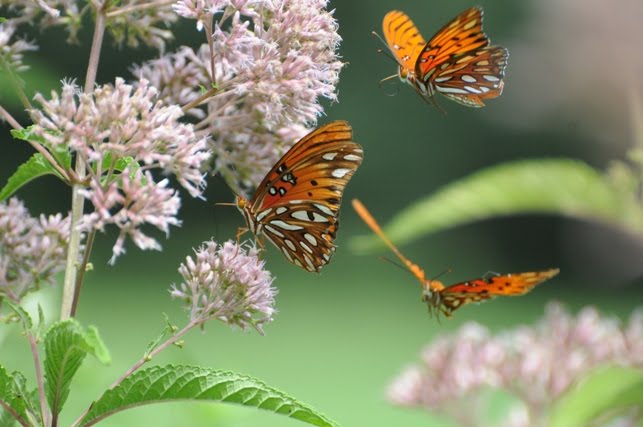
We won the photo contest with the image showing three Gulf Fritillaries during the Mepkin Abbey field trip.  We'll see everyone next year!

Images by Mark Musselman

Friday, May 21, 2010

Wannamaker Nature Preserve

Today at the Wannamaker Nature Preserve, Audubon South Carolina hosted 4th graders from Guinyard Elementary School in St. Matthews, SC.  In the past, the lack of restroom facilities have limited access to the nature preserve, but the site now has a restroom, shelter, bus parking, and miles of trails.


The first activity was the mammal track activity.  Students moved between the eleven stations and used the track key to determine the identity of the animal track in the clay.  The rubber scat at some stations was an extra clue.  The size of the scat for the feral hog and the black bear were big hits with the boys.

After the track activity, the six Ss of birding were discussed.  The six Ss are size, shape (body, head, wing, leg, and tail), shade (color and markings), surroundings, style (behaviors and how they are performed), and sound.  The heat of the day kept the birds to a minimum, but students did identify by sound a Blue Jay, Mourning Dove, American Crow, Northern Cardinal and Carolina Wren.  A Turkey Vulture was spotted soaring overhead and a variety of food items (berries, seeds, insects, and spiders) were identified in the habitat.  Several students asked if any birds eat the ubiquitous ticks!

Images by Mark Musselman

Wednesday, May 19, 2010

SC LIFE Beginner Bird Course

The education staff at the Audubon Center at Francis Beidler Forest continues to learn in order to better serve our audiences!  On Monday, we completed the SC LIFE course Introductory Birding for Teachers.

On of the requirements was the birdwatching.  Tough stuff!  We documented some of what we saw in the following video:


Another requirement was participation in citizen science.  Again, tough stuff!  Project PROTHO was a given, but we also participated in the Great Backyard Bird Count and the Deveaux Bank nest counting highlighted in yesterday's blog entry.  We documented our citizen science in the following video:


Images and videos by Mark Musselman

Tuesday, May 18, 2010

Deveaux Bank and Birds

Some poor soul had to back out of nest counting at the Deveaux Bank Seabird Sanctuary with SC DNR.  We were asked if we wanted to take their place.  It was not likely a serious question.  The old-growth swamp at the Audubon Center at Francis Beidler Forest is awesome, but so is a chance to visited a closed seabird rookery and participate in some citizen science!

From the SC DNR webpage:
Deveaux Bank Seabird Sanctuary was established to protect significant nesting habitat of sea and shorebirds. Deveaux Bank Seabird Sanctuary encompasses approximately 215 acres at the mouth of the North Edisto River in Charleston County. The size of this sanctuary varies and may sometimes disappear entirely. Deveaux Bank is an estuarine island that was first documented in 1921. It has been documented as a seabird rookery since the 1930s. Nesting was temporarily halted during World War II due to the island's use as a bombing range. The island is part of a dynamic system; it completely subsided in 1980 due to erosion from Hurricane David. It has slowly reemerged and seabirds began nesting on the island again in 1983.

The Seabird Sanctuaries are sandspit islands formed by deposits from their associated river systems. The islands are dynamic and shift in position and structure due to erosion and deposition of sand.

Deveaux Bank supports colonies of nesting waterbirds because of its isolated nature and lack of mammalian predators. Although all species may not nest on the island each year, examples of species that have used the island include: brown pelican, least tern, royal tern, black skimmer, gull-billed tern, sandwich tern, common tern, laughing gull, Wilson's plover, American oystercatcher, willet, great egret, snowy egret, tricolored heron and ibis. Besides providing nesting habitat, the sanctuary provides winter loafing and feeding areas for numerous species, including the federally-threatened piping plover.

The colonial nesting behavior of these birds makes them very susceptible to disturbance. Birds are densely packed into breeding sites during the nesting season, rendering the entire colony susceptible to disruption or destruction. Therefore, the sanctuary is open only below the high tide line except in the designated recreation area. Dogs are prohibited year round.


We arrived by boat from the Rockville boat landing and walked to the ocean side of the bank.  We then moved in a line through the Brown Pelican nesting site counting all of the nests to our right as far as the next person in the line.  Not only did we need to pay close attention to the the nests in our zone, but we needed to watch for smaller ground nest like those of the Laughing Gull.


Although not eager to do so, the pelicans flushed from their nests before we walked carefully through the site.  Not waiting for the large birds to depart, one runs the risk of getting hit by the bird as it struggles for lift and altitude, having the birds panic and injure chicks or damage eggs, and/or being immediately down range of jettisoned waste.


Sometimes, pelicans disgorged their load of fish before flying off.  Laughing Gulls quickly moved in for the free meal.


The rookery is a noisy and dangerous place.  Eggs or chicks left unattended are easy targets for the abundant Laughing Gulls.  Therefore, even if a dog or curious human doesn't step on any eggs or capture any birds, the disturbance in the rookery causes eggs and chicks to be exposed to predators and the elements.  The Snowy Egret chicks shown below have grown to a sufficient size that they are not likely to be attacked by gulls.


Images by Mark Musselman