Showing posts with label migration. Show all posts

Saturday, May 04, 2013

Spring? Spring? Anyone?

We have not posted lately from the Audubon Center at Francis Beidler Forest, because the weather has kept things relatively quiet in the swamp over the last ten days.  The weather has also kept our camera indoors, so we have gone to the files for this entry's images.


Overcast skies and cool weather continue today and have kept reptile sightings at a bare minimum.   Based on our observations, there do not seem to be as many Prothonotary Warblers (Protonotaria citrea) around the boardwalk.  Normally, there would be plenty of male-vs-male battles for territory and mates.  However, the territories around the boardwalk are relatively quiet and behavior is civil.  Therefore, we suspect that all residing Prothonotary Warblers have ample space and mating opportunities and have no need to waste energy in confrontations.  Meanwhile, plenty of Black-throated Blue Warblers (Setophaga caerulescens) have been seen along the edge of the swamp and behind the nature center as they linger along their migration north.

Black-throated Blue Warbler - Mark Musselman
Several of the Prothonotary Warblers around the boardwalk are banded birds from previous years.  We have begun to create individual pages for those banded birds, so if visitors spot a banded bird or previous visitors have images of banded birds, they can see their bird's Beidler Forest history.  This week, A037 has been battling for territory in the area near Goodson Lake, A250 has been absent, A048 appears to have an unbanded mate in the area around #7, and A012 and his unbanded mate have a nest and four eggs in the nest box behind the sign at #18.
Prothonotary Warbler (A037) - Mark Musselman
Unfortunately, the nest in the cypress knee near the tower at Goodson Lake previously used by A026 appears to have been cleaned out by a raccoon.  Visitors had been reporting activity at the nest site, but yesterday nesting material could be seen hanging from the cavity entrance as well as floating in the shallow water below the cavity.  Both the unbanded male and female visited the nest site with the female repeatedly entering and exiting the cavity.  The fact that the male was bringing caterpillars to the nest site and feeding them to the female outside of the cavity leads us to believe that there were quite recently chicks to feed.  If a snake had visited the nest, it would have consumed the eggs or chicks without tossing the nesting material.  Raccoons are not as subtle as they reach into the cavity to remove what they seek to eat.
Cypress Knee Nest Cavity - Mark Musselman
On a brighter note, the Red-shouldered Hawks (Buteo lineatus) are reusing the nest they had last year in the bald cypress near #154 on the boardwalk.  No chicks were observed and the adult remained on the nest.  Earlier this week, we searched for the Swallow-tailed Kite nest that we are sure exists as these kites are spotted above the eastern half of the boardwalk on a daily basis.  Using Google Earth, we captured the coordinates for trees that appeared to be above the rest of the canopy.  We visited those trees, but did not find anything that would be considered a nest.  The weather was overcast, cool and windy, so it was not a great day for soaring kites.  A kite flying to the nest would have made discovering the nest much easier.  We will keep plotting Swallow-tailed Kite sightings on the map in hopes that the nest location will become apparent.  You can help with Swallow-tailed Kite conservation by reporting your sightings to the Center For Birds of Prey website.

You can help ornithologists by monitoring nests you discover.  The procedures, to protect you and the birds, can be found at the Nestwatch site.  Currently, only two Prothonotary Warbler nests are being monitored and they are both at the Francis Beidler Forest.


The rainy weather did not bother every living thing.  Mac Stone and friends were out in the swamp on Sunday and captured some amazing images (see Mac's here), including a White-tailed Deer (Odocoileus virginianus) fawn resting near a cypress.
Fawn - Mac Stone Photography

Wednesday, January 30, 2013

Sandhill Cranes in the Bend

Sandhill Cranes (Gurs canadensis) are back in the Bend this winter.  The Bend is the community roughly bordered by Four Holes Swamp to the north and east and I-26 from the northwest to southeast.

The Bend
Specifically, the cranes are often seen in the large field bordered by Second Bend Road and Two Churches Road.  Although range maps do not show the bird as a winter resident for our area, we have spotted Sandhill Cranes in that field over the years.  During the 2011 Christmas Bird Count (CBC), 15 Sandhill Cranes were seen and 79 were observed during the 2012 CBC.  In February 2011, we photographed 20 cranes in the field and saw 17 and 24 on consecutive mornings this past weekend.  We did not have time to stop for a photograph this weekend, so the image below is from February 2011.  However, an image taken this weekend would have appeared identical.

Sandhill Cranes in Henbit - Mark Musselman
Mornings are a better time to observe the cranes at the location marked in the image.  We have never observed cranes in this field late in the day.  Lex Glover, South Carolina Department of Natural Resources, suspects that the cranes we are seeing are a small foraging flock from the large contingent Sandhill Cranes wintering at the Santee National Wildlife Refuge north of Lake Marion.  The birds feed mainly on grains and seeds along with some insects.  Therefore, once the fields get plowed in preparation for spring planting, the cranes will be gone from the area until next winter.

Thursday, October 11, 2012

Mangrove Swamps

The latest edition of the National Geographic Magazine contains an article regarding the Mesoamerican Reef.  Mangrove swamps are a critical component of the reef ecosystem as they prevent sediment and other pollutants from reaching the coral reef, break wave energy thereby protecting sea grass pastures, and provide shelter and nursery space for a variety of marine organisms.

From the article:
Mangroves are not just a convenience for [parrotfish] Scarus guacamaia. They are a necessity. When mangroves are carved away, to make room for tourist venues, for example, the species tends to go locally extinct, with repercussions in all directions. Coevolution has brought the coral reef and its parrotfish into balance; when the horny-beaked herbivores are fished out or otherwise eliminated, the reef declines, its corals overgrown by carpets of the algae the parrotfish normally eat.

John Muir told us what we can expect when humans with their habits begin to unravel a sound ecosystem. “When we try to pick out anything by itself, we find it hitched to everything else in the universe,” he wrote. The parrotfish are a case in point. The Mesoamerican Reef is one section of the universe where the hitches are particularly tight.
Prothonotary Warbler - Mark Musselman

You may have been wondering why this blog's subject is a reef system thousands of miles away from Four Holes Swamp.  Note the John Muir wrote "universe."  Depending on when one starts to pick, those hitched to an ecosystem may not even be present.  Prothonotary Warblers (Protonotaria citrea) breed at the Francis Beidler Forest and the eastern United States, but they spend the winter in mangrove swamps in Central America and the northern coast of South America.  Therefore, the clearing of mangrove swamp for development and tourism is not simply a local issue affecting the reef ecosystem, but it is a hemispheric issue affecting birds we expect to return north in the spring.

Picking at the mangrove swamps reduces the number of Prothonotary Warblers surviving their winter, which in turn means few birds eating insects or feeding insects to their chicks on their breeding territories in the United States, which means fewer eggs or chicks to feed raccoons or rat snakes, which...leads us to discover that it's "hitched to everything in the universe."

Friday, September 28, 2012

Around #104

You do not need to walk far out the back door of the nature center at Audubon's Francis Beidler Forest to see migration in action as there is plenty happening around #104.

Although only the male Hooded Warbler (Setophaga citrina) below stayed close enough for a picture, he was joined by a Black-throated Blue Warbler (Setophaga caerulescens), a Worm-eating Warbler (Helmitheros vermivorus), a Veery (Catharus fuscescens), both sexes of American Redstart (Setophaga ruticilla), a Northern Parula (Setophaga americana), and a Black-and-white Warbler (Mniotilta varia).

Hooded Warbler - Mark Musselman

Hooded Warbler - Mark Musselman


Nearby some color was added by a Purple Lobelia (Lobelia elongata)...

Purple Lobelia - Mark Musselman

and a fruiting Jack-in-the-Pulpit (Arisaema triphyllum).

Jack-in-the-Pulpit - Mark Musselman


Thursday, September 13, 2012

How Are We Supposed to Work?

Having inside work to do when working at an old-growth swamp is always tough!  However, at the Audubon Center at Francis Beidler Forest it is especially tough during the periods of bird migration.  Nature is right out every window of the nature center and we all have unobstructed views from our desks.  Here is a small sample of what distracted us today:

Black-and-white Warbler - Mark Musselman
Black-and-white Warbler - Mark Musselman 


White-eyed Vireo - Mark Musselman


Acadian Flycatcher - Mark Musselman

American Redstart - Mark Musselman

American Redstart - Mark Musselman

Hooded Warbler - Mark Musselman

Hooded Warbler - Mark Musselman

Tuesday, September 04, 2012

Rainy Day Migrants

Rain during the past two weeks has often kept us trapped within the building at the Audubon Center at Francis Beidler Forest.


Another unfortunate side effect of the rain is the presence of mosquitoes.  As long as there is water flowing in the swamp, mosquitoes are seldom an issue as they prefer standing water.  However, a portion of the boardwalk traverses the high, dry forest and later parallels the edge of the swamp.  The high volume of rain has filled depressions, like those caused when trees tip over, throughout the dry forest bordering the swamp and mosquitoes have taken advantage of the situation.

Even if adult mosquitoes were not present to lay eggs in the standing water, mosquito eggs can survive dry periods and hatch once water returns...cue the rain.  Predators in the water, like mosquito fish or dragonfly nymphs, and predators in the air, like Blue-gray Gnatcachers (Polioptila caerulea) have put a dent in the mosquito population.  However, for a time a bloody gauntlet needed to be endured to reach the sanctuary of the swamp.  The aberrant situation has nearly returned to normal.

We cannot do anything to manage mosquitoes in the forest, but you can manage them in your yard.  Eliminating standing water in any containers is the most effective control.  Mosquitoes obtain viruses during feeding on an infected host and then when next feeding they can introduced the virus to humans and pets via the mosquito's salivary glands. Therefore, if mosquitoes are already present, applying insect repellent and wearing clothing that prevents exposed skin are effective defensive strategies.

Poor weather might slow bird migration, but it will not stop migration.  Even with the rain, we saw birds foraging outside the office window that likely were not residents during the breeding season.  Hooded Warblers (Setophaga citrina), Prothonotary Warblers (Protonotaria citrea), and Worm-eating Warblers (Helmitheros vermivorus) were some examples.  A Green Heron (Butorides virescens) spent a few days wading in the shallow water at #104 just behind the nature center.  Green Herons are not normally seen along the boardwalk, so it may be a bird migrating from higher latitudes or a local bird that could not resist the glut of fish gorging themselves on mosquito larvae in the shallow water.

Another bird seen out the office window is definitely a migrant.  The male American Redstart is black and orange overall, so the bird in the images is likely a female or possibly a juvenile male.

American Redstart - Mark Musselman

American Redstart - Mark Musselman

American Redstart - Mark Musselman

 On Friday, we were able to get out on the boardwalk during a break in the weather.  Two steps out the door we encountered a Blue-winged Warbler, a Worm-eating Warbler, a Black-and-white Warbler, a Northern Parula, two Red-eyed Vireos, a Downy Woodpecker, several Carolina Wrens, and a White-eyed Vireo.  Below, you can see the complete list, including a Veery at #113.

Francis Beidler Forest Audubon Center & Sanctuary, Dorchester, US-SC
Aug 31, 2012 2:00 PM - 4:00 PM
Protocol: Traveling
1.75 mile(s)
Comments:    Clear, 80Fs
25 species

Wood Duck (Aix sponsa)  4
Great Egret (Ardea alba)  2
White Ibis (Eudocimus albus)  27
Red-shouldered Hawk (Buteo lineatus)  1
Yellow-billed Cuckoo (Coccyzus americanus)  5
Barred Owl (Strix varia)  2
Red-bellied Woodpecker (Melanerpes carolinus)  6
Downy Woodpecker (Picoides pubescens)  2
Pileated Woodpecker (Dryocopus pileatus)  3
Acadian Flycatcher (Empidonax virescens)  4
Great Crested Flycatcher (Myiarchus crinitus)  1
White-eyed Vireo (Vireo griseus)  10
Red-eyed Vireo (Vireo olivaceus)  2
American Crow (Corvus brachyrhynchos)  4
Carolina Chickadee (Poecile carolinensis)  8
Tufted Titmouse (Baeolophus bicolor)  6
White-breasted Nuthatch (Sitta carolinensis)  2
Carolina Wren (Thryothorus ludovicianus)  9
Blue-gray Gnatcatcher (Polioptila caerulea)  4
Veery (Catharus fuscescens)  1
Worm-eating Warbler (Helmitheros vermivorum)  1
Blue-winged Warbler (Vermivora cyanoptera)  1
Black-and-white Warbler (Mniotilta varia)  1
Northern Parula (Setophaga americana)  7
Northern Cardinal (Cardinalis cardinalis)  2

Wednesday, August 15, 2012

Let the Migration Begin

With temperatures in the area still in the 90Fs, it is hard to think about winter weather at the Audubon Center at Francis Beidler Forest.  However, birds are already succumbing to the urge to fly south.  The first American Redstart (Setophaga ruticilla) of the fall season was spotted near #106, but the male remained hidden by the foliage and moved too quickly to be caught on camera.

Prothonotary Warbler (Protonotaria citrea) A012 is still foraging in the upland area near his swamp territory, but other unbanded Prothonotary Warblers are in the denser habitat at the swamp's edge near #114 on the boardwalk.  Being unbanded, it's not known if these birds have moved to the edge of the swamp from territories deeper in the swamp or if they are merely making Beidler Forest a stop on their way to Central America.

Prothonotary Warbler - Mark Musselman
Whether the Prothonotary Warblers were local residents or not, they were not welcomed by the resident Carolina Wren.  Both the male and female that we observed were aggressively chased by a vocal Carolina Wren (Thryothorus ludovicianus).  As has been observed in many a household, only the individual at the bottom of the pecking order is without a target for their displeasure.  After receiving his scolding, the male Prothonotary Warbler made it his mission to chase a lone Louisiana Waterthrush (Seiurus motacilla) from the area.  Meanwhile, amid the noise of the Carolina Chickadee (Poecile carolinensis) and the Tufted Titmouse (Baeolophus bicolor), a Black-and-white Warbler (Mniotilta varia) quietly foraged for a meal along a tree trunk.

Black-and-white Warbler - Mark Musselman
Elsewhere along the boardwalk, a Barred Owl (Strix varia) preened while perched on a branch near the boardwalk and a Banded Water Snake took advantage of the midday sun.

Banded Water Snake - Mark Musselman
Carolina Wren nest UPDATE:  During the night, an unknown predator made off with the five chicks.  Carolina Wrens have made a nest in the cigarette waste container in 2007, 2008, 2010, and 2012.  Only the 2010 nest fledged chicks.  A 25% success rate sounds low, but birds can have multiple nesting attempts each breeding season and 4-5 chicks will fledge from a wren nest.  The adults only need two of their chicks (from any of their breeding seasons) to reach adulthood in order to replace themselves.  There are enough chicks to reach this goal and provide meals to other animals of the forest.

Friday, March 30, 2012

Bird Arrivals This Week

It has been a busy week at the Audubon Center at Francis Beidler Forest.  Unfortunately, we have spent almost all of it elsewhere!  The education department conducted three days of programming (birds, food webs, and mammal tracks) with St. Matthews Elementary and Sandy Run Elementary Schools at the Wannamaker Nature Preserve outside of St. Matthews.  Wednesday was spent at the Charleston Air Force Base's Earth Day helping 5th graders from the tri-county area identify macroinvertebrates in samples we collected from the swamp.  Therefore, we have only had time for some quick, late afternoon excursions onto the boardwalk to discover what bird species have arrived back from their wintering grounds.

Here are the bird species that are new this week:
  1. Prothonotary Warbler
  2. Swallow-tailed Kite
  3. Chimney Swift
  4. Red-eyed Vireo
  5. Ovenbird
The Prothonotary Warbler numbers have not peaked and some can still be difficult to located as they continue foraging in the mid-canopy.  We were finally able to spot two singing males and discovered that they were banded during Project PROTHO.  The first male, A250, is singing regularly around the Meeting Tree at #120 and was banded nearby at #118 on April 28, 2010.

Prothonotary Warbler A250 with caterpillar - Mark Musselman
The second male, A014, is singing around #130 and was banded from the boardwalk on April 19, 2011.

Prothonotary Warbler A014 - Mark Musselman


Red-eyed Vireos are singing along the edges of the swamp and in the parking area, but the Ovenbird we spotted was silent except for a slight rustle of the leaves.

Ovenbird - Mark Musselman
Although Barred Owls are here all year, they are especially active now during the day as they have extra mouths to feed.  The pair that nests along the backside of the boardwalk between #13 and #17 are prodigious hunters and quite photogenic.  We have previously reported this pair hunting Wood Duck ducklings, Yellow-bellied Sapsuckers, and crayfish.

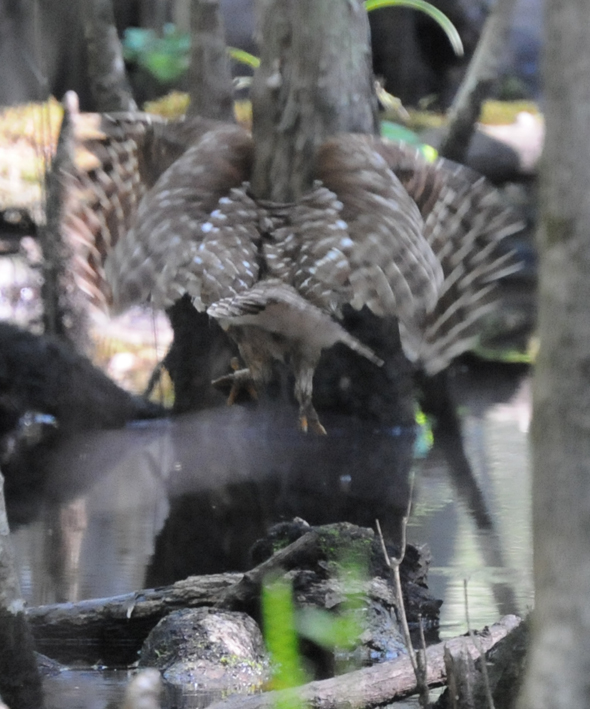
While running an errand on the boardwalk this morning, we caught sight of a Barred Owl wrestling with something on a log in the water.  Using the binoculars, we realized that the owl had a turtle, but we could not identify the dark, wet turtle carapace clutched in the talons of the owl.

Barred Owl with turtle - Mark Musselman

Barred Owl with turtle - Mark Musselman

Barred Owl with turtle - Mark Musselman

Barred Owl with turtle (left talons) - Mark Musselman

Barred Owl with turtle - Mark Musselman
 After much effort, the Barred Owl was unable to extract the turtle from its shell.  The owl flew to a branch over the water to watch for easier prey and eventually took a moment to stretch and preen.

Barred Owl - Mark Musselman

Barred Owl - Mark Musselman
 After the owl departed, we went into the creek to find what might be left of the turtle in order to identify the species.  We found the Eastern Mud Turtle shown below.  The Eastern Mud Turtle has a hinged forward section on its plastron (bottom portion of shell) that can be closed like a box turtle's in order to protect the head and much of the front legs.  The turtle can pull in its rear legs and tail so that they are flush with the plastron.  Unlike the musk turtle, the mud turtle's plastron covers and protects most of its underside.  The only sign of injury on the erstwhile breakfast item was a small bone protruding from the underside of the front right leg, which didn't seem to affect the turtle's ability to use the limb.

Eastern Mud Turtle - Mark Musselman
 The owl got an A for effort, but did not have time to contemplate the missed meal.  Soon after turning its attention from the resilient reptile, an owlet began its begging cry and the adult focused on catching something easier to open!


Friday, March 23, 2012

Migration and Radar

We continue to check around the boardwalk at the Audubon Center at Francis Beidler Forest to see what new bird species may have arrived overnight.  eBird offers a BirdCast based on birding observations and radar images showing migration activity.  They predict that between March 16-22, the Southeast should expect to see the following birds species:  Louisiana Waterthrush, Prothonotary Warbler, Yellow-throated Vireo, and Yellow-crowned Night Heron.  We heard a Yellow-throated Vireo today, so all that we're missing is the Prothonotary Warbler!

Understanding Radar and Birds: Part 1

March 16, 2012
Understanding Radar and Birds: Part 1 Nexrad radar mosaic, 8 May 2009
Since the first units were placed along the Gulf Coast in the 1950s, ornithologists and birders have become increasingly aware of the power of using radar as a tool for understanding bird migration. In addition to detecting and depicting meteorological phenomena, this radar network can be used to watch and to track the movements of birds. In this feature we will provide some basics for how to interpret radar data, in particular how to understand the movements of birds on Weather Surveillance Radar – 1988D (WSR-88D). A second installment will discuss challenges in identifying biological targets and some locally interesting patterns visible on radar.  Read more...

To help visualize and better understand how you can use radar to examine migration, watch the animation below of Nexrad Radar of a flight on 8 - 9 May 2009. Watching this animation will allow you to see differences between precipitation and migrating birds.

Thursday, March 22, 2012

2012 Great Backyard Bird Count Results

It was a record-breaking year for the Great Backyard Bird Count!  Thank you to all who participated.  If you didn't participate in the citizen-science project this year, mark your calendars for Feb. 15-18, 2013.

Great Backyard Bird Count Highlights

By Marshall Iliff, Christopher Wood, Brian Sullivan, Dick Cannings, and Pat Leonard
March 19, 2012
 Birdwatcher_BrendaChmiel_NJ12.jpg
  Bird watcher by Brenda Chmiel, New Jersey,
  2012 GBBC


Overview

The 2012 Great Backyard Bird Count (GBBC) was one of stark contrasts. Arctic-dwelling Snowy Owls and redpolls irrupted into the Great Plains and the West in the largest numbers ever recorded in the 15-year history of the Great Backyard Bird Count. Participants reported Eurasian Collared-Doves and Great-tailed Grackles in northerly locations, a sign of the species' continuing range expansion. And spring migration was already underway for several species including Red-winged Blackbirds, Sandhill Cranes, and Snow Geese. Even the Blue Jay, a species often thought to be resident, showed unusual patterns with low numbers recorded in much of the East.

By the Numbers

First, let’s look at the raw numbers. GBBC participants submitted a record-smashing 104,151 checklists with 17.4 million individual bird observations! Participants set new checklist records in 22 states and in 6 Canadian provinces. Across the continent and in Hawaii, participants identified 623 species. Read more...

______________________________________________________________________________

You can see the results from the United States and Canada here.  South Carolina ranked seventh in species reported for all the states, provinces and the District of Columbia.  You can check here to see how your community ranked within South Carolina.  Note that the coastal communities had the advantage with regard to number of species, but Spartanburg had far and away the greatest number of checklists submitted!


Sunday, March 18, 2012

Latest 2012 Arrivals

For those of you keeping score at home, we have a few more arrivals to report at the Audubon Center at Francis Beidler Forest.

A flock of White Ibis (Eudocimus albus) were observed wading in the water behind the beaver dam north of the boardwalk at #3.  They are mainly feeding on crayfish and the water behind the beaver dam appears to be a rich hunting area.

White Ibis - Mark Musselman
We previously reported one Yellow-crowned Night Heron (Nyctanassa violacea) near the boardwalk, but additional individuals have arrived in the swamp.  Yellow-crowned Night Herons are searching exclusively for crayfish.  Watch carefully.  When one of these birds has a crayfish in the crosshairs the bird's tail end begins to wiggle back and forth.  A quick jab with its sturdy bill usually results in a crayfish meal.

Yellow-crowned Night Heron - Mark Musselman
The native azaleas (Rhododendron canescens) are now blooming in the swamp.  There is a fine specimen directly behind the nature center.
Swamp Azalea - Mark Musselman
Finally, we thought we heard a short song from a Summer Tanager (Piranga rubra).  If that bird has indeed arrived, it would be several weeks early.  We'll keep our ears open!


Sunday, March 11, 2012

White-eyed Vireo Has Returned

On Friday, White-eyed Vireos (Vireo griseus) were heard singing in the parking area at the Audubon Center at Francis Beidler Forest and along the canoe trail.

White-eyed Vireo - Mark Musselman

We cannot wait to see what might have arrived over the weekend!

Friday, March 09, 2012

Northern Parula Has Returned

Northern Parula Warblers (Setophaga americana) returned overnight and are now adding their songs to the swamp chorus in the Francis Beidler Forest!

Male Northern Parula - Mark Musselman
During our walk yesterday, we did not hear anything resembling a Northern Parula.  The normal arrival time at Beidler Forest for this species is mid-March, so this year's group is about a week early.  This bird winters in the Caribbean and central Mexico to Central America.  Once they have claimed a breeding territory here, they will build a nest in the ubiquitous Spanish Moss (Tillandsia usneoides) hanging from the trees.  The same nest site will often be used, though the high winds the other week may have blown down some of those sites.

Will the Prothonotary Warblers be early too?  We'll keep checking!

Friday, October 21, 2011

Migrant Visitors

Although the cooler weather has limited the sightings of wildlife along the boardwalk at the Audubon Center at Francis Beidler Forest, there are still jewels to be found!

Rose-breasted Grosbeaks (Pheucticus ludovicianus) were seen again outside the office window eating Flowering Dogwood fruit.  Black-throated Blue Warblers (Setophaga caerulescens) were spotted in several places around the boardwalk (#4, #14) and in the parking area.

Male Hooded Warblers (Setophaga citrina) are still being seen regularly around the boardwalk, especially near the swamp edge between #2 and #3 and along the return loop at #14.


An Ovenbird (Seiurus aurocapillus) was spotted walking under the Dwarf Palmettos near #1.


Today, the first Winter Wren (Troglodytes hiemalis) was spotted moving low at the swamp's edge behind the outdoor classroom.

Other residents like the cool weather just fine as well as the sanctuary from those with guns!


Images by Mark Musselman

Wednesday, October 05, 2011

Rose-breasted Grosbeak on Migration

Another first for the education department's office window at the Audubon Center at Francis Beidler Forest!

While working on the computer, movement outside our window caught our eye.  Earlier, an adult and a first-year Pine Warbler posed outside the window comfortable in the knowledge that our camera was still in the bag.  Naturally, once the camera was out and ready, the birds found a better place to be.  Throughout the day, birds, mainly Northern Cardinals of which we have plenty of pictures, had been clearing the Flowering Dogwood of its fruit.  However, the combination of black, white, and red in the last mass of movement must have set off alarms in our subconscious. Looking up, there was no mistaking the rose-colored breast and the need to get the camera into position.

Funny thing about preparation...it gives you the opportunity to make something happen, but you still need make it happen.  We failed to adequately navigate the space between our window and the male Rose-breasted Grosbeak.  A small twig was all that was necessary to blur our shot before the bird went about his business beyond our sight.  Patience, however, is said to be a virtue.


Within the hour, a male Rose-breasted Grosbeak returned with a female to dine on the fruit of the Flowering Dogwood.  Not only did we have our camera ready, we had our window open, which eliminated one obstacle to a clear picture.


The swamp has been getting a touch of red from Poison Ivy, Cardinal Flower, Flowering Dogwood fruit, but the Rose-breasted Grosbeak is a treat!

Images by Mark Musselman