Showing posts with label old-growth. Show all posts

Wednesday, January 18, 2012

Gone Hog Wild!

Actually, they are Wild Pigs (Sus scrofa), but either label congers images of a mess.  Wild pigs are in Four Holes Swamp and have begun to frequent the area around of the boardwalk.  We have noted the negative effects of this issue before in this blog and the South Carolina Department of Natural Resources and the Clemson Extension have dedicated substantial resources toward the increasing problem...and it's not just a problem in South Carolina as a quick Google search reveals.

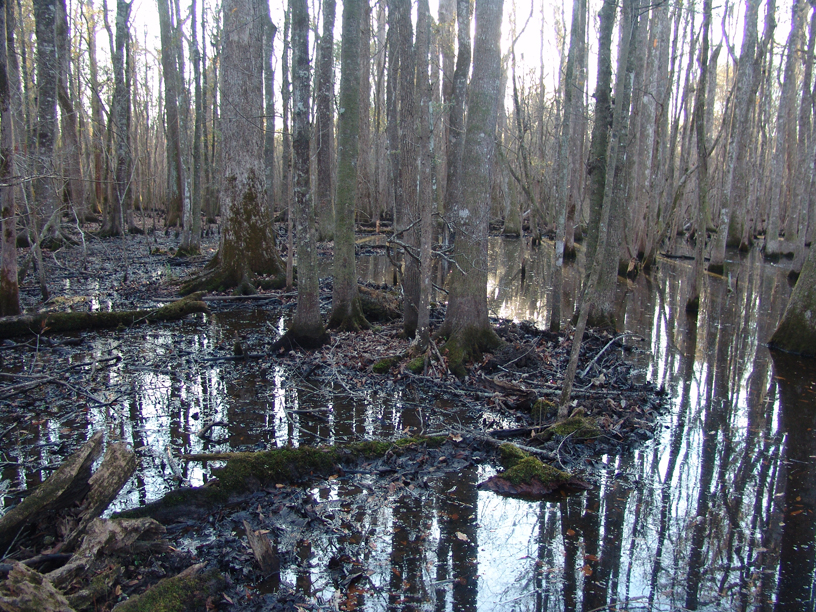
Signs of pig activity can be seen around the southern leg of the boardwalk, which traces a path along the edge of the swamp.  Pigs root through the soil in search of food, which can turn the soil up to three feet deep, disturbing the habitat sufficiently as to make it unsuitable for native plant and animal species.


Pigs also create extensive wallow areas, think large mud puddles, to help cool their bodies and rid themselves of parasites.  This makes the swamp quite attractive to the pigs.


A major obstacle to the removal of invasive pigs is the inability to be at the same place at the same time as the pigs.  We have set up cameras to see if there is a pattern to the pigs' mainly nocturnal movement, but have yet to capture images showing that species of mammal.  However, we have plenty of images for the ubiquitous Eastern Gray Squirrel (Sciurus carolinensis).


We have also set a trap in the upland area beyond sight of the boardwalk.  Significant damage has been done to that habitat as pigs have rooted around in search of plant and animal meals.


The gates at the front of the trap swing to allow access into the trap, but cannot be pushed in the opposite direction to allow pigs to exit the trap.  So far, the corn bait has only attracted hungry raccoons (Procyon lotor) and passing interest from a wary pig or two.


Finally, even the beavers (Castor canadensis) are likely tired of their invasive mammalian kin.  During a recent swamp stomp, we noticed that pigs had been rooting within the beavers' dam and had created numerous breaches along the structure.


Images by Mark Musselman

Thursday, October 06, 2011

TV Crew in the Swamp

On Tuesday, a crew from WLCN television came to the Audubon Center at Francis Beidler Forest to film a new show hosted by Tara Bailey.  The show aims to highlight the variety of outstanding, low-cost outdoor experiences available to residents of the Charleston area.  For the first show, what better site than the old-growth swamp!


At Beidler Forest, the ancient trees, the wildlife, and the quiet flow of blackwater all await you. Frequented by nature photographers from all over for its unique landscape and dynamic ecosystem, the swamp at Beidler Forest offers a beauty unsurpassed by any other nature sanctuary in the South Carolina Lowcountry. Beidler Forest sits within the Four Holes Swamp, a 45,000-acre matrix of black water sloughs and lakes, shallow bottomland hardwoods, and deep bald cypress and tupelo gum flats. Four Holes Swamp is also a major tributary of the Edisto River, part of the Charleston area’s famous ACE basin. Over 16,000 of the swamp’s acres are owned by the National Audubon Society and make up what is known as the Francis Beidler Forest, which is less than an hour from Charleston and Columbia and located just north of I-26 outside the town of Harleyville, SC. It is easily accessed from either I-26 East or West, as well as I-95. Beidler Forest was originally established to preserve 1,800 acres of old-growth swamp forest, one of only two such stands still left in the state. A visitor center (hours & admission), 1.75-mile boardwalk trail, and a canoe and kayak trail for naturalist-guided paddling tours provide visitors the chance to explore deep within the swamp’s interior.

Stay tuned!  After production work is completed, we'll let you know when Backyard Explorers will air.

Image by Mark Musselman

Friday, September 30, 2011

Monarch Migration

At the Audubon Center at Francis Beidler Forest, our Project PROTHO citizen-science project involves observing Prothonotary Warblers (Protonotaria citrea) along the boardwalk in the old-growth forest.  However, those birds have already migrated south for the winter, so we must look elsewhere for a citizen-science opportunity.

Visit Journey North's Monarch Butterfly Migration Tracking Project to help track the monarch butterfly (Danaus plexippus) migration each fall and spring as the butterflies travel to and from Mexico. Report your own observations of migrating butterflies to real-time migration maps.


Scientists alone cannot cover the entire migration route for these butterflies.  You can look at the fall migration map and help fill in gaps in observations!  This is a perfect opportunity for families to go outside together and gather data that will help in the conservation of the monarch butterfly.

Image by Mark Musselman

Thursday, September 08, 2011

Migration Is On!

Today, while walking the 1.75-mile boardwalk at the Audubon Center at Francis Beidler Forest, we spotted a variety of animals, including some migrating birds.  A Yellow-billed Cuckoo announced our presence into the swamp, but numerous other bird species picked up the chorus as we approached the Meeting Tree.

A brilliantly-colored male American Redstart welcomed us to the ancient Bald Cypress and continued the show at eye level just off the boardwalk for over thirty seconds.  Flaring his tail as he inspected the leaves and branches, the burnt orange and black contrasted bright green, sun-washed leaves.  Overhead, Carolina Chickadees, Tufted Titmice, Red-bellied Woodpeckers, Downy Woodpeckers, Yellow-throated Warblers, Northern Parulas, and Blue-gray Gnatcatchers called or sang as they moved about in search of food.

Approaching Goodson Lake, the seemingly angry chatter of a Belted Kingfisher let the alligator and Yellow-bellied Sliders know that we were approaching.  In the distance, Pileated Woodpeckers called loudly as Barred Owls hooted and hollered to each other.  As we departed the lake, a White-tailed Deer was surprised by the sound of our boots crushing the dry leaves on the boardwalk.  Although the doe moved away from us, we caught up with her as our paths crossed near #12.  The doe moved up the creek channel browsing indiscriminately (at least to us) on green vegetation growing in the dry areas of the swamp or hanging from low tree branches.  At one point, the doe browsed Resurrection Fern from the trunk of a Tupelo Gum.  With some type of plant hanging from the right side of her mouth, the doe froze and stared back toward the T of the boardwalk.  Leaves could be heard rustling, but no other deer or predator could be seen.  Nevertheless, the doe remained on alert!  Apparently, just as we did, the doe saw the high-domed, male Eastern Box Turtle crawling through the leaves and relaxed with her snack.  As the doe continued up the creek channel, we continued back to the nature center.

Our walk back was uneventful except for a pair of Red-shouldered Hawks engaged in a war on silence.

As the month progresses, we will continue to see migrating birds stopping by the old-growth swamp for a rest and a bite to eat!

Monday, August 01, 2011

Francis Beidler Ghost Logs

The Francis Beidler Forest was created via a purchase of approximately 3400 acres from the Beidler family in 1969.  Although the logging of old-growth forest on Beidler family properties in South Carolina ended by the early 1970s, some of those logs are still around and in the news.

Today's Post and Courier reports on the controversy regarding harvesting logged trees resting at the bottom of Lake Marion.

Monday, May 23, 2011

Canoe Review

For those of you who have yet to take a canoe trip through the old-growth, cypress-tupelo swamp in the Francis Beidler Forest, here's an unbiased review from a paying customer:

http://discoversouthcarolina.com/Insider/Outdoor/Blog/4573


Image by Mark Musselman

Friday, March 05, 2010

New Seasonal Naturalists Are Here!

Denise Ecker and Amy Johnson seasonal naturalists at Audubon's Francis Beidler Forest by Mark MusselmanThe new seasonal naturalists have arrived at the Audubon Center at Francis Beidler Forest!

Denise Ecker hails from Allentown, PA. She attended Penn State University and graduated with a degree in Biology. Denise worked here in The Swamp (as she refers to it to all of her friends) two seasons ago as a Seasonal Naturalist. When she was offered the position of Project PROTHO Field Technician (and sometimes guide), she eagerly jumped on the chance to return to South Carolina driving through a Nor’easter Snowstorm to make it back. When she isn’t jaunting around the swamp, Denise likes to spend her time reading, hiking and just generally being a nuisance to all the people around her...oh, and birding!

Amy Johnson was born and raised in West Columbia, South Carolina. As a kid she spent countless hours outside fishing, playing in the woods, and chasing around her two older brothers. Due to this, and her father’s love for the outdoors, Amy developed an interest and admiration for nature at a young age. She continued on this path when she attended Clemson University and majored in Wildlife and Fisheries Biology. In addition, while at Clemson Amy worked for the nature television show, “Expeditions with Patrick McMillan,” which opened many doors for her. After graduation she worked at Clemson’s Youth Learning Institute as an instructor teaching Environmental Education to school groups.

Amy’s hobbies include running, reading, hiking, cheering for Clemson football, and now -thanks to Beidler Forest- canoeing. She is very excited to be a seasonal naturalist and cannot wait for warmer weather and all the animals and plants that come along with it!

Spring is a fantastic time to bring students to the Francis Beidler Forest! All the education program information, including standards-based lessons, can be found on our webpage. Bring your class or encourage teachers to bring their classes to the swamp and help put these young ladies to work.

Image by Mark Musselman